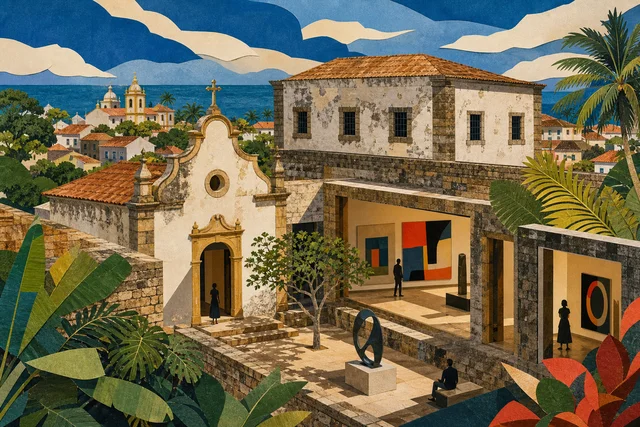
Urban heritage · Olinda / Ribeira
Ribeira Market

A market where people were also sold
The Mercado da Ribeira was built at the end of the seventeenth and beginning of the eighteenth century, probably around 1693, and stands on Rua Bernardo Vieira de Melo in the upper part of Olinda. It is one of the town's oldest commercial buildings.
Here meat, flour, fish and enslaved people were sold. That last fact usually appears in passing, though it is what explains what a colonial market was as an institution.
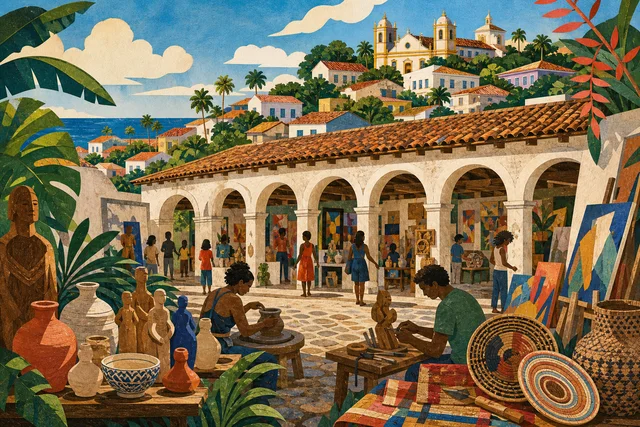
Today the building has been restored in its original style and holds craft shops with clay, lace, leather and straw pieces, along with the papier-mâché masks and Pernambuco souvenirs. Workshops of woodcarvers, engravers and painters operate here too.
Come with double attention: this is a place of living craft and a building with a heavy history.
For buying, it is the best point in Olinda, because pieces are made on site and you can watch the process.
A practical conclusion: plan this stop deliberately, because its value emerges through the context of the town rather than through a single striking object.
Around 1693 and today's workshops
The building is dated to the late seventeenth and early eighteenth century, probably around 1693, that is, to the rebuilding of Olinda after Dutch destruction.
The market worked as a place of provisioning and of trading in people: meat, flour, fish and human trafficking shared one space, a normal arrangement in a colonial town.
With the end of slavery and the change of the urban economy the building's function shifted, and the block gradually lost commercial weight.
Later it was restored in its original style and given over to craft shops and workshops, which turned it into a cultural stop.
Today it remains a working market rather than a museum, and that matters for understanding what you see. Note that dates of construction, consecration and completion of finishes often diverge in Brazil, so official sources may give different years for the same building.
What is sold and made here
Inside are shops with clay, lace, leather and straw work, along with the papier-mâché masks tied to Olinda's carnival tradition.
Workshops of woodcarvers, engravers and painters also operate here, so part of the work is produced on the spot.
The architecture is plain and utilitarian: a colonial commercial building restored in its original style.
The range changes with the season and with which masters are present, which distinguishes a market from a museum with a fixed display.
Prices and quality vary, so it pays to walk the whole building before buying.
Keep in mind that the tropical climate defines everything, since humidity, salt and heavy rain dictate what survives and how often restoration is needed.
How to look closely
Watch the work rather than only the product: when a master works in front of you, technique, tools and the time a piece takes all become visible.
Tell handmade from mass-produced, because Olinda's stalls carry both and the difference in price usually has a reason.
Notice the carnival masks, which are not decorative souvenirs but part of the living practice of street groups.
Study the building itself: simple volumes, openings and the arrangement of stalls show a rational colonial market with almost no ornament.
And keep its past in mind, because knowing that people were sold here changes how the space feels.
Notice what restoration chose to show and what it left hidden, because every display in a historic building is a decision.
Ribeira and the upper town
The market lies in the Ribeira district in the upper historic centre, on Rua Bernardo Vieira de Melo.
Around it are studios, galleries and homes, and the main walking routes of the historic site pass nearby.
From the market it is easy to climb to the Alto da Sé or descend to Carmo and the lower town.
By day it is busy, especially at weekends when visitors arrive and every shop opens.
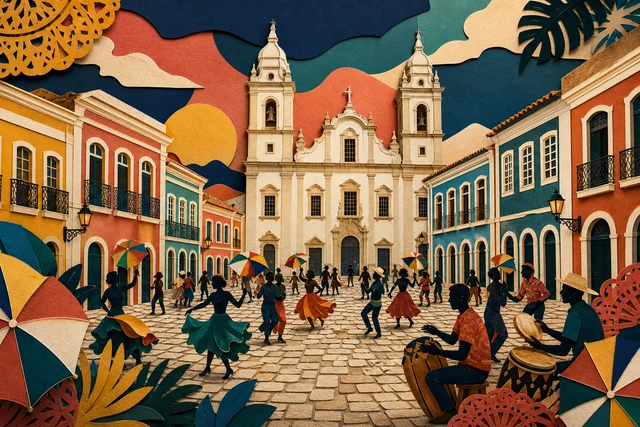
During Carnival the block joins the routes of street groups and the rhythm changes completely. It is worth walking the block on a weekday and at the weekend, because Olinda has two rhythms and tourist flow changes how the streets feel.
Human trafficking in a colonial market
Official sources state it directly: meat, flour, fish and enslaved people were sold here. That is not a footnote but part of the building's central function.
Understanding this changes the reading: a colonial market was infrastructure for an economy in which a human being was merchandise, and buildings like it survive across Brazil.
The present function, craft trade, does not erase the past, and good interpretation has to say both things.
It is worth remembering that many of the crafts sold here come from Afro-Brazilian tradition, that is, from descendants of the people this same market traded.
That proximity of past and present is the densest thing about the place.
Planning the visit
Allow twenty to thirty minutes for a walk through, and about an hour if you plan to buy and talk with the makers.
Come in the morning: shops open gradually and the upper town is harder work in the heat.
Ask about technique, because most artisans enjoy explaining how a piece is made, and that is the best part of the visit.
If you want a carnival mask, compare several workshops, since the difference in execution is visible.
Combine the stop with the Alto da Sé and the museums of the upper town nearby.
Build a day of three or four stops with pauses, because trying to see more in Olinda usually ends in fatigue.
Getting there and access
The market stands on Rua Bernardo Vieira de Melo in the upper historic centre of Olinda, about seven kilometres from central Recife.
It is easier to ride up and walk down, because the slope is steep and the paving old and uneven.
The building is historic and entrances may have steps and thresholds, so check accessibility on site.
Parking on the block is limited, especially at weekends.
In hot hours the walk tires you: bring water and sun protection. Plan your return in advance, because transport is harder to find in the historic part after dark.
Where to go next
The nearest stops are the Alto da Sé with its cathedral, sacred art museum and seminary, minutes away on foot.
Downhill lies the Mercado Eufrásio Barbosa with the Mamulengo Museum and the theatre.
If craft interests you, add the studios of the Amparo district and the Museum of Popular Art in Recife.
For a rest there are cafés in the historic centre.
And keep the hilltop panorama for sunset.
Remember that upper and lower town work differently, with churches and views above and markets and daily life below.
Verified facts
Every fact below is linked to this profile’s source codes.
- Location
- Ribeira · Olinda OLINDA_MON · MTUR_OLINDA
- Listed address
- Rua Bernardo Vieira de Melo, s/n OLINDA_MON · MTUR_OLINDA
- Documented focus
- Colonial market today associated with galleries, workshops and production by local artisans and artists. OLINDA_MON · MTUR_OLINDA
- Evidence basis
- Identity, location and cultural relevance are supported by primary evidence. OLINDA_MON · MTUR_OLINDA
Original Meu Recife editorial copy based only on this profile's source codes. It does not reproduce third-party text in full or turn a community-guide opinion into fact.
Before visiting
This is a working craft market rather than a museum: the range depends on the season and on which makers are there that day. Come in the morning, when every shop is open and the upper town is cooler. Ask the artisans about technique, which is the best part of the visit.
- Reference address
- Rua Bernardo Vieira de Melo, s/n, Ribeira, Olinda — PE
- Urban heritage
- 30–90 min
- What can change
- Hours, tickets, accessibility and temporary closures can change. Confirm with the official source before visiting.
Getting there
Coordinates cross-checked against multiple mapping sources
- Reference address
- Rua Bernardo Vieira de Melo, s/n
- District and city
- Ribeira · Olinda, PE
- Verified coordinates
-8.015624, -34.852636