Skip to content
MEU RECIFERECIFE · PERNAMBUCO
The city portal for Recife and PernambucoNEWS · EVENTS · SERVICES
Cultural atlas

Museums & memory · Olinda / Amparo

Olinda Regional Museum
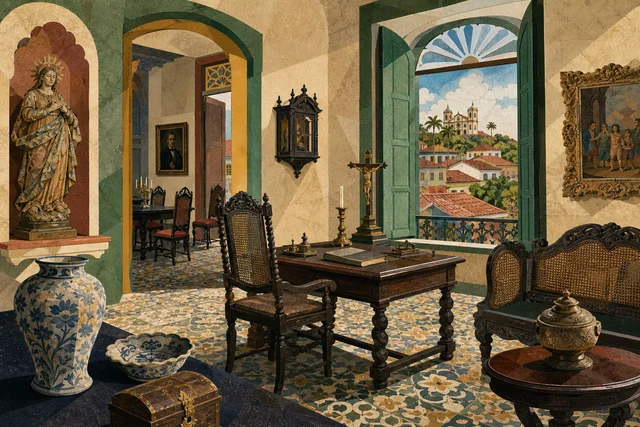
Historic house with furniture, sacred art and objects linked to the domestic, political and religious life of Olinda.
1 sources and traceabilityVerified 2026-07-28
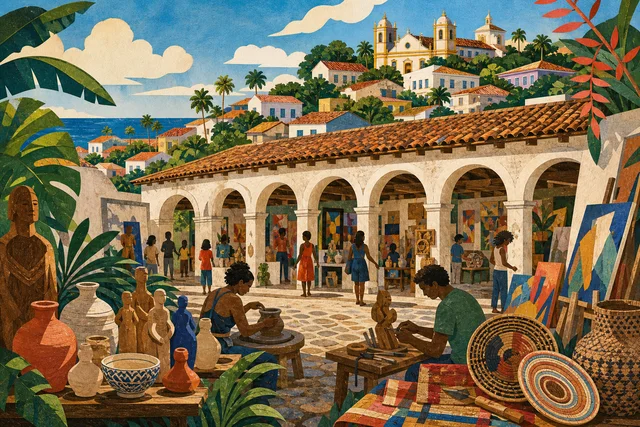
Olinda Regional Museum — Original Meu Recife editorial illustration — not a documentary photograph.
Original Meu Recife editorial illustration — not a documentary photograph. · Meu Recife
01

A house museum in a former bishop's residence

The Regional Museum of Olinda occupies a colonial-style mansion built between 1745 and 1749, originally an episcopal residence. Today it is a house museum: the display shows less about individual masterpieces than about how life in such a house was organised.

The museum was founded in 1935 to mark four hundred years since Duarte Coelho's arrival in Pernambuco, so it began as an institution of memory about the colony's beginnings.

The collection gathers furniture, sacred art and objects tied to the domestic, political and religious life of Olinda. That composition is typical of a house museum and lets you see daily life rather than only ceremony.

Come for the scale of the everyday: after cathedrals and convents it helps to see how the people who commissioned them lived.

It is also a good place to grasp the town's chronology, because the museum tells Olinda as a whole.

A practical conclusion: plan this stop deliberately, because its value emerges through the context of the town rather than through a single striking object.

02

1745-1749, 1935 and today

The mansion was built between 1745 and 1749, during the rebuilding that followed Dutch destruction, and first served as the bishop's residence.

In 1935 the Regional Museum of Olinda opened here to mark four hundred years since Duarte Coelho's arrival. That commemorative occasion explains a collection oriented towards the memory of colonial foundation.

Across the decades the museum gathered furniture, household objects and sacred art, some of it arriving from town houses and parishes.

Like other historic buildings in Olinda, the house needs constant care and its condition depends on support programmes.

Keep three layers in mind: colonial residence, twentieth-century commemorative institution, working museum today. Note that dates of construction, consecration and completion of finishes often diverge in Brazil, so official sources may give different years for the same building.

03

Furniture, sacred art and daily life

The core of the collection is furniture, sacred art and objects tied to the domestic, political and religious life of the town.

A house museum differs from an art museum because an object matters as part of an environment: a chest, a chair and a crucifix together describe the daily life of a social class.

Colonial furniture from Pernambuco is a subject in itself, with tropical timbers, local workshops and European models forming a recognisable hybrid.

The mansion's plan keeps its eighteenth-century logic, with rooms in sequence, a separation of formal and service areas and deliberate handling of air and shade.

As in other Olinda museums, the selection on show may vary.

Keep in mind that the tropical climate defines everything, since humidity, salt and heavy rain dictate what survives and how often restoration is needed.

04

How to look closely

Read the furniture as engineering: joints, timbers, marks of repair. In the tropics furniture survives worse than in Europe, and what remains reflects selection and care.

Study the plan: where the formal rooms were, where the service areas, how air moved. The house was built before any cooling system existed.

Look for religious objects in the living rooms, because household oratories and images show that the border between church and home was movable.

Compare this mansion with the episcopal palace that now holds the sacred art museum: two houses of the religious hierarchy with different functions.

And keep 1935 in mind, the museum's founding year, because the selection reflects what was then considered worth remembering.

Notice what restoration chose to show and what it left hidden, because every display in a historic building is a decision.

05

Amparo and the historic centre

The museum sits in the Amparo district of historic Olinda, near the church of the same name and one of the town's finest squares.

The block is calmer than the touristic hilltop, which lets you see everyday Olinda, with homes, shops and studios.

From the museum it is easy to climb to the Alto da Sé or descend to Carmo and the lower town.

Proximity to the Amparo church makes the pairing especially good, because a house museum and a brotherhood church explain different sides of one society.

At weekends the district livens up, and during Carnival it joins the street routes. It is worth walking the block on a weekday and at the weekend, because Olinda has two rhythms and tourist flow changes how the streets feel.

06

Whose daily life is preserved

A house museum always shows the daily life of those who had a house, furniture and objects, that is, the top of society. The everyday of most of colonial Olinda's population did not survive and barely appears in museums.

It is worth remembering that maintaining such a house depended on the labour of enslaved people, whose names are usually absent from inventories and whose tools and quarters were not kept as valuables.

The founding in 1935 coincided with a period when the Brazilian state was actively building a national narrative, and the selection of objects reflected that demand.

Contemporary museum practice increasingly returns the question of the invisible participants in domestic life to such displays.

Looking at the collection while asking what is missing is the more honest approach.

07

Planning the visit

Confirm the hours in advance, because museum schedules in Olinda change and small institutions are sensitive to holidays and building work.

Allow thirty to forty minutes: the house is compact and its value lies in the integrity of the setting rather than the number of rooms.

It pairs naturally with the Amparo church and its square, with a climb to the Alto da Sé afterwards.

If colonial furniture interests you, move slowly and study joints and grain, a subject labels usually ignore.

With children a house museum works better than an art museum, because the objects read without preparation.

Build a day of three or four stops with pauses, because trying to see more in Olinda usually ends in fatigue.

08

Getting there and access

The museum lies in the Amparo district of Olinda, about seven kilometres from central Recife. You can arrive by taxi or bus with a walk.

The building is historic, with steps, thresholds and stairs between floors, so accessibility is limited and should be confirmed in advance.

The streets around slope and are stone-paved, becoming slippery after rain.

Parking in the district is limited, especially at weekends.

The terrain here is gentler than at the Alto da Sé, which makes the visit less tiring. Plan your return in advance, because transport is harder to find in the historic part after dark.

09

Where to go next

The nearest stop is the Church of Nossa Senhora do Amparo on the neighbouring square, the temple of the mixed-race brotherhood.

Climbing leads to the Alto da Sé with its cathedral, sacred art museum and seminary; descending leads to the markets and the Mamulengo Museum.

The Museum of Contemporary Art in the former Aljube completes the picture of urban history from another angle.

For a rest there are cafés and studios in the historic centre.

And keep the hilltop panorama for the end of the day.

Remember that upper and lower town work differently, with churches and views above and markets and daily life below.

10

Verified facts

Every fact below is linked to this profile’s source codes.

Location
Amparo · Olinda
OLINDA_MON
Listed address
Rua do Amparo, 128
OLINDA_MON
Documented focus
Historic house with furniture, sacred art and objects linked to the domestic, political and religious life of Olinda.
OLINDA_MON
Evidence basis
Identity, location and cultural relevance are supported by primary evidence.
OLINDA_MON

Original Meu Recife editorial copy based only on this profile's source codes. It does not reproduce third-party text in full or turn a community-guide opinion into fact.

11

Before visiting

Confirm the hours in advance, because small museums in Olinda are sensitive to holidays and building work. Allow thirty to forty minutes, since the house is compact and its value lies in the integrity of the setting. It pairs well with the Amparo church on the neighbouring square, and the terrain here is gentler than at the Alto da Sé.

Reference address
Rua do Amparo, 128, Amparo, Olinda — PE
Museums & memory
1–2 hours
What can change
Hours, tickets, accessibility and temporary closures can change. Confirm with the official source before visiting.
12

Getting there

Coordinates cross-checked against multiple mapping sources

Reference address
Rua do Amparo, 128
District and city
Amparo · Olinda, PE
Verified coordinates
-8.013294, -34.852965
The interactive map will load as you scroll
Location map for Olinda Regional Museum
Coordinates cross-checked against multiple mapping sources · map © OpenStreetMap