Urban heritage · Recife / Bairro do Recife
Malakoff Tower

A tower built from another fort's stones
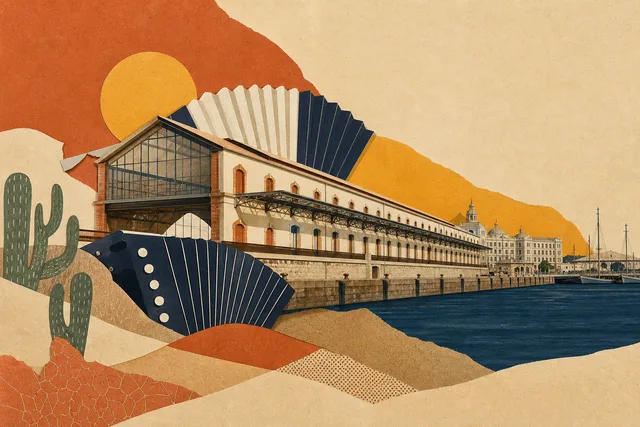
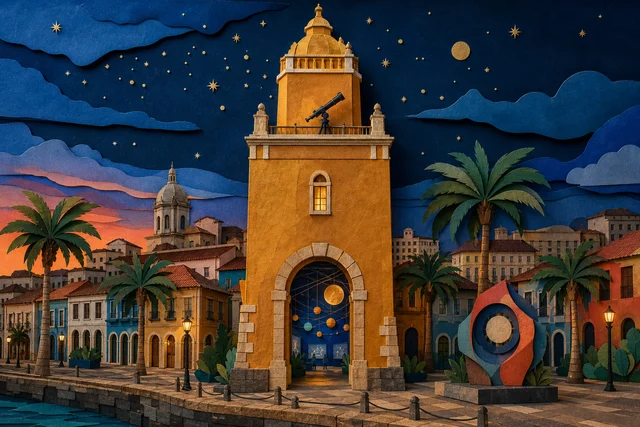
Torre Malakoff is a rare case in which a building explains the city through its own biography. It was raised in the nineteenth century using material left from the demolition of the Forte do Bom Jesus, and it carried two functions at once: monumental gate of the Navy arsenal and astronomical observatory. Stones from an earlier fortification went into a structure that looked at the port and at the sky. The military character shows in the façade, while the symmetry of the plan lends this severe object an unexpectedly Eastern resonance that makes many descriptions compare it to a mosque. Today it is a cultural space with eight exhibition rooms, but the building itself is worth the trip, a compact lesson in how Recife reuses its own past.
From arsenal gate to cultural space
The chronology is short and full of turns. The Forte do Bom Jesus stood here first and was demolished in the nineteenth century, its material reused in the new construction. The tower then served as the monumental entrance to the Navy arsenal and as an astronomical observatory, a combination that sounds odd now and made sense then, since the navy needed exact time and observation of the sky. The military function dissolved as the port changed, and the building remained expressive but little used. In 2000 it became a cultural space with an emphasis on music and photography. The monument is listed by Fundarpe, and the surrounding district lies within an area recognised by Iphan. Hold all four layers in mind: fort stone, gate, observatory, gallery.
How the space is organised
There are eight exhibition rooms plus educational and administrative rooms, and outside an amphitheatre hosts concerts and events. That arrangement defines the character of the place: this is not a museum with a permanent collection but a venue whose programme changes, with a historic specialisation in music and photography. The question of what is on show therefore has to be asked again before each visit. The constant is the architecture: wall thickness, the design of the openings, staircases and the vertical logic of a tower in which floors are strung along a climb. There is also the observatory, which according to official information receives the public on Sunday afternoons and links today's cultural use to the building's original purpose.
How to look closely
Start with the material. Once you know the stone came from a dismantled fort, the masonry stops being background: look for heterogeneity, marks of reuse, differences in cutting. Then read the façade as military work, its proportions, blind planes and rhythm of openings designed to represent and control rather than to welcome. Compare that with the plan, whose symmetry softens the severity and produces the Eastern likeness the descriptions mention. Inside, watch how each temporary show handles the building: the tower imposes a route, and good projects play with the vertical while weak ones simply hang work on walls. Before leaving, look upward, since this house was created to observe the sky.
Praça do Arsenal around it
The tower stands on Praça do Arsenal in old Recife, a few steps from Paço do Frevo and two minutes from Rua do Bom Jesus. This is the densest cultural point of the old city: within a short radius sit the former telegraph office, the synagogue, the port and the square, each telling its own version of the same story about Recife's connection to the world. The district went through decades of emptying and returned from the late 1990s with cultural institutions, bars and offices. Around the tower it is easy to feel the difference between layers: imperial military infrastructure, commercial port, abandonment and today's tourist rhythm. Walk the perimeter of the square to see the building in the perspective of the street.
Uncomfortable questions for a handsome building
The beauty of the object should not obscure its origin. An arsenal gate is infrastructure of military force rather than urban ornament, and it was built from the stones of another colonial power's fortification. At the base of this building, then, lies a chain of conquest, demolition and reuse typical of a colonial port. It is worth remembering who physically built such works in nineteenth-century Brazil and whose labour sustained the port economy, a point on which official descriptions are usually silent. Finally, note the contemporary turn: converting a military structure into a house for music and photography looks like unambiguous good news, yet it raises the question of which exhibitions reach it and who decides what counts as culture in a restored and touristic centre.
Planning the visit
The visit is short: forty minutes to an hour covers the rooms and the building itself, unless a large project is running. The sensible move is to fold Malakoff into a sequence with its neighbours, starting at the synagogue, moving through Paço do Frevo and leaving the tower for late afternoon. If you want to see the observatory, plan for a Sunday, since official information indicates late-afternoon public sessions. Entry to the space, by the same source, is free, but hours, programme and observatory access change and should be checked before you leave. Do not build the visit around a specific exhibition without confirming that it is open, because there is no permanent display here. The visit works well with children, since the climb, the view and the story of the observatory explain the building better than any text, and the short format does not tire anyone.
Getting there and access
The reference is simple: Praça do Arsenal, no number, Recife Antigo. From Marco Zero it is about seven minutes on foot and from Cais do Sertão about ten; by car, expect the district's paid car parks, which fill on event days. Buses serve old Recife, but the last stretch is always on foot over cobbles. The building is vertical, its floors linked by stairs, and the climb is part of the experience, so a lift, an accessible route, an adapted toilet and resting points should be confirmed with the venue for your date. For evening events and Sunday observations, plan the return in advance, since the district grows quieter after dark.
Where to go next
The natural continuation is Paço do Frevo, two steps away: a telegraph office and an arsenal gate together show that the port dealt in cargo but also in communication, time and control. The Kahal Zur Israel Synagogue then adds the human dimension of a community to that infrastructural story. Cais do Sertão on the waterfront turns the conversation from the sea towards the interior of the state. If the day is long and you want contrast, walk to Marco Zero and look at the river from open ground, because after the tower's vertical the horizontal of the water reads very clearly. The finest ending is to come back to Malakoff at night.
Verified facts
Every fact below is linked to this profile’s source codes.
- Location
- Old Recife · Recife REC_TOUR_DATA
- Listed address
- Praça do Arsenal, s/n REC_TOUR_DATA
- Documented focus
- Former monument portal from the 19th century converted into a cultural, exhibition and astronomical dissemination space. REC_TOUR_DATA
- Evidence basis
- Identity, location and cultural relevance are supported by primary evidence. REC_TOUR_DATA
Original Meu Recife editorial copy based only on this profile's source codes. It does not reproduce third-party text in full or turn a community-guide opinion into fact.
Before visiting
There is no permanent exhibition, so check before you set out which show is running and whether the rooms are open, since the programme changes. The observatory, according to official information, receives visitors on Sunday afternoons, and that is worth confirming separately. Climbing the stairs is part of the visit, so arrange accessibility in advance.
- Reference address
- Praça do Arsenal, s/n, Bairro do Recife, Recife — PE
- Urban heritage
- 30–90 min
- What can change
- Hours, tickets, accessibility and temporary closures can change. Confirm with the official source before visiting.
Getting there
Coordinates cross-checked against multiple mapping sources
- Reference address
- Praça do Arsenal, s/n
- District and city
- Bairro do Recife · Recife, PE
- Verified coordinates
-8.060777, -34.870831