Museums & memory · Olinda / Sítio Histórico
Olinda Museum of Contemporary Art — MAC

Contemporary art in a former church prison
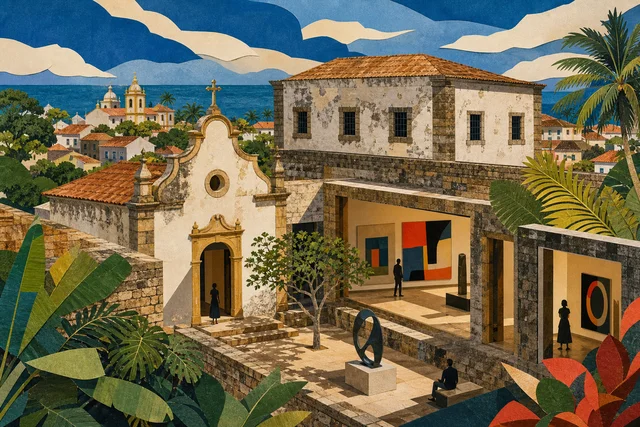
The Museum of Contemporary Art of Olinda occupies a building of 1765 raised as the Aljube, the ecclesiastical prison where inquisition punishments were carried out. The Chapel of São Pedro Advíncula stands in front of it. That combination alone makes the address unusual: modern and contemporary art shown inside walls built for coercion.
The museum opened on 23 December 1966, with the donation to the state of part of Ambassador Assis Chateaubriand's collection. In the same year the Aljube and chapel complex was restored and listed by Iphan as a historic monument.
The collection holds more than four thousand works of varied techniques, periods and styles, from French academicism to the contemporary, with names such as Portinari, Cícero Dias, Eliseu Visconti and Djanira.
Come for that contrast, twentieth-century art inside colonial architecture of coercion.
A practical conclusion: plan this stop deliberately, because its value emerges through the context of the town rather than through a single striking object.
1765, 1966 and after
The building went up in 1765 as the Aljube, a prison of ecclesiastical jurisdiction used for inquisition punishments. Before it rose the Chapel of São Pedro Advíncula, dedicated to the saint associated with release from chains.
In 1966 the complex was restored and listed by Iphan as a historic monument.
On 23 December of the same year the Museum of Contemporary Art of Pernambuco opened here, formed from the donation to the state of part of Ambassador Assis Chateaubriand's collection.
Since then the collection has grown beyond four thousand works, covering nineteenth-century academic painting through to contemporary practice.
Two dates, 1765 and 1966, are exactly two centuries and two opposite functions of one building apart. Note that dates of construction, consecration and completion of finishes often diverge in Brazil, so official sources may give different years for the same building.
Building, chapel and collection
The architecture of the Aljube is utilitarian: thick walls, small openings, a simple plan dictated by confinement rather than display. That severity now works as a neutral ground for exhibitions.
The Chapel of São Pedro Advíncula in front belongs to the ensemble and recalls the religious jurisdiction the prison answered to.
The collection exceeds four thousand works, spanning French academicism, Brazilian modernism and contemporary techniques, with artists such as Portinari, Cícero Dias, Eliseu Visconti and Djanira.
Not everything is on show at once: as in any museum of this size, displays rotate and part of the holdings stays in storage.
It is worth watching how each exhibition handles the historic space.
Keep in mind that the tropical climate defines everything, since humidity, salt and heavy rain dictate what survives and how often restoration is needed.
How to look closely
Start with the building itself and try to work out where the cells were, how the openings are arranged and why the walls are so thick. Understanding the original function changes any exhibition inside.
Look at the chapel and its dedication, because São Pedro Advíncula is Peter in chains, a pointed choice in the context of a prison.
In the display, look for Brazilian modernists: Cícero Dias came from Pernambuco, and his presence ties the collection to the place.
Notice how contemporary art relates to the colonial volume, because good installations use that contrast while weak ones try to smooth it away.
And check what is currently on, since a long-term display is not the point here.
The historic centre around it
The museum sits in Olinda's historic centre, a World Heritage area, among churches, convents and colonial houses.
Proximity to religious complexes makes the context sharper still: one walk takes in a convent, a parish church, an ecclesiastical prison and a museum of contemporary art.
Studios and galleries operate nearby, and the streets are sloping and paved in stone, as everywhere in the old town.
From the museum it is easy to climb to the Alto da Sé or descend to Carmo and the lower town.
At weekends and during Carnival the flow of visitors grows considerably. It is worth walking the block on a weekday and at the weekend, because Olinda has two rhythms and tourist flow changes how the streets feel.
Inquisition, collection and where things come from
The Aljube was built as an instrument of ecclesiastical coercion, and that is not a metaphor: punishments under inquisitorial jurisdiction were carried out here. The museum occupies a building with that history.
The second thread is the collection's origin, formed from the donation by Assis Chateaubriand, a major media magnate of the twentieth century, and the making of such collections is always tied to the power and capital of its time.
The third is access: a contemporary art museum in a touristic historic centre serves visitors above all, and keeping a local audience takes deliberate effort.
Finally, housing a museum in a colonial building means a permanent compromise between preserving the monument and serving the exhibition.
An honest view keeps all four lines.
Planning the visit
Check the programme in advance, because the content depends on the current exhibition and museum hours in Olinda change, especially out of season.
Allow forty minutes to an hour: the collection is large but exhibition space is limited by the historic building.
It is best combined with neighbouring stops in the historic centre, all within walking distance.
If Brazilian modernism interests you, ask whether works by Cícero Dias and Portinari are on show, since they belong to the strongest part of the collection.
And leave time for the chapel and the exterior, because the building is as informative as the exhibition.
Build a day of three or four stops with pauses, because trying to see more in Olinda usually ends in fatigue.
Getting there and access
The museum lies in the historic centre of Olinda, about seven kilometres from central Recife. You can arrive by taxi, bus or guided tour.
The building is historic, with steps, thresholds and narrow passages, so accessibility is limited and should be confirmed in advance.
The streets around are stone-paved and sloping and become slippery after rain, so wear firm shoes.
Parking in the historic site is limited, especially at weekends.
Consider the climate, because in hot hours the walk between stops tires you more than the visit itself. Plan your return in advance, because transport is harder to find in the historic part after dark.
Where to go next
The nearest stops are the Museum of Sacred Art of Pernambuco in the former bishops' palace and the Regional Museum of Olinda: three museums within a short walk offer three different views of the town.
Beyond them lie the churches of the centre, the São Bento monastery and the Sé at the top.
To change register, descend to the Mercado da Ribeira with its craft workshops or to the Mercado Eufrásio Barbosa with the Mamulengo Museum.
For a rest there are cafés and studios in the surrounding blocks.
And keep the contrast with old Recife for another day.
Remember that upper and lower town work differently, with churches and views above and markets and daily life below.
Verified facts
Every fact below is linked to this profile’s source codes.
- Location
- Historic Centre · Olinda OLINDA_MON
- Listed address
- Rua 13 de Maio, s/n OLINDA_MON
- Documented focus
- Museum located in the old Aljube and Capela de São Pedro Advíncula, bringing together a wide collection of modern and contemporary art. OLINDA_MON
- Evidence basis
- Identity, location and cultural relevance are supported by primary evidence. OLINDA_MON
Original Meu Recife editorial copy based only on this profile's source codes. It does not reproduce third-party text in full or turn a community-guide opinion into fact.
Before visiting
What you see depends on the current exhibition, so check the programme and hours in advance, since museums in Olinda change their schedules, especially out of season. Allow forty minutes to an hour and keep time for the Chapel of São Pedro Advíncula in front. The building is historic, so confirm accessibility before your visit.
- Reference address
- Rua 13 de Maio, s/n, Sítio Histórico, Olinda — PE
- Museums & memory
- 1–2 hours
- What can change
- Hours, tickets, accessibility and temporary closures can change. Confirm with the official source before visiting.
Getting there
Coordinates cross-checked against multiple mapping sources
- Reference address
- Rua 13 de Maio, s/n
- District and city
- Sítio Histórico · Olinda, PE
- Verified coordinates
-8.016198, -34.853460