Skip to content
MEU RECIFERECIFE · PERNAMBUCO
The city portal for Recife and PernambucoNEWS · EVENTS · SERVICES
Cultural atlas

Religious heritage · Olinda / Bonsucesso

Our Lady of the Rosary of Black Brotherhoods Church
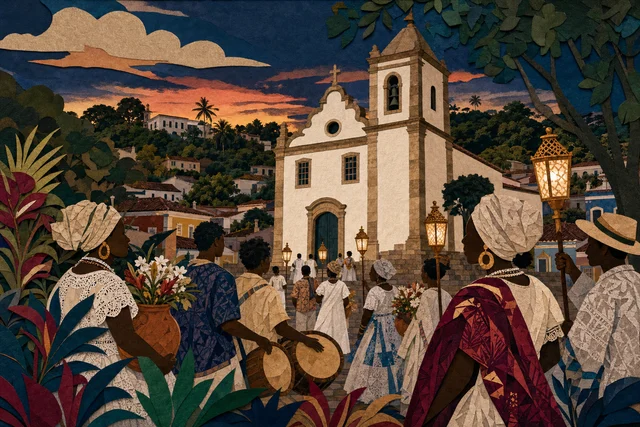
Temple of the black brotherhood of Olinda, associated with religious practices and celebrations of African origin in the colonial period.
1 sources and traceabilityVerified 2026-07-28
01

The church of Olinda's Black brotherhood

The Church of Nossa Senhora do Rosário dos Homens Pretos was founded in the second half of the seventeenth century by the brotherhood of the same name, formed by enslaved Black people. It is the first church in Pernambuco with a brotherhood that gathered them.

Its significance goes beyond architecture. Rosário brotherhoods reached Brazil in the mid-sixteenth century, Olinda's being the first, and the cult was spread mainly by Jesuits and Franciscans, working as a powerful form of evangelisation and of control over the poorest population.

At the same time the brotherhood gave enslaved people a space of their own, with an intense festive calendar that promoted integration and the rebuilding, in the Americas, of family ties lost in the diaspora.

It was here that syncretism between African cultures and Catholic religion took shape, producing a particularly Brazilian religiosity with the crowning of kings and queens, as in some kingdoms of the continent of origin.

Come knowing this is not a secondary church but a key to the Black history of Brazil.

A practical recommendation: come after seeing the convents and the cathedral, because the contrast between the orders' resources and the brotherhood's explains colonial society better than any single monument.

02

The brotherhood before the building

The chronology begins with the community rather than the fabric. Rosário brotherhoods appeared in Brazil in the mid-sixteenth century, and the Black brotherhood of Olinda was the first in the country.

The church itself was founded in the second half of the seventeenth century, after the Dutch period, when the town was rebuilding and brotherhoods could fix their presence in the urban fabric.

What follows is the long history typical of brotherhood churches: upkeep through the community's dues and donations, repairs, and dependence on the number and means of members.

In the twentieth and twenty-first centuries the listing and restoration line common to Olinda's whole historic centre was added.

Reading the building, remember that the community is older than the walls.

03

What the church is

The temple belongs to the tradition of brotherhood churches: smaller than convent complexes, with its own ornament paid for by the community's contributions.

Such houses were built gradually as funds arrived, so their architecture often combines periods, with decoration concentrated in the chancel and side altars.

What matters here is not luxury but how a community without resources created its own sacred space: proportions, simple solutions and precise accents say more than gilding.

Another layer is the festive function, because the church was the centre of the brotherhood's calendar, including the crowning of kings and queens of the Rosário.

There is no permanent display: the institution and its continuity in today's festivals are the substance.

04

How to look closely

Notice the scale and what explains it: this is a temple raised by people with almost no property rights, and every detail was paid for by dues.

Look for signs of the festive function, because the space in front and the internal arrangement served processions and coronations rather than liturgy alone.

Study the images of Nossa Senhora do Rosário and how European iconography and local tradition meet in them.

Compare this church with Amparo and with the convents: three levels of colonial society produce three kinds of building.

And remember that this is an active church where the Rosário festival remains a living event rather than a historical reconstruction.

05

Bonsucesso and the urban fabric

The church stands in the Bonsucesso district, off the main circuit towards the Alto da Sé, which is itself telling, because temples of Black brotherhoods rarely stood in the town's ceremonial quarter.

Around it lies ordinary residential Olinda, with houses, corner shops, sloping streets and daily life without a tourist front.

That location is part of the content, since the geography of temples in a colonial town reflected social hierarchy directly.

You can walk here from the Largo do Amparo or the centre, but the climbs and descents demand energy.

On the days of the Rosário festival the district changes completely and becomes the centre of city life.

06

Evangelisation and control

Official accounts state plainly that the Rosário cult was spread by Jesuits and Franciscans and worked as a powerful form of evangelisation and of control over the population, especially the poorest. That needs saying.

At the same time the brotherhood offered enslaved people what the system denied: mutual aid, funeral rites, festivals, internal offices and the rebuilding of ties broken by the diaspora.

The syncretism was not ornamental: it allowed elements of African cultures to survive within Catholic form, and from that a specifically Brazilian religiosity emerged.

It is worth remembering that crowning kings and queens reproduced forms of authority from African kingdoms from which people had been taken.

Holding both faces in view, control and resistance, is the only honest reading.

07

Planning the visit

The church is active and small: allow twenty to thirty minutes and confirm the hours beforehand, since parishes of this size change their schedules often.

The ideal moment is during the Rosário festival, when the brotherhood and its heirs hold the celebrations and the purpose of the building becomes obvious.

On ordinary days, pair it with the Amparo church to see the full system of brotherhoods.

Dress for entering a working church and confirm whether photography is allowed, since parishes with a living festival may keep stricter rules.

And do not expect tourist infrastructure: this is a district without souvenir shops.

08

Getting there and access

The church lies in Bonsucesso, Olinda, about seven kilometres from central Recife. A taxi is the most practical approach, since it sits away from the usual walking routes.

The streets slope, the paving is old and uneven and the entrance has steps, so accessibility is limited and should be confirmed with the parish.

There is little shade on the way, and in hot hours the approach is harder than the map suggests.

In the evening the district is quiet with modest lighting, so plan your return.

On festival days access and routes change, and it is worth asking in advance.

09

Where to go next

The closest neighbour in meaning is the Church of Nossa Senhora do Amparo, of the mixed-race brotherhood: together they complete the picture.

From there you can climb to the Alto da Sé with the cathedral and the Misericórdia, or descend to Carmo and the São Francisco convent.

If Black history is your central subject, continue to Recife, where the Abolition Museum and brotherhood churches extend the picture.

For a rest, the lower town offers a market and ordinary streets.

And keep the panorama from the Alto da Sé for the end of the day.

10

Verified facts

Every fact below is linked to this profile’s source codes.

Location
Bonsucesso · Olinda
OLINDA_CHURCH
Listed address
Largo do Bonsucesso, 45
OLINDA_CHURCH
Documented focus
Temple of the black brotherhood of Olinda, associated with religious practices and celebrations of African origin in the colonial period.
OLINDA_CHURCH
Evidence basis
Identity, location and cultural relevance are supported by primary evidence.
OLINDA_CHURCH

Original Meu Recife editorial copy based only on this profile's source codes. It does not reproduce third-party text in full or turn a community-guide opinion into fact.

11

Before visiting

The church is active and small, and parishes like this change their schedules often, so confirm the hours in advance. The best moment is the Rosário festival, when the brotherhood holds its celebrations and the building's meaning becomes fully visible. The district is residential, without tourist infrastructure, so a taxi is the most practical way there.

Reference address
Largo do Bonsucesso, 45, Bonsucesso, Olinda — PE
Religious heritage
30–60 min
What can change
Hours, tickets, accessibility and temporary closures can change. Confirm with the official source before visiting.
12

Getting there

Coordinates cross-checked against multiple mapping sources

Reference address
Largo do Bonsucesso, 45
District and city
Bonsucesso · Olinda, PE
Verified coordinates
-8.010051, -34.853524
The interactive map will load as you scroll
Location map for Our Lady of the Rosary of Black Brotherhoods Church
Coordinates cross-checked against multiple mapping sources · map © OpenStreetMap