Skip to content
MEU RECIFERECIFE · PERNAMBUCO
The city portal for Recife and PernambucoNEWS · EVENTS · SERVICES
Cultural atlas

Religious heritage · Olinda / Amparo

Our Lady of Amparo Church
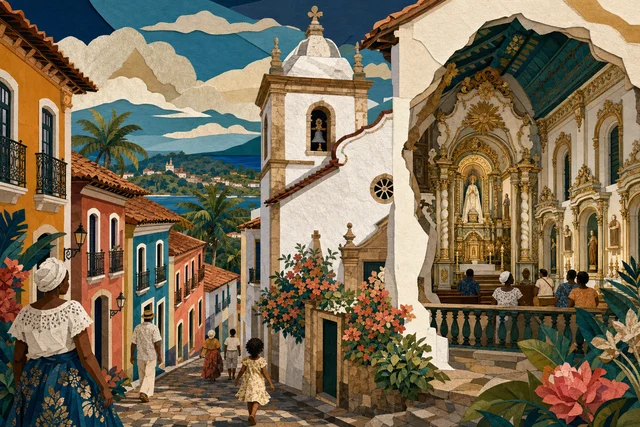
Temple linked to the Brotherhood of Brown Men, rebuilt after 1631 and marked by side altars and gilded carvings.
1 sources and traceabilityVerified 2026-07-28
01

The church of the brotherhood of mixed-race men

The Church of Nossa Senhora do Amparo in Olinda was built in 1613 by the Brotherhood of Nossa Senhora do Amparo dos Homens Pardos, an association of men of mixed descent. That is decisive: in colonial society brotherhoods were organised by social condition and colour, and the temple of one is a document of social structure rather than only a monument.

It is worth reading it from that angle. The white elite, mixed-race men and enslaved Africans belonged to separate brotherhoods and raised separate churches, and the geography of those temples in Olinda reveals how colonial society was organised.

The second reason is the tiles. In the last restoration, completed in 1992, seventeenth-century Portuguese azulejos were uncovered where wooden ceilings had hidden them.

The third is the Largo do Amparo itself, one of the finest squares of the historic centre, with a neighbourhood formed around it.

Come to see Olinda as a system of communities rather than a list of churches.

02

1613, 1631, 1644, 1992

The church was built in 1613 by the Brotherhood of Nossa Senhora do Amparo dos Homens Pardos, one of the few early seventeenth-century dates preserved in the biography of a specific Olinda building.

Less than two decades later, in 1631, the temple was partly destroyed by a fire caused by the Dutch. It is a common fate in this town, since almost every church went through that episode.

In 1644 the church was rebuilt, well before most neighbouring temples whose recovery began only after 1654. That says a great deal about the brotherhood's resources and organisation.

Finally, 1992: the last major restoration, when seventeenth-century Portuguese tiles were uncovered beneath wooden ceilings.

Four dates summarise everything: foundation by a community, destruction, rapid rebuilding and the modern revealing of hidden layers.

03

What is inside

The greatest artistic value lies in the seventeenth-century Portuguese tiles revealed in 1992, long hidden under wooden ceilings. Such discoveries are rare and change our sense of how interiors looked before later remodelling.

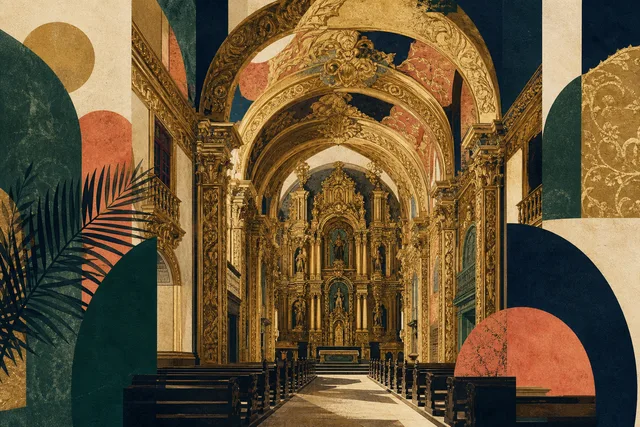
Besides the tiles, the church is known for its side altars and the gilded carving characteristic of Pernambuco baroque. In brotherhood churches the ornament is usually more restrained than in conventual ones and more expressive than in parish churches.

Note the scale: this is neither cathedral nor convent church but a building raised by a specific community, its dimensions reflecting that community's means.

The space in front belongs to the ensemble, since the Largo do Amparo served for the brotherhood's meetings and festivals.

There is no permanent display: what matters is the interior and its layers.

04

How to look closely

Look for the tiles and notice exactly where they survive, because the revealed passages show the original finish while areas under later coverings tell the story of remodelling.

Study the side altars and the gilded carving, comparing them with conventual interiors in town, since the difference in budget and purpose is immediately clear.

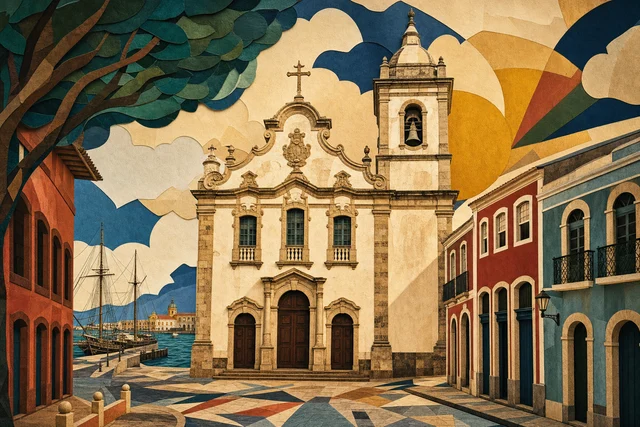
Notice how the church fits its square: the façade was designed to be seen from the Largo do Amparo, and without that space the building reads only half way.

Think about who prayed here, because the brotherhood of pardos gathered people excluded from other associations, and the church was their way of asserting presence in urban space.

And compare it with the Rosário dos Homens Pretos church: two brotherhoods, two social positions, two buildings.

05

The Largo do Amparo

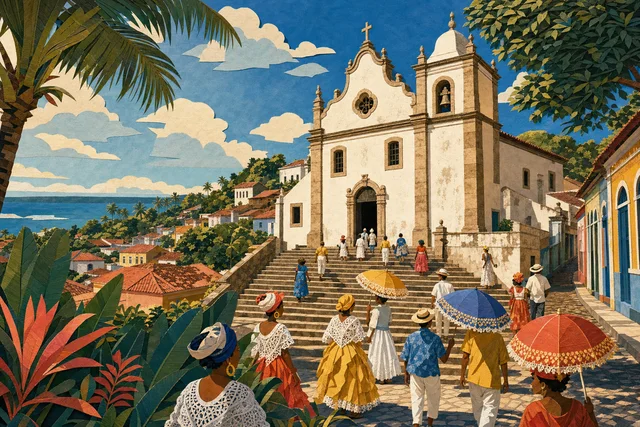
The church stands on the Largo do Amparo, one of the most picturesque squares of the historic centre, with a residential neighbourhood of coloured houses and studios around it.

The place sits slightly off the main flow climbing to the Alto da Sé, and is therefore calmer. For walking that is an advantage: you see Olinda without the crowd.

Workshops and small businesses operate nearby, and in the evening the block comes alive with residents rather than visitors.

From the square it is easy to climb to the upper town or descend to Carmo, so Amparo often becomes an intermediate stop.

During Carnival this block turns into one of the town's main stages.

06

Brotherhoods and colour

The history of this church shows directly that colonial society was structured by colour and origin. Brotherhoods of whites, pardos and Black men existed separately, with different rights and their own temples.

For mixed-race men the brotherhood was a route to recognition, access to rites, mutual aid and a place in urban life. The church is the material trace of that struggle for status.

It is worth remembering that this separation was sustained by Church and civil power together rather than arising spontaneously.

Notice too how the heritage is presented today, because the story of pardo and Black brotherhoods usually gets less space on tourist routes than the convents, though socially it matters more.

A visit here is therefore a way of restoring proportion.

07

Planning the visit

The church is active, visits happen outside services, and hours should be confirmed in advance, because small parishes change their schedules more often.

Allow twenty to thirty minutes for the church and a little more for the square, which deserves its own walk.

It fits well between Carmo and the Alto da Sé, saving you from climbing twice.

Dress for entering a working church and confirm the rules on photography.

If social history interests you, pair it with the Rosário dos Homens Pretos church, since together they complete the picture of the brotherhoods.

08

Getting there and access

The church lies in the Amparo district of Olinda's historic centre, about seven kilometres from central Recife. You can arrive by taxi or bus with a final walk.

The terrain here is gentler than at the Alto da Sé, but the streets still slope and the paving is old and uneven.

The entrance has steps, so wheelchair access is limited and should be confirmed with the parish.

The square is level and shaded by trees, a good place to rest in the heat.

In the evening the block is quiet, with more modest lighting than the tourist streets.

09

Where to go next

The nearest continuation is the Rosário dos Homens Pretos church, the temple of the Black brotherhood, which together with Amparo explains the social structure of colonial Olinda.

Climbing takes you to the Alto da Sé with the cathedral and the Misericórdia; descending leads to Carmo, the São Francisco convent and the lower town.

If interiors interest you, add the São Bento monastery with its gilded carving and São Francisco with its tile cycle.

For a rest, walk through the Amparo neighbourhood with its studios and small cafés.

And for contrast, keep another day for old Recife.

10

Verified facts

Every fact below is linked to this profile’s source codes.

Location
Amparo · Olinda
OLINDA_CHURCH
Listed address
Rua do Amparo, s/n
OLINDA_CHURCH
Documented focus
Temple linked to the Brotherhood of Brown Men, rebuilt after 1631 and marked by side altars and gilded carvings.
OLINDA_CHURCH
Evidence basis
Identity, location and cultural relevance are supported by primary evidence.
OLINDA_CHURCH

Original Meu Recife editorial copy based only on this profile's source codes. It does not reproduce third-party text in full or turn a community-guide opinion into fact.

11

Before visiting

The church is active and visits happen outside services; since small parishes change their schedules often, confirm the hours in advance. The Largo do Amparo deserves a separate walk, being among the calmest and finest squares of the centre. The entrance has steps, so confirm accessibility with the parish.

Reference address
Rua do Amparo, s/n, Amparo, Olinda — PE
Religious heritage
30–60 min
What can change
Hours, tickets, accessibility and temporary closures can change. Confirm with the official source before visiting.
12

Getting there

Coordinates cross-checked against multiple mapping sources

Reference address
Rua do Amparo, s/n
District and city
Amparo · Olinda, PE
Verified coordinates
-8.011920, -34.853574
The interactive map will load as you scroll
Location map for Our Lady of Amparo Church
Coordinates cross-checked against multiple mapping sources · map © OpenStreetMap