Urban heritage · Olinda / Sítio Histórico
Historic Centre of Olinda

The first town of Pernambuco
Olinda was founded in 1535 as the first urban nucleus of Pernambuco and became one of the most important centres of the colonial sugar economy. In 1982 its historic centre entered the UNESCO World Heritage List, a recognition that applies not to a single building but to the whole ensemble: streets, ladeiras, houses and churches.
Treating Olinda as a list of sights is a mistake. The value lies in its integrity: stone streets, coloured townhouses and centuries-old churches along the slopes form an environment that only reads on foot.
The second distinctive trait is that the town is alive. Studios, galleries, craft fairs, restaurants and cafés occupy old houses, and the historic fabric has not become an open-air museum with closed shutters.
Finally, Olinda lies about seven kilometres from Recife, and the contrast between a colonial hill town and the port metropolis beside it is itself worth a day.
1535, the seventeenth century, 1968, 1982
The town was founded in 1535 as the captaincy's first urban centre and soon became the core of a sugar economy enriched by the surrounding estates. That wealth paid for the churches and monasteries we see today.
The seventeenth century brought the Dutch invasion and significant destruction; after the Dutch left, Olinda was rebuilt, and much of the present ensemble belongs to that reconstruction.
In 1968 the historic centre was listed by Iphan, a recognition of the ensemble rather than of isolated monuments. In 1982 came the UNESCO World Heritage title.
In parallel the region's economic centre moved to Recife, and it was precisely that relative stagnation which spared Olinda from large-scale demolition.
What the ensemble is made of
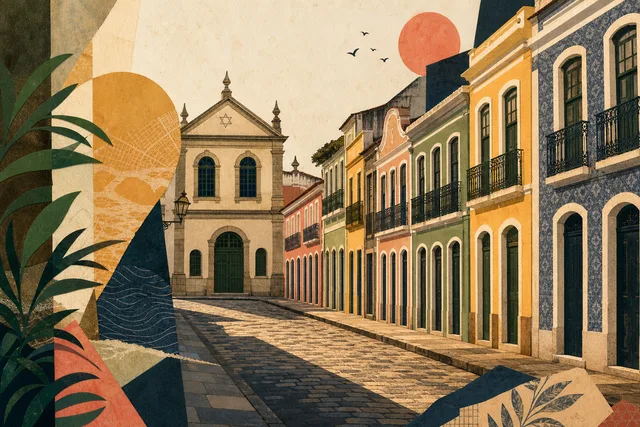
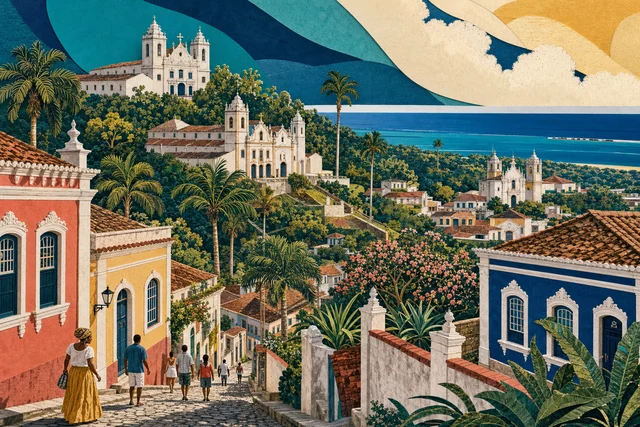
The base is the urban fabric: narrow stone streets, steep ladeiras, dense rows of single-storey houses and townhouses painted in strong colours. The terrain is what distinguishes Olinda from flat Recife and shapes every view.
The second layer is religious architecture: the Sé at the top, the São Bento monastery, churches and convents, each with its own history of rebuilding after the seventeenth century.
The third is contemporary cultural life, with studios, galleries, fairs, restaurants and cafés installed in old houses, keeping the town active all year rather than only at Carnival.
The fourth is the views: from the Alto da Sé the coast and Recife open up, and the relationship between the two towns is part of the experience.
A word about colour as well: the vivid paintwork is not pure colonial tradition but the result of later decisions and restoration practice, which changes how the postcard view reads.
How to look closely
Read the terrain as the main exhibit, because each ladeira imposes its own rhythm and turns the ensemble into a sequence of views rather than a row of façades.
Notice the condition of the houses, with restored townhouses standing beside buildings in difficulty, an honest picture of what it costs to keep heritage in the tropics.
Look for colonial detail, azulejos, ironwork, wooden shutters and church portals, which in Olinda are not gathered in a museum but scattered along living streets.
And watch the people, because the town is inhabited and its residential function outweighs the touristic one, visible in washing lines, corner shops and sounds from open windows.
Between the sea and Recife
Olinda occupies hills by the coast about seven kilometres from central Recife, and the relationship between the two shapes its character, with residents working in Recife while Olinda stays residential, cultural and touristic.
Below the historic centre lie beaches and market streets; above are churches and viewpoints. That vertical organisation favours walking and tires you in the heat.
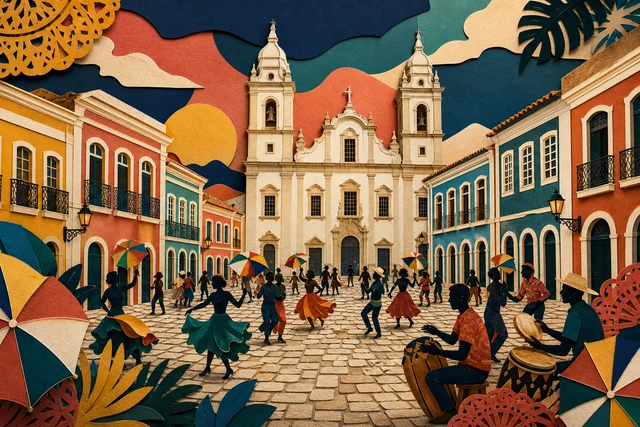
Olinda's Carnival is an institution of its own, when the ensemble becomes a stage for hundreds of thousands of people and everything else recedes.
Outside that season the town is calm, and the best way to understand it is to come on a weekday and walk down without hurrying.
Sugar, destruction and rebuilding
The wealth that created Olinda came from a sugar economy sustained by the labour of enslaved Africans and by the displacement of Indigenous populations. The beauty of the ensemble is inseparable from that base.
The Dutch invasion and the subsequent rebuilding form a second layer: much of what we call colonial heritage appeared after destruction, as the result of a war between European powers over the same economy.
The third is contemporary. World Heritage status brings attention and funding, but it also raises the cost of living, tourist pressure and the risk that residents are pushed out of the centre.
So the question of whom Olinda belongs to today is as concrete as any question about its past.
Planning the visit
Set aside a day and start early, because the climbs are heavy in midday heat. The best scheme is to ride up to the Alto da Sé, take in the panorama and the cathedral, then walk down, entering churches and studios.
Allow four to five hours for an unhurried route with pauses. Firm shoes are necessary, water is essential and sun protection helps, since there is little shade on the ladeiras.
Confirm church hours in advance, since they are active and receive visitors outside services on schedules that change. The São Bento monastery deserves its own planning.
In Carnival season expect a different town altogether, with crowds, closures and no chance of quiet looking.
Getting there and access
Olinda lies about seven kilometres from central Recife. You can arrive by taxi, bus or guided tour, with a journey of twenty minutes to an hour depending on traffic. Driving up is possible, but parking in the upper town is limited and the streets are narrow.
The main limitation is the terrain, because steep ladeiras and old paving make the route hard for anyone with reduced mobility. The sensible strategy is to ride up and walk down.
Accessibility at each church and institution has to be confirmed separately, since there is no single answer for the town.
Consider the climate, because humidity and heat increase the effort and the stone becomes slippery after rain.
Where to go next
Within Olinda the route organises itself: the Alto da Sé with the cathedral, the São Bento monastery, the churches of the historic centre and the studios and fairs between them.
Further down lie beaches and a market, worth seeing for the everyday side of the town.
For contrast, on the same day or the next, go to old Recife, because the port, the synagogue, Paço do Frevo and Marco Zero show how the neighbour that took over the economic role developed.
And if you are staying longer, return to Olinda in the evening, when lit churches and the view of Recife's lights form a different experience.
Verified facts
Every fact below is linked to this profile’s source codes.
- Location
- Historic Centre · Olinda UNESCO_OLINDA · IPHAN_PE · MTUR_OLINDA
- Listed address
- Sítio Histórico de Olinda UNESCO_OLINDA · IPHAN_PE · MTUR_OLINDA
- Documented focus
- Urban complex recognized by UNESCO, combining topography, gardens, houses, convents and baroque churches. UNESCO_OLINDA · IPHAN_PE · MTUR_OLINDA
- Evidence basis
- Identity, location and cultural relevance are supported by primary evidence. UNESCO_OLINDA · IPHAN_PE · MTUR_OLINDA
Original Meu Recife editorial copy based only on this profile's source codes. It does not reproduce third-party text in full or turn a community-guide opinion into fact.
Before visiting
Olinda is seen as a whole rather than as a list of sights: allow four to five hours and start early, because the climbs are hard in the heat. The sensible scheme is to ride up to the Alto da Sé and walk down. The churches are active, their hours change and need checking, and the stone paving is slippery after rain.
- Reference address
- Sítio Histórico de Olinda, Sítio Histórico, Olinda — PE
- Urban heritage
- 30–90 min
- What can change
- Hours, tickets, accessibility and temporary closures can change. Confirm with the official source before visiting.
Getting there
Coordinates published by an institutional source
- Reference address
- Sítio Histórico de Olinda
- District and city
- Sítio Histórico · Olinda, PE
- Verified coordinates
-8.013333, -34.845000