Religious heritage · Recife / Bairro do Recife
Kahal Zur Israel Synagogue
The first synagogue in the Americas
Kahal Zur Israel is the first synagogue on the American continent, and what matters is not the title but how precisely the history is pinned to this address. This is not a general monument to Jewish presence but one specific house on a commercial street, where a community lived between 1637 and 1654, during the two Dutch decades in Pernambuco when open Jewish religious life was permitted. Before and after, it was not. The second decisive detail is how the place came back: the traces were not found in a park or under ruins but beneath the floor of a working electrical supplies shop. The visit is therefore about faith and equally about how a city loses its own memory. Come prepared to look downward, because what counts here lies below eye level.
Twenty years of freedom, three centuries of silence
The Dutch held Pernambuco from 1630 to 1654, and the period's religious tolerance drew people fleeing persecution in Europe. The Kahal Zur Israel community functioned between 1637 and 1654 on the street then called Rua dos Judeus, the Street of the Jews. Dutch withdrawal broke everything: the property passed to João Fernandes Vieira and, in 1679, was donated to Oratorian priests, who destroyed what remained of the synagogue. Three centuries of ordinary commercial life followed, the address changing hands until, by the 1990s, the ground floor held a shop selling electrical supplies. The return began with maps. The archaeologist José Luiz Mota Menezes overlaid historical plans to fix the exact spot, and a UFPE team led by Professor Marcos Albuquerque excavated from October 1999 to February 2000. The memorial opened on 18 March 2002.
What is on show: the mikveh and the dig
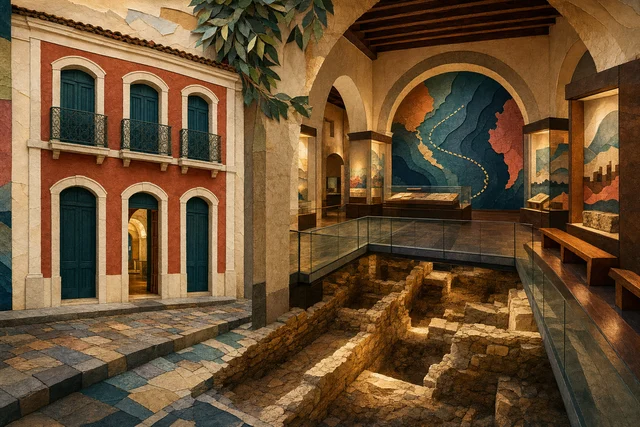
The core of the house is the mikveh, the ritual bath found beneath the floor. Its authenticity was not accepted on resemblance: the measurements were checked against the prescriptions and validated by a rabbinic tribunal, and it remains the central proof that a synagogue operated here. Around it lies the archaeological layer, which the display does not hide behind reconstruction: seventeenth-century masonry is visible, along with defensive walls of the period and the change in level showing the old street some seventy centimetres below today's paving. The excavation produced more than forty thousand finds, among them Portuguese and Dutch smoking pipes, ceramics and metal pieces, the daily refuse of a trading quarter from which the evidence is assembled. The Jewish Federation of Pernambuco runs the memorial, and the display is deliberately small.
How to look closely
Read the mikveh as engineering rather than decoration: steps, depth and the way water was brought in all matter, because ritual requirements shaped the structure and that is exactly what allowed it to be identified three and a half centuries later. Find the points where the change in level shows: seventy centimetres between the seventeenth-century street and today's paving is the most direct way to feel that old Recife lies literally underfoot. In the cases, look for the everyday rather than the rare, since pipes and potsherds describe a trading quarter more honestly than any ceremonial object. And keep the original separate from the restored: façade and interiors are largely restitution, while the layer below is authentic material.
Rua do Bom Jesus, the street that changed its name
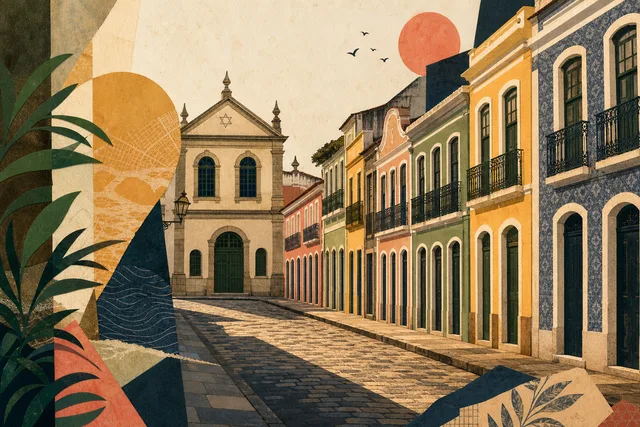
The address is Rua do Bom Jesus, numbers 197 and 203, but in the Dutch years the street was called Rua dos Judeus. The change of name already tells the district's story: this was a working commercial street of the port, where the community lived and traded beside the quays rather than in an isolated ghetto. Today it is the most photogenic street in old Recife, with cobbles, painted façades, bars and a steady tourist flow, and the contrast with the memorial's content is sharp: celebration outside, a conversation about the fragility of rights inside. Walk the street in both directions until you see the port and the square, and it becomes clear why the community settled here. This is the geography of trade, not of theology.
A freedom with an expiry date
The uncomfortable idea in this place is that freedom here was not a settled norm but a temporary regime that lasted exactly as long as Dutch power did. Twenty years of open religious life ended in 1654, and with them ended the possibility of remaining who you were at this address. The destruction of the synagogue's remains in 1679 was not simple rebuilding but deliberate erasure, which is why archaeology functions here as a form of redress. It is worth resisting two easy reactions, celebration of the first in the Americas label and the reduction of everything to tragedy. More accurate is to watch how quickly rights appear and vanish with the political order, and how long it takes afterwards to recover even the record of a presence.
Planning the visit
The memorial is small, and it helps to know that: forty minutes to an hour is enough for a careful pass with the captions, and there is no long exhibition route. Begin below, with the archaeological layer and the mikveh, and go up only afterwards, because the reverse order blurs the essential part. When this text was prepared, official information indicated afternoon opening from Tuesday to Sunday with a later close on Sundays, but hours, admission and group arrangements change and should be confirmed before you set out. It makes an excellent first stop of a day in old Recife: after it, Paço do Frevo and Torre Malakoff read as chapters of one conversation about the port. With children, explain beforehand that the visit looks at finds beneath the floor.
Getting there and access
The reference point is Rua do Bom Jesus, 197 and 203, in Recife Antigo; from Marco Zero it is a five to seven minute walk, and since the street is closed to through traffic, taxis and buses leave you at the start of the block. By car, expect paid car parks nearby and remember that the district is closed off on event days. The building is historic and narrow, with stairs, changes of level and limited circulation, so wheelchair access, staff assistance and the possibility of going down to the archaeological layer should be confirmed with the Jewish Federation of Pernambuco for your date. Wear stable shoes: the old paving outside is slippery after rain, and there are steps without handrails inside.
Where to go next
The best continuation is not another subject but the same port from another angle. Paço do Frevo, minutes away, shows a city that turned street culture into an institution and also gives relief after a heavy topic. Torre Malakoff adds the technical line: the same port seen by engineers and astronomers. Marco Zero and the waterfront are there so you can see the water that determined everything, both the community's arrival and its departure. If time and energy remain, Cais do Sertão across the water turns the conversation from the sea towards the interior of the state. Simply avoid stacking two dense museums with no interval: this address needs time to settle, and the street itself is a good place to give it.
Verified facts
Every fact below is linked to this profile’s source codes.
- Location
- Old Recife · Recife REC_TOUR_DATA · REC_1DAY
- Listed address
- Rua do Bom Jesus, 197 REC_TOUR_DATA · REC_1DAY
- Documented focus
- Jewish memory center on the site associated with the first synagogue in the Americas, with archaeological remains and historical narrative. REC_TOUR_DATA · REC_1DAY
- Evidence basis
- Identity, location and cultural relevance are supported by primary evidence. REC_TOUR_DATA · REC_1DAY
Original Meu Recife editorial copy based only on this profile's source codes. It does not reproduce third-party text in full or turn a community-guide opinion into fact.
Before visiting
Confirm opening hours, admission and group arrangements with the Jewish Federation of Pernambuco on the day of your visit, since this is a small memorial with its own schedule that changes through the year. If you need help moving around, confirm access to the archaeological layer and the mikveh in advance. Allow about an hour.
- Reference address
- Rua do Bom Jesus, 197, Bairro do Recife, Recife — PE
- Religious heritage
- 30–60 min
- What can change
- Hours, tickets, accessibility and temporary closures can change. Confirm with the official source before visiting.
Getting there
Coordinates published by an institutional source
- Reference address
- Rua do Bom Jesus, 197
- District and city
- Bairro do Recife · Recife, PE
- Verified coordinates
-8.061859, -34.871317