Religious heritage · Olinda / Carmo
Carmo Church in Olinda
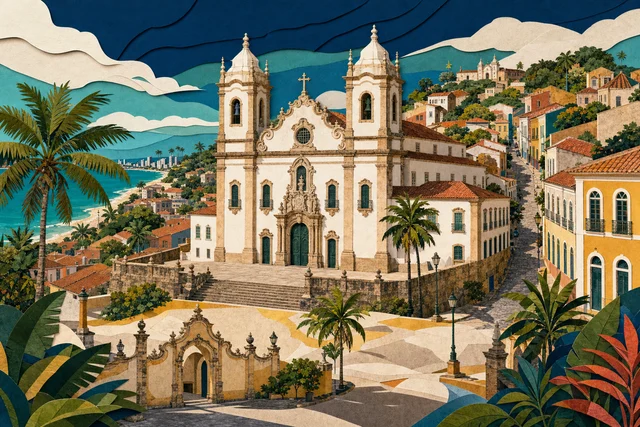

The first Carmelite church in the Americas
The Carmo church in Olinda is the first church of the Carmelite Order raised in the Americas, which alone makes it a key point for understanding how European religious orders divided the new territory among themselves.
The building went up in 1580 as the Chapel of Santo Antônio and São Gonçalo, and with the arrival of the Carmelites in 1581 work began on their own premises, the oldest of the order on the continent.
The church stands at the entrance to the historic site, so for most arrivals it is the first Olinda building seen at close range. That makes it a natural start for a route from the bottom up.
It also passed through destruction, a century of rebuilding and a long contemporary restoration, so its biography works as a compact manual of what happens to colonial heritage in Brazil.
Come less for a dazzling interior than for the sequence: foundation, war, return, restoration.
1580, 1631, 1654, 1704, 1726, 1938, 1995
The dates speak for themselves. In 1580 construction began on the site of the hermitage of Santo Antônio and São Gonçalo; in 1581 the Carmelite Order settled in Olinda, and its buildings became the oldest in the Americas.
In November 1631, when the Dutch destroyed Olinda, church and convent were seriously damaged. From 1654, after the invaders were expelled, the friars returned to the ruins and began rebuilding.
In 1704 interior works started and the cruzeiro was raised in front of the temple, while the south tower was completed in 1726. The present appearance took nearly a century to form.
In 1938 the Church of Nossa Senhora do Carmo, of the former Convent of Santo Antônio do Carmo, was listed by Iphan.
The full restoration began in 1995 and received around six million reais of federal funding through the Ministry of Culture and Iphan, in programmes such as Pronac, Monumenta and PAC Cidades Históricas, with the Olinda city government and the order taking part.
What the church is today
The church belongs to the baroque tradition formed in Pernambuco after the rebuilding of the seventeenth and eighteenth centuries, and its present appearance results from works spread across decades.
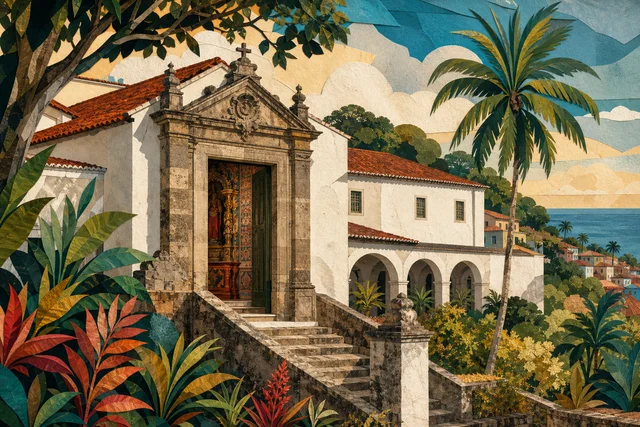
A façade with tower and a cruzeiro before the entrance form the composition typical of colonial temples: the cross on the forecourt marked the boundary of sacred space and served as a gathering point for processions.
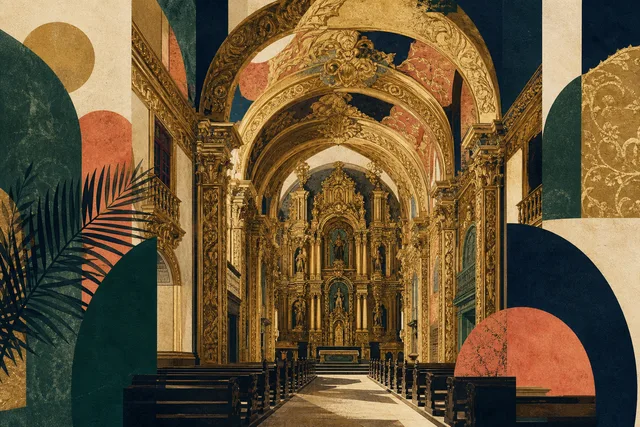
Inside, study the chancel and the relation between baroque decoration and relatively sober walls, because rebuilding after destruction usually meant simplifying structure while keeping richness of ornament.
Another layer is the mark of contemporary restoration, which lasted two decades. Works of that scale change not only appearance but the definition of which historical layer counts as the reference.
There is no museum display: the point of the building is that it returned to liturgical use.
How to look closely
Start with the siting, because the church stands at the entrance to the site, on the passage from the lower town to the slopes, and is visible from afar. That is colonial urban logic rather than accident.
Look at the cruzeiro in front and imagine the procession it was raised for, because without that element the façade reads as scenery and with it as part of a ritual script.
Notice the south tower, completed in 1726, whose masonry differs from earlier parts to an attentive eye.
Inside, look for signs of restoration: replaced elements, recovered gilding, passages left as they were. Good restoration does not hide itself.
And compare this church with the São Bento monastery: two orders, two approaches to decoration, one era.
The gateway to the historic site
The church sits in the Carmo district at the entrance to historic Olinda, near the São Francisco convent and minutes from the start of the climb.
It is the town's transport hub, with buses and taxis arriving here and walking routes beginning here, so the surroundings are always busy, with street trade and guided groups.
Below lies the lower town with its market and daily life; above are ladeiras, churches and viewpoints. Carmo sits exactly on the border between those two Olindas.
For a route that is practical: see it at the start of the day or leave it for the end, on the way down.
Note that during Carnival this point is among the busiest in town.
Order, town and restoration money
The history of this church is the history of heritage funding. The destruction of 1631 came from a war between European powers over the colony, and rebuilding took a century precisely because resources were short.
The same plot repeated in the twentieth century: the full restoration begun in 1995 required around six million reais and the combination of several federal programmes, the city government and the order. Without that arrangement the building would not have survived.
It is worth recalling the origin of the original wealth, because the Carmelites, like the other orders, existed inside a colonial economy based on sugar and enslaved labour.
The 1938 listing belongs to the history of Brazilian heritage policy, when the state began protecting colonial monuments systematically.
All those lines sit in one building for anyone who knows where to look.
Planning the visit
The church is active, so visits happen outside services and hours should be confirmed in advance, since they change with parish life.
Allow twenty to thirty minutes: the temple does not demand a long visit but rewards an attentive one, especially if you have already seen other churches in town and can compare.
It is best seen at the start of the route, right on arrival, while you still have energy for the climb. The alternative is to keep it for the end, coming down from the Alto da Sé.
Dress for entering a working church and confirm whether photography is allowed.
At weekends expect guided groups, since this is the first stop on almost every route.
Getting there and access
The church stands in Carmo at the entrance to Olinda's historic centre, about seven kilometres from central Recife. Buses and taxis arrive here, which makes it the town's most transport-accessible point.
The building is historic: the entrance has steps and the forecourt is paved in stone. Wheelchair access is limited and should be confirmed with the parish.
The paving around it is uneven and slippery after rain, so wear firm shoes.
If you plan to climb, note that the demanding part of the slope begins here and is hard in the heat.
For the return, this is also the best place to find transport.
Where to go next
The nearest stop is the São Francisco convent, with its cloister and azulejo panels, a few minutes on foot.
From there the route climbs: the churches of the historic centre, the São Bento monastery with its gilded carving, and the Sé at the top with views of the coast and Recife.
If the history of the orders interests you, add the Seminary of Nossa Senhora da Graça, the former Jesuit college, and the Misericórdia church tied to the Santa Casa.
In the lower town the market and ordinary streets show Olinda outside the tourist script.
And for contrast, visit old Recife another day, the city that took over Olinda's economic role.
Verified facts
Every fact below is linked to this profile’s source codes.
- Location
- Carmo · Olinda OLINDA_CHURCH · UNESCO_OLINDA
- Listed address
- Praça do Carmo, s/n OLINDA_CHURCH · UNESCO_OLINDA
- Documented focus
- Landmark of Carmelite implantation in the Americas, rebuilt in Baroque language and integrated into the entrance to the historic site. OLINDA_CHURCH · UNESCO_OLINDA
- Evidence basis
- Identity, location and cultural relevance are supported by primary evidence. OLINDA_CHURCH · UNESCO_OLINDA
Original Meu Recife editorial copy based only on this profile's source codes. It does not reproduce third-party text in full or turn a community-guide opinion into fact.
Before visiting
The church is active: visits happen outside services and hours change, so confirm in advance. It stands at the entrance to the historic centre, working equally as the first stop of a route or the last one on the way down. The entrance has steps and the forecourt is stone, so confirm accessibility with the parish.
- Reference address
- Praça do Carmo, s/n, Carmo, Olinda — PE
- Religious heritage
- 30–60 min
- What can change
- Hours, tickets, accessibility and temporary closures can change. Confirm with the official source before visiting.
Getting there
Coordinates cross-checked against multiple mapping sources
- Reference address
- Praça do Carmo, s/n
- District and city
- Carmo · Olinda, PE
- Verified coordinates
-8.017431, -34.849201