Religious heritage · Olinda / Carmo
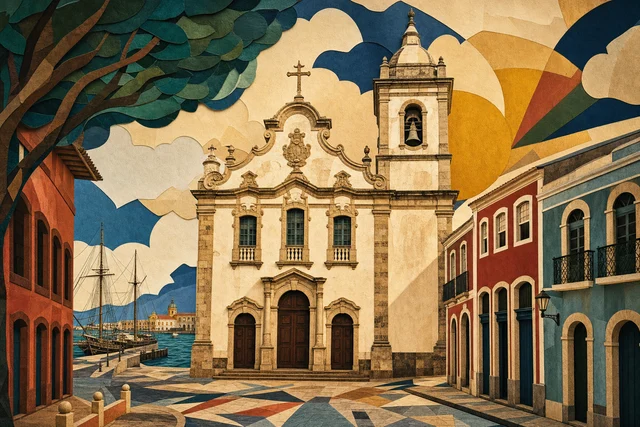
São Francisco Convent and Our Lady of the Snows Church

The first Franciscan convent in Brazil
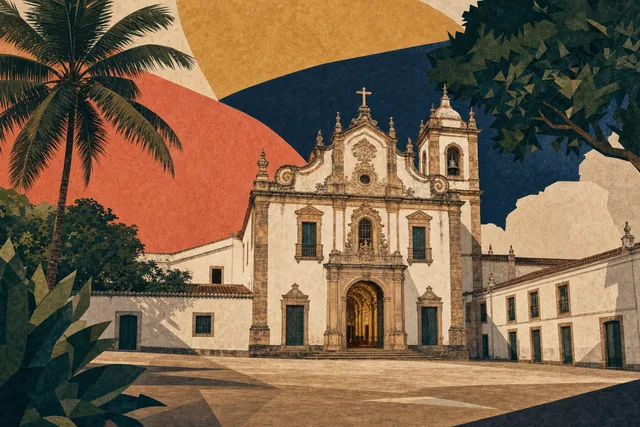
The Convent of São Francisco in Olinda is the country's oldest Franciscan complex: construction began in 1585 with the order's arrival in Brazil, to a design by Friar Francisco dos Santos. This is not simply another Olinda church but the starting point of the Franciscan presence in the colony.
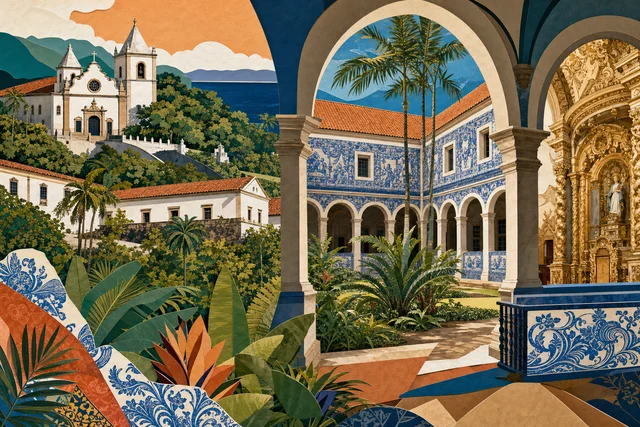
The complex gathers several parts: the Church of Nossa Senhora das Neves, the Chapel of São Roque, the oldest surviving chapel of the Franciscan lay Third Order in the country, the Chapel of Santana lined with azulejo panels, the cloister and the sacristy. Few complexes have reached us so complete.
The greatest artistic value lies in the Portuguese azulejos: in the cloister, sixteen panels narrate the life and death of Francis of Assisi. To these are added a carved ceiling with coffers holding eighteenth-century paintings.
Come for the integrity of the ensemble: here you see how a convent works, not only what a church looks like.
1585, 1631 and the eighteenth century
The count begins in 1585, when the Franciscans founded the order's first convent in Brazil at Olinda. For the colony it meant an institution devoted to worship, teaching, mission and the organisation of lay brotherhoods.
In 1631, during the Dutch invasion, the building was seriously damaged and abandoned. That date recurs in almost every biography of Olinda's churches and explains why the town's present appearance is largely later.
Rebuilding took place in the eighteenth century, and it was then that the complex gained the appearance for which it is called one of the finest in Brazil. Baroque decoration, azulejos and carving belong to that period.
Keep the three dates together, foundation, destruction and rebuilding, because they summarise the history of Olinda as a whole.
Cloister, azulejos and carving
The core is the cloister, with sixteen panels of Portuguese azulejos devoted to the life and death of Francis of Assisi. It is a complete narrative cycle rather than scattered ornament, and it should be read in sequence as you walk around the courtyard.
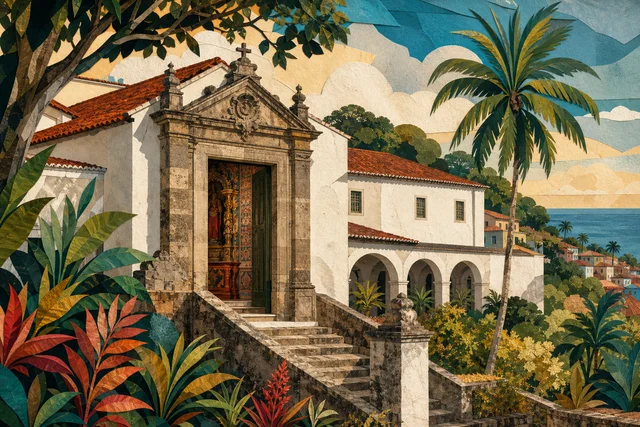
The Chapel of São Roque carries historical weight: it is the oldest surviving chapel of the Franciscan lay Third Order in the country, evidence of how the order worked with townspeople rather than only inside the convent.
The Chapel of Santana is lined with azulejo panels, and the interiors are marked by a carved wooden ceiling whose coffers hold eighteenth-century paintings. Carving, painting and tilework together display the full repertoire of colonial sacred art.
The sacristy and the passages between parts reveal conventual life: where visitors were received, where liturgy was prepared, where the community lived.
How to look closely
Start in the cloister and follow all sixteen panels in order, because azulejo works like a book and a scene taken out of sequence loses its meaning. Notice the compositional solutions and the use of a limited palette.
Then look up at the coffered ceiling, since the eighteenth-century painting in the coffers is a layer easily missed while studying the walls.
In the Chapel of São Roque look for signs of the lay brotherhood, because the space was made for townspeople rather than friars, and its scale and decoration differ from the main church.
And compare the state of conservation across the parts: restoration work is visible here and worth noticing rather than taking everything for sixteenth-century original.
Carmo and the slopes
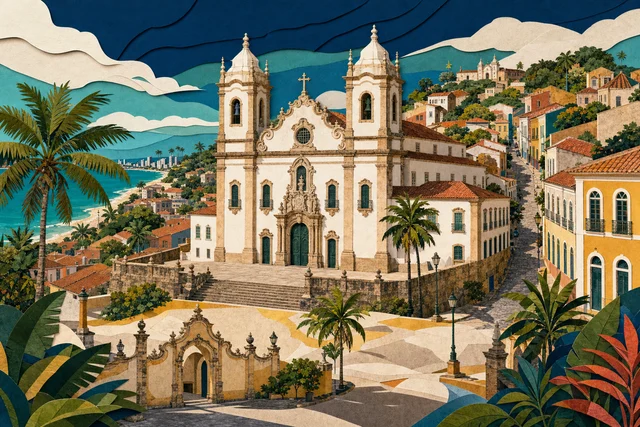
The convent stands in the Carmo district, in the lower part of the historic centre, near the Carmo church that greets arrivals at the edge of the old town. It makes a good starting point for a route from bottom to top.
Around it lies Olinda's typical urban fabric of narrow streets, coloured houses, stairs and ladeiras. You can walk from the convent to the Alto da Sé, but the climb is real and in the heat belongs to the morning.
Guided routes pass nearby and craft trade operates around it, with a much heavier flow at weekends.
The location also explains the history, because the Franciscans settled inside the town, and the convent always belonged to everyday life.
Mission, brotherhoods and colonial order
The Franciscan order in Brazil did not confine itself to worship: it worked on the catechism of Indigenous peoples, and lay brotherhoods were an instrument of social organisation in colonial society. The beauty of the ensemble is inseparable from that function.
It is worth remembering who built and sustained such complexes. Olinda's wealth came from a sugar economy based on enslaved labour, and religious buildings were financed from the same sources.
The Dutch destruction of 1631 recalls that churches were also military targets in a contest between European powers over control of the colony.
Finally, the eighteenth century, from which most of the decoration comes, was the height of that economy, and the luxury of azulejos and carving is directly tied to its income.
Planning the visit
This is a working convent and church, so the visit depends on the community's schedule: access happens outside services, hours change and should be confirmed before travelling.
Allow forty minutes to an hour, because a cloister with sixteen panels needs time if you want to read them in order. For anyone interested in tilework this is probably the main stop in Olinda.
It helps to build the route from the bottom up: São Francisco first, then the churches of the centre and the climb to the Alto da Sé, leaving the effort for the start of the day.
Dress for entering a working church and confirm in advance whether photography is allowed.
Getting there and access
The convent lies in Carmo, in the lower historic centre of Olinda, about seven kilometres from central Recife. You can arrive by taxi, bus or guided tour.
Inside there are steps, thresholds and passages between parts, and the surrounding paving is uneven, so wheelchair access is limited and should be confirmed with the institution.
Wear firm shoes, because Olinda's streets are stone and slippery after rain.
If you plan to climb to the Alto da Sé afterwards, budget your energy, since the slope is steep and shade is scarce.
Where to go next
The nearest stop is the Carmo church, the oldest Carmelite church in the Americas, at the entrance to the historic site. Together with São Francisco it shows how the orders divided the town.
Climbing further you reach the churches of the centre, the São Bento monastery with its gilded carving and the Sé at the top with its panorama.
If your interest is tilework and colonial sacred art, add the Seminary of Nossa Senhora da Graça and the Misericórdia church, where layers of azulejo and painting also survive.
And to close the day, descend to the lower town and see everyday Olinda, with its market and residential streets.
Verified facts
Every fact below is linked to this profile’s source codes.
- Location
- Carmo · Olinda OLINDA_CHURCH · MTUR_OLINDA
- Listed address
- Rua de São Francisco, 280 OLINDA_CHURCH · MTUR_OLINDA
- Documented focus
- First Franciscan establishment in Brazil, with cloister, chapels, carvings and extensive panels of Portuguese tiles. OLINDA_CHURCH · MTUR_OLINDA
- Evidence basis
- Identity, location and cultural relevance are supported by primary evidence. OLINDA_CHURCH · MTUR_OLINDA
Original Meu Recife editorial copy based only on this profile's source codes. It does not reproduce third-party text in full or turn a community-guide opinion into fact.
Before visiting
This is a working convent: visits happen outside services and hours change, so confirm before travelling. Allow at least forty minutes to follow the sixteen azulejo panels of the cloister in order rather than at a glance. Dress for entering a church and ask in advance whether photography is allowed.
- Reference address
- Rua de São Francisco, 280, Carmo, Olinda — PE
- Religious heritage
- 30–60 min
- What can change
- Hours, tickets, accessibility and temporary closures can change. Confirm with the official source before visiting.
Getting there
Coordinates cross-checked against multiple mapping sources
- Reference address
- Rua de São Francisco, 280
- District and city
- Carmo · Olinda, PE
- Verified coordinates
-8.013888, -34.847367