Religious heritage · Olinda / Carmo
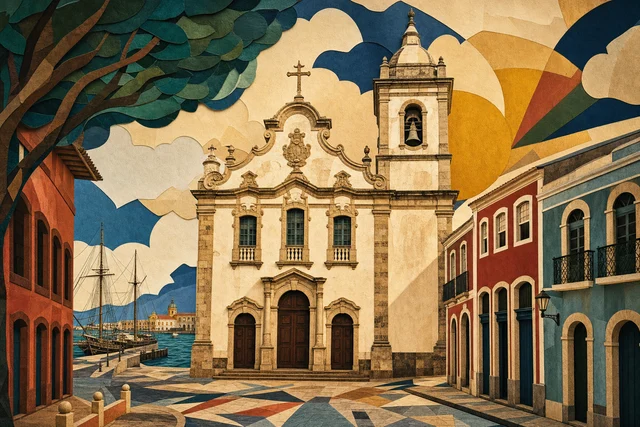
Our Lady of the Conception Church and Convent
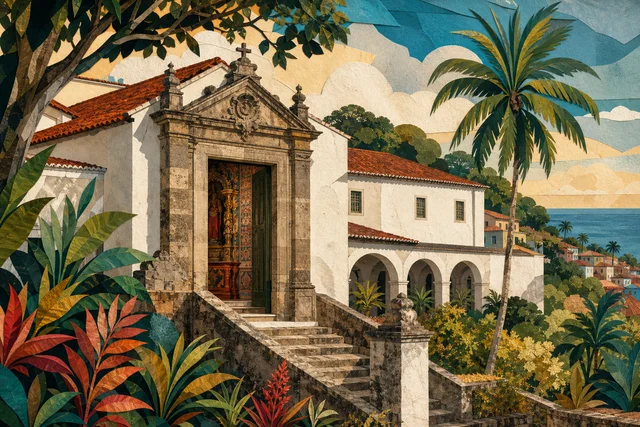
One of Brazil's oldest convents for women
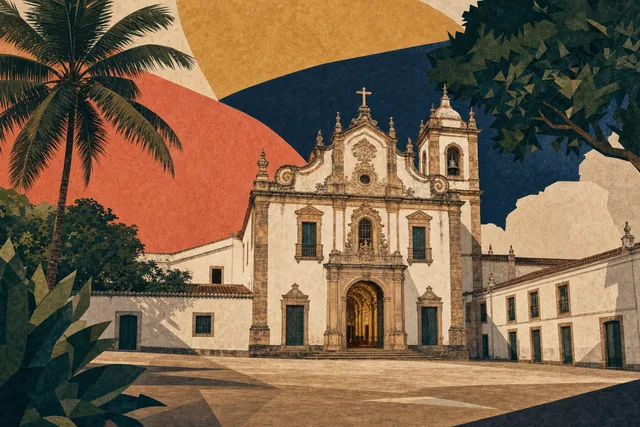
The Church and Convent of Nossa Senhora da Conceição was built in the sixteenth century and is one of the oldest convents for women in Brazil, as well as the first dedicated to Nossa Senhora da Conceição.
That matters because female religious houses appeared later than male ones in the colony and served a specific social function: they were at once places of religious life and refuges for women left without family protection.
It was precisely that role the building took after rebuilding, serving as a religious house of refuge for abandoned women, that is, working as a social institution long before any modern welfare system.
Another turn in its biography: in 1831 the first public library of Pernambuco was installed here, and the convent briefly became a place of secular learning.
Come for that succession of functions, rare even in Olinda.
A practical detail: access is often limited, so confirm what is open beforehand, because even an exterior visit repays you once you know the building's biography.
The sixteenth century, 1631, rebuilding, 1831
The building was raised in the sixteenth century as a recolhimento, a female religious house, the first under the devotion of Nossa Senhora da Conceição in the country.
In 1631 the convent was sacked and burned by the Dutch, sharing the fate of most religious buildings in Olinda at that time.
After the Pernambuco Restoration, with the Dutch expelled, it was rebuilt by João Fernandes Vieira and took on the function of a religious refuge for abandoned women.
In 1831 the first public library of Pernambuco was installed here, the moment when a religious institution gave part of its space to public instruction.
Four markers form an unusually coherent biography: foundation, destruction, rebuilding with a new social function, and transformation into a cultural institution.
Note the role of João Fernandes Vieira, a figure of the Pernambuco Restoration who rebuilt institutions as well as military positions.
Painting, polychromy and Portuguese stone
The complex preserves elements typical of the earliest colonial convents: painting, polychromy, carving and details in Portuguese stone brought across the ocean.
Portuguese stone in the finishes marks status and connection with the metropolis, because transporting it was expensive and its presence signals the standing of the house.
The plan is typical of a women's convent: enclosure, internal courtyards and limited contact with the town, reflecting the rules of the cloister.
Study the combination of modest volumes and quality of finish, because resources went into detail rather than scale.
There is no permanent museum display, and access depends on the complex's present use.
Remember that women's convents were built for enclosure, with grilles, separate entrances and reception rooms, architectural consequences of a rule.
How to look closely
Look for Portuguese stone in portals and details, because its texture and cutting differ from local material and reveal the import at once.
Notice the polychromy and painting where they survive, since in women's convents colour solutions often differed from those in male houses.
Read the plan: where the boundary of enclosure ran, how the openings and passages work, how the community dealt with the outside world.
Think about the refuge function, because spaces meant for the permanent residence of women without families differ from strictly monastic ones.
And keep the 1831 library episode in mind, which explains why part of the premises may have been adapted.
Carmo and the historic centre
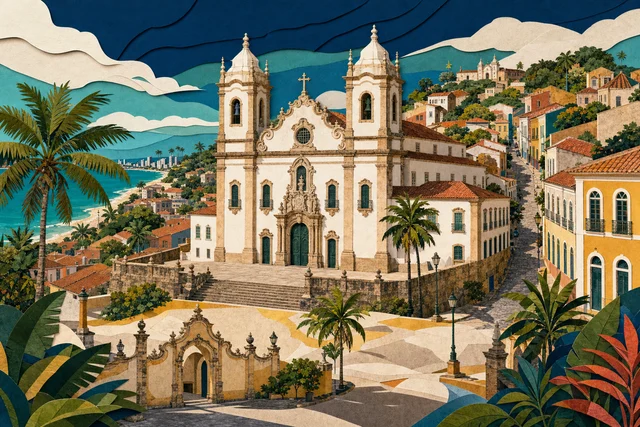
The convent stands in the Carmo district of historic Olinda, near the Carmo church and the São Francisco convent, in the area where the town's largest religious complexes cluster.
The setting suits a route, because ensembles of different orders and functions lie within a short walk.
Around it is Olinda's ordinary urban fabric of sloping streets, coloured houses and studios.
From here you can climb to the Alto da Sé or stay in the lower part, where distances are shorter and the terrain gentler.
Note that at weekends and during Carnival the block fills with people.
Refuge, enclosure and the limits of choice
Female religious houses in the colony served a function worth naming plainly: they took in women with no acceptable alternatives, widows, orphans and those abandoned by their families.
That was real protection and at the same time a form of control, because enclosure limited freedom and the decision to enter often lay with the family rather than the woman herself.
The destruction of 1631 and the rebuilding by João Fernandes Vieira show how such institutions depended on military and political circumstance.
The installation of Pernambuco's first public library here in 1831 signals the secularisation under way, when state and society began claiming spaces once ecclesiastical.
Looking at the convent with all those lines in view is the more honest approach.
Planning the visit
Access depends on the complex's present use and on religious routine, so confirm visiting conditions in advance.
Allow twenty to thirty minutes, because this is not a museum and the route is limited to the areas that are open.
It pairs naturally with the Carmo church and the São Francisco convent, both a few minutes away on foot.
Dress for entering a religious space and confirm whether photography is allowed.
If the history of women in the colony is your interest, plan carefully, because the material here is rare and asks for time.
Plan the visit for the morning, when the Carmo district is calmer and religious complexes are more often open.
Getting there and access
The convent lies in the Carmo district of Olinda, about seven kilometres from central Recife. You can arrive by taxi or bus with a final walk.
The building is historic: entrances have steps and thresholds, internal passages are narrow and the paving around is uneven, so accessibility is limited.
The terrain in the lower town is gentler than at the Alto da Sé, which makes this visit less demanding than the climb to the cathedral.
After rain the stone is slippery, so wear firm shoes.
Confirm in advance whether the complex is open on the day of your visit.
Where to go next
The nearest stops are the Carmo church and the São Francisco convent with its cloister and tile cycle, both minutes away.
Climbing leads to the Alto da Sé with the cathedral, the Misericórdia and the seminary; descending leads to the lower town and the market.
If social and women's history interests you, add the brotherhood churches, Amparo and Rosário dos Homens Pretos, which complete the colonial picture.
For a rest there are cafés and studios in the Carmo district.
And another day, old Recife is worth it for the contrast.
Verified facts
Every fact below is linked to this profile’s source codes.
- Location
- Carmo · Olinda OLINDA_CHURCH
- Listed address
- Rua Bispo Coutinho, Largo da Misericórdia OLINDA_CHURCH
- Documented focus
- Former women's retreat of 16th century origin, with paintings, polychrome, carvings and Portuguese stone elements. OLINDA_CHURCH
- Evidence basis
- Identity, location and cultural relevance are supported by primary evidence. OLINDA_CHURCH
Original Meu Recife editorial copy based only on this profile's source codes. It does not reproduce third-party text in full or turn a community-guide opinion into fact.
Before visiting
Access depends on the complex's present use and on religious routine, so confirm the conditions in advance. This is not a museum: the route covers only the open areas and takes twenty to thirty minutes. The Carmo church and the São Francisco convent are next door and fit the same sequence.
- Reference address
- Rua Bispo Coutinho, Largo da Misericórdia, Carmo, Olinda — PE
- Religious heritage
- 30–60 min
- What can change
- Hours, tickets, accessibility and temporary closures can change. Confirm with the official source before visiting.
Getting there
Coordinates cross-checked against multiple mapping sources
- Reference address
- Rua Bispo Coutinho, Largo da Misericórdia
- District and city
- Carmo · Olinda, PE
- Verified coordinates
-8.011761, -34.851504