Skip to content
MEU RECIFERECIFE · PERNAMBUCO
The city portal for Recife and PernambucoNEWS · EVENTS · SERVICES
Cultural atlas

Urban heritage · Recife / Santo Antônio

Republic Square
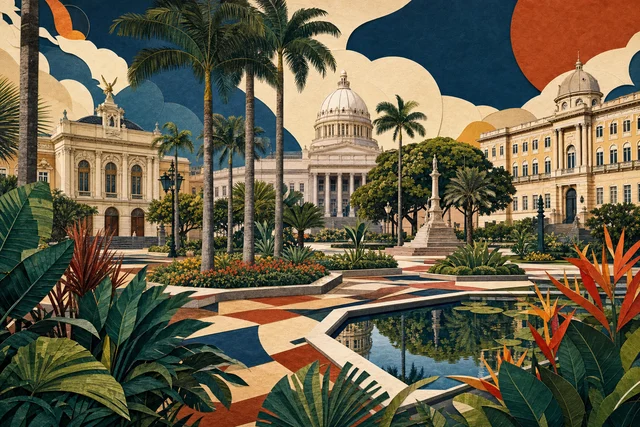
Historic garden associated with Burle Marx, surrounded by the Santa Isabel Theatre, Palace of Justice and Palácio do Campo das Princesas.
1 sources and traceabilityVerified 2026-07-28
01

The square of power and its garden

Praça da República is Recife's principal ceremonial square and at the same time one of the greenest patches of the centre. Around it stands the ensemble of power: government buildings, courts and the Teatro de Santa Isabel, raised in the mid-nineteenth century as part of the same design.

The meaning of the square comes from two functions at once. On one side it is a stage for state representation, with façades meant to be seen from a distance and an arrangement that reinforces hierarchy. On the other it is an ordinary urban garden, with large trees, paths and benches used for rest and shade.

Monuments and statues around it tell part of the local history, while events and fairs held nearby add the everyday layer.

Come not as to an isolated sight but as to the place from which the logic of the centre becomes clear.

02

How the ensemble came together

The key date is 1850, when the Teatro de Santa Isabel opened, conceived by the leadership of the province. The theatre was designed as part of the ceremonial ensemble, and its façade was calculated to be seen from this square.

Administrative and judicial functions settled around it, and the square became the place where power showed itself to the city. That layout is typical of nineteenth-century Brazilian provincial capitals looking to European models.

The twentieth century added the green layer, with trees, lawns and paths that turned a space of representation into a public garden in daily use.

Today the square works in three registers at once, as monument, active administrative area and place of rest.

03

What is here

The core is the garden itself, with large trees, tended lawns and well-placed benches. It is the scale of the canopy and the shade that make the square usable through the day in a tropical climate.

Around the perimeter stands historic architecture: the Teatro de Santa Isabel, government and justice buildings whose façades form an almost closed ring. Differences of style and height show that the ensemble did not appear at once.

Another layer is the monuments and statues referring to episodes of local history, best read as a statement about whom the city chose to remember in stone.

Cultural events and fairs take place nearby, so on some days the square becomes the backdrop to a programme rather than a quiet garden.

Note that almost every building around it is closed to free entry: these are working institutions, and the square is the only part of the ensemble open to anyone at any hour.

04

How to look closely

Start with the trees, because their age and size explain why the square stays comfortable in the heat and show that the green structure is as historic as the buildings.

Then walk the perimeter and study the façades from different points, since theatre, administrative blocks and courts were designed for reading at a distance.

Read the inscriptions on the monuments: to whom they were raised, when and in whose name. In central Recife that almost always leads back to the nineteenth century and the elite's version of history.

And watch the crowd, because officials, people attending court, students and those simply resting use the same square at different hours.

05

Santo Antônio around it

The square lies in Santo Antônio, the administrative and business core of the centre, a short walk from the bridges over the Capibaribe and from the commercial streets.

In one direction the way to old Recife begins across the Maurício de Nassau bridge; in the other lie dense commerce and São José with its market and Pátio de São Pedro. That position makes the square a natural crossroads for any walk through the centre.

By day the district works and is crowded; in the evening the administrative part empties faster than the commercial one, and the square grows notably quieter.

For a visitor it is a good starting point, with routes in every direction and no need for transport.

06

Whom the stone remembers

Nineteenth-century ceremonial ensembles were built in a society of restricted rights, with a provincial economy resting on sugar and enslaved labour. A square designed as a showcase of order was a showcase of that order.

Monuments and statues record the elite's choice of which names deserve bronze and which stay outside the account, a discussion increasingly present in Brazilian cities.

There is also a present-day question: central squares in Brazil concentrate tensions between administration, commerce, policing and homeless people, and how a city handles that shows up on the benches themselves.

Seeing the square with both lines in view, the solemn and the everyday, is the more honest approach.

07

Planning the visit

The square needs no dedicated visit, because it fits into the route between Santo Antônio and old Recife. Allow twenty to thirty minutes for the perimeter with stops at the monuments.

The best moments are early morning and late afternoon, when the heat eases and the shade works better. At midday it serves well as a pause between museums.

If the theatre interests you, plan around its schedule, with guided visits on Sundays and performances in the evening.

Official sources list limited hours for the square, which sounds unusual for open ground, so in the evening it is worth checking on the spot.

08

Getting there and access

The reference is Praça da República in Santo Antônio. From Marco Zero it is about twenty minutes on foot across the bridges, bus routes pass nearby, and by car you should expect paid car parks, since spaces beside the square are few.

The space is level, with wide paths, which usually suits wheelchairs and families with children. Restrictions come less from the square than from the entrances of the surrounding buildings, each with its own rules.

There is enough shade, but bring water, because the centre is hot and humid almost all year.

In the evening the district is calmer than the commercial streets, but it empties once offices close.

09

Where to go next

The obvious step is the Teatro de Santa Isabel on the square itself: even without a performance the façade is worth seeing and the visiting times worth checking.

From there you can go down to the Maurício de Nassau bridge and cross into old Recife, where the port route begins with Marco Zero, Paço do Frevo and the synagogue.

In the opposite direction lies São José with Pátio de São Pedro, four museums and the market, along with Teatro do Parque and Cinema São Luiz in Boa Vista.

For a single day the chain works well: square, theatre, bridge, old town and a return here in the late afternoon.

10

Verified facts

Every fact below is linked to this profile’s source codes.

Location
Santo Antônio · Recife
REC_MEMORY
Listed address
Praça da República
REC_MEMORY
Documented focus
Historic garden associated with Burle Marx, surrounded by the Santa Isabel Theatre, Palace of Justice and Palácio do Campo das Princesas.
REC_MEMORY
Evidence basis
Identity, location and cultural relevance are supported by primary evidence.
REC_MEMORY

Original Meu Recife editorial copy based only on this profile's source codes. It does not reproduce third-party text in full or turn a community-guide opinion into fact.

11

Before visiting

The square works as the crossroads of a walk through the centre: twenty minutes on foot to Marco Zero and ten to Pátio de São Pedro. The best times are early morning and late afternoon, since at midday only the shade of the trees helps. Official sources list limited hours, so in the evening check on the spot.

Reference address
Praça da República, Santo Antônio, Recife — PE
Urban heritage
30–90 min
What can change
Hours, tickets, accessibility and temporary closures can change. Confirm with the official source before visiting.
12

Getting there

Coordinates cross-checked against multiple mapping sources

Reference address
Praça da República
District and city
Santo Antônio · Recife, PE
Verified coordinates
-8.060781, -34.878493
The interactive map will load as you scroll
Location map for Republic Square
Coordinates cross-checked against multiple mapping sources · map © OpenStreetMap