Skip to content
MEU RECIFERECIFE · PERNAMBUCO
The city portal for Recife and PernambucoNEWS · EVENTS · SERVICES
Cultural atlas

Urban heritage · Olinda / Alto da Sé

Alto da Sé Water Tower and Panoramic Lift
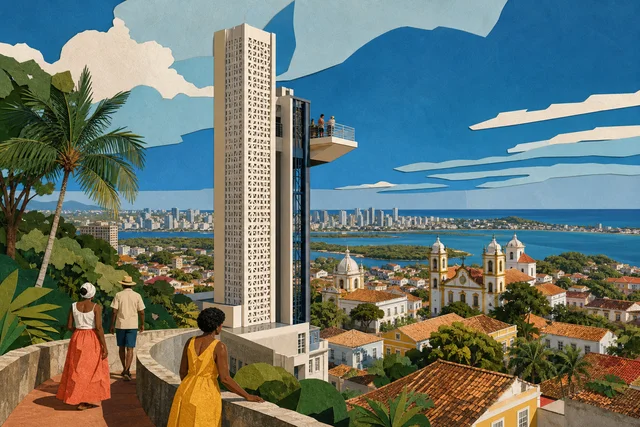
Modernist landmark from 1934 associated with the pioneering use of cobogó, later adapted as a panoramic viewpoint.
1 sources and traceabilityVerified 2026-07-28
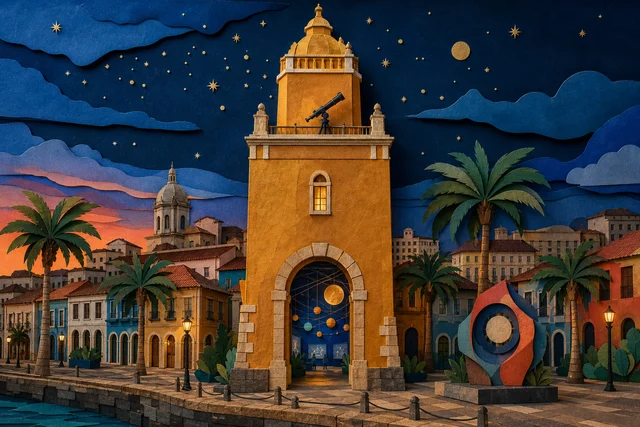
Alto da Sé Water Tower and Panoramic Lift — Original Meu Recife editorial illustration — not a documentary photograph.
Original Meu Recife editorial illustration — not a documentary photograph. · Meu Recife
01

A modernist water tower turned viewpoint

The Caixa d'Água at the Alto da Sé is a 1934 water reservoir designed by the architect Luis Nunes and recognised as a landmark of modern Brazilian architecture. In a town of baroque and colonial houses it is the only modernist marker of that scale.

The building, about twenty metres high, later received a panoramic lift, and a technical structure became a viewpoint with a 360-degree view over the two sister cities, Olinda and Recife.

That change of function is typical of twentieth-century infrastructure: what was built to supply water now works as an attraction and an urban symbol.

Visits to the viewpoint have passed to private management, so hours and prices depend on the operator.

Come for two things at once: 1930s architecture and the best view of the coast.

A practical conclusion: plan this stop deliberately, because its value emerges through the context of the town rather than through a single striking object.

02

1934 and the turn to a viewpoint

The tower was built in 1934 to a design by Luis Nunes, an architect linked to early Brazilian modernism and to rationalist solutions in public works in Pernambuco.

It began as a purely utilitarian structure: a reservoir supplying the upper part of Olinda, where the change in level makes water distribution a technical problem.

Later a panoramic lift was installed and the tower gained a second life as a viewpoint with a circular outlook.

Visiting is now run by a private operator, which changed hours and the way access works.

Keep two dates in mind: 1934 as an architectural landmark and the present as the moment infrastructure became an attraction. Note that dates of construction, consecration and completion of finishes often diverge in Brazil, so official sources may give different years for the same building.

03

Structure and view

The essential thing is the structure itself: a vertical volume about twenty metres high, designed with modernist logic, clean geometry and no historical ornament.

The panoramic lift is a later addition and shapes the experience, because the ascent becomes part of the attraction.

From the top opens a circular view: the historic centre of Olinda with its churches, the coastline and the skyline of Recife on the horizon.

It is the combination of height and hilltop siting that produces this view, unavailable at street level.

There is no display inside: the content of the visit is the architecture and the panorama.

Keep in mind that the tropical climate defines everything, since humidity, salt and heavy rain dictate what survives and how often restoration is needed.

04

How to look closely

Read the building from below as an architectural object: proportions, surface treatment and the absence of decoration reveal the modernist programme of the 1930s.

From the top, try to read the town: find the Sé, the monasteries, the coastline, and see where Olinda ends and Recife begins.

Notice the density of the historic centre, because from above the organisation of the ensemble becomes clear in a way the streets never show.

Compare the view by day and at sunset if you can, since light changes the legibility of the panorama entirely.

And keep the original function in mind: this is an engineering work, not a viewpoint built for the view.

Notice what restoration chose to show and what it left hidden, because every display in a historic building is a decision.

05

The Alto da Sé

The tower stands at the Alto da Sé beside the cathedral, the sacred art museum and the town's main square, where people gather for sunset.

This is the most visited point in Olinda, with trade, musicians and guided groups at all hours.

The descents to the churches of the historic centre and to the lower town start here.

Allow for the terrain, because the climb is steep and in the heat it is better done by car.

In the evening the square fills, which is worth factoring into a visit to the viewpoint. It is worth walking the block on a weekday and at the weekend, because Olinda has two rhythms and tourist flow changes how the streets feel.

06

Infrastructure, tourism and private management

Turning a technical work into a tourist attraction is a common plot in historic centres, and it always raises the balance between access and commerce.

Private management of visits means hours, prices and rules depend on the operator rather than the city, which changes how available the viewpoint is to residents themselves.

It is worth remembering that modernist heritage in Brazil is less protected than colonial: buildings from the 1930s appear less often on listing registers and are altered more freely.

Finally, the view also shows problems: built density, the state of the roofs, and the boundary between restored and unrestored parts of town.

A viewpoint here is not only entertainment but an instrument of observation.

07

Planning the visit

Confirm hours and prices in advance, because visits to the viewpoint are privately managed and conditions can change.

Allow twenty to thirty minutes: ascent, view and descent need no more if there is no queue.

The best moment is late afternoon for the light, but expect a queue and a crowded square.

Morning offers clearer air and fewer people, and the panorama reads well in side light.

Combine the stop with the cathedral, the sacred art museum and the seminary, all a few steps away.

Build a day of three or four stops with pauses, because trying to see more in Olinda usually ends in fatigue.

08

Getting there and access

The tower sits at the Alto da Sé in the upper historic centre of Olinda, about seven kilometres from central Recife. The sensible approach is to ride up and walk down.

Access to the viewpoint is by panoramic lift, which in principle helps, but specific conditions for visitors with reduced mobility should be confirmed with the operator.

The square around is paved in uneven stone and slippery after rain.

Parking at the top is limited, especially at sunset and at weekends.

Consider the heat, because there is almost no shade up here. Plan your return in advance, because transport is harder to find in the historic part after dark.

09

Where to go next

Next to it stand the Sé cathedral, the Museum of Sacred Art of Pernambuco and the Seminary of Nossa Senhora da Graça, all a short walk away.

Descending brings you to the churches of the historic centre, the Mercado da Ribeira and further on the São Bento monastery.

In the lower town the Mercado Eufrásio Barbosa with the Mamulengo Museum is worth entering.

If you want to visit Recife, visible from here on the horizon, keep a separate day for the old town.

And the viewpoint itself repays two visits: by day and at sunset.

Remember that upper and lower town work differently, with churches and views above and markets and daily life below.

10

Verified facts

Every fact below is linked to this profile’s source codes.

Location
Alto da Sé · Olinda
OLINDA_MON
Listed address
Rua Bispo Coutinho, s/n
OLINDA_MON
Documented focus
Modernist landmark from 1934 associated with the pioneering use of cobogó, later adapted as a panoramic viewpoint.
OLINDA_MON
Evidence basis
Identity, location and cultural relevance are supported by primary evidence.
OLINDA_MON

Original Meu Recife editorial copy based only on this profile's source codes. It does not reproduce third-party text in full or turn a community-guide opinion into fact.

11

Before visiting

Visits to the viewpoint are privately managed, so confirm hours and prices in advance, since they can change. Allow twenty to thirty minutes if there is no queue; at sunset there are far more people, while the morning brings clearer air. There is almost no shade at the top, so bring water and sun protection.

Reference address
Rua Bispo Coutinho, s/n, Alto da Sé, Olinda — PE
Urban heritage
30–90 min
What can change
Hours, tickets, accessibility and temporary closures can change. Confirm with the official source before visiting.
12

Getting there

Coordinates cross-checked against multiple mapping sources

Reference address
Rua Bispo Coutinho, s/n
District and city
Alto da Sé · Olinda, PE
Verified coordinates
-8.013485, -34.849989
The interactive map will load as you scroll
Location map for Alto da Sé Water Tower and Panoramic Lift
Coordinates cross-checked against multiple mapping sources · map © OpenStreetMap