Religious heritage · Olinda / Alto da Sé
Olinda Seminary and Our Lady of Grace Church
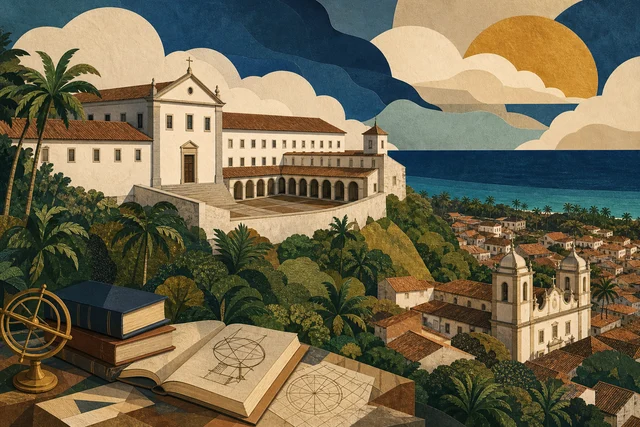

The Jesuit college and the Graça church
The Seminary of Olinda and the Church of Nossa Senhora da Graça form one of the most important testimonies of sixteenth-century Jesuit architecture in Brazil. The colony's educational system began here, not only its religious life.
The church was built in rammed earth by the donatary Duarte Coelho in 1551, and the temple and surrounding land were given to the Jesuits to begin the catechism of Indigenous people and to build the College of Olinda.
Between 1584 and 1592 Father Luiz Grã undertook new works: a single nave, a rectangular front body and a two-slope roof, based on the plan of the Church of São Roque in Lisbon.
The result was a building that combines mission, teaching and architectural import from the metropolis.
Come to understand that a colonial town was built with schools as well, and that the Jesuit college was the first of them.
A practical detail: interior access depends on the complex's present use, and the visit often comes down to the exterior and the church, which does not undermine the point of the stop. There is also the view from the top, which rewards the climb even when the interior is closed.
1551, 1584-1592 and after
The count begins in 1551, when the donatary Duarte Coelho raised a rammed-earth church on the hill later named after the seminary.
Giving the temple and its lands to the Jesuits meant launching the catechism of Indigenous people and building the college, an institution that formed the colony's elite for two centuries.
Between 1584 and 1592 Father Luiz Grã rebuilt the temple on the Lisbon model, a phase considered decisive for the history of Jesuit architecture in Brazil.
The building then passed through the town's disasters and rebuildings and, in recent times, became the subject of restoration programmes.
Keep the sequence: 1551 for foundation, the late sixteenth century for architectural maturity, the present for conservation.
Architecture on a Lisbon model
The central feature is a single nave with a rectangular front body and a two-slope roof, based on the plan of the Church of São Roque in Lisbon. This is direct architectural import adapted to local materials.
The scheme was rational: it allowed rapid building, held many people and avoided complex vaulting, decisive in a colony with limited resources.
Beside the church stands the complex of the former college, later the seminary, whose blocks set the scale of the whole ensemble on the hilltop.
Watch the relation between simple geometry and detail, because that contrast reveals the logic of Jesuit building.
There is no museum display: the value lies in the architecture and the historical function.
It helps to know that the single-nave plan became a model for dozens of churches in Brazil, because the Jesuits effectively exported a type design adapted to local materials.
How to look closely
Start with the plan, because a single nave reads at once and its simplicity is a decision reproducing the Lisbon model rather than poverty.
Look at the roof and how the covering is solved, since a two-slope scheme without complex structure explains why such churches went up quickly and survive today.
Note the hilltop siting, from which the surroundings could be seen and controlled, a relevant point for an institution of mission and teaching.
Compare this temple with Olinda's later baroque churches, because the difference between the sixteenth and eighteenth centuries is obvious.
And remember that this is first of all a house of learning.
Alto da Sé and the seminary hill
The complex sits in the upper historic centre beside the Alto da Sé, one of the most visited areas of Olinda.
Proximity to the cathedral and the viewpoint makes it easy to include in a route, but it also means constant people, trade and guided groups around it.
From the seminary it is easy to descend to the other churches of the centre or to climb to the panorama.
Allow for the terrain, because the slope is steep, the paving old, and heat makes the effort heavier.
In the evening the upper town comes alive for the sunset, the best moment for a walk. This stretch of the Alto da Sé is less crowded than the square in front of the cathedral, and in the morning you can study the architecture without the crowd.
Catechism and the power of knowledge
The Jesuit college was created to catechise Indigenous people, which made it an instrument of cultural assimilation rather than a neutral school. That is worth remembering before this sober and handsome architecture.
At the same time it was the centre of colonial education and formed the elite, deciding who would reach knowledge and power. That double face marks the Jesuit presence in the Americas.
Remember too the fate of the order: in the eighteenth century the Jesuits were expelled from Portuguese domains and their institutions passed to other control.
Finally, the building exists in a town whose wealth came from sugar and enslaved labour, and the school belonged to that system.
An honest view keeps both faces, the educational and the colonial.
Planning the visit
Confirm access in advance, because the complex belongs to a religious institution, part of the premises is closed and the church's hours change.
Allow twenty to thirty minutes for the temple and its surroundings when open, and combine the stop with the Sé cathedral next door.
The best moment is morning, before the heat and the flow of tours, or late afternoon for the light.
Dress for entering a working church and confirm the rules on photography.
Bring water, since shade is scarce at the top and the descent still takes energy. Combine the stop with the Sé and the Misericórdia, since the three points share the same hilltop and add up to about two hours.
Getting there and access
The complex lies at the Alto da Sé in the upper historic centre of Olinda, about seven kilometres from central Recife. The sensible approach is to ride up and walk down.
The slope is steep, the paving old and uneven and the entrances have steps, so accessibility is limited and should be confirmed with the institution.
Parking at the top is limited, especially at weekends and around sunset.
After rain the stone is slippery, so wear firm shoes.
In hot hours the climb is heavy; prefer the morning.
Where to go next
The nearest stops are the Sé cathedral and the Misericórdia church, both a few steps away.
Descending brings you to the other churches of the centre and to the São Bento monastery with its gilded carving.
If the orders interest you, add the São Francisco convent with its tile cycle and the Carmo church, the oldest Carmelite church in the Americas.
Below, see ordinary Olinda with its market and residential streets.
And for contrast, give another day to old Recife.
Verified facts
Every fact below is linked to this profile’s source codes.
- Location
- Alto da Sé · Olinda OLINDA_CHURCH · UNESCO_OLINDA
- Listed address
- Rua Bispo Coutinho, s/n OLINDA_CHURCH · UNESCO_OLINDA
- Documented focus
- Set in the former Jesuit College, an essential reference of 16th century religious architecture in Brazil. OLINDA_CHURCH · UNESCO_OLINDA
- Evidence basis
- Identity, location and cultural relevance are supported by primary evidence. OLINDA_CHURCH · UNESCO_OLINDA
Original Meu Recife editorial copy based only on this profile's source codes. It does not reproduce third-party text in full or turn a community-guide opinion into fact.
Before visiting
The complex belongs to a religious institution: part of the premises is closed and the church's hours change, so confirm in advance. It stands beside the Sé cathedral, and the two are best seen together. The climb is steep with little shade, so ride up and walk down.
- Reference address
- Rua Bispo Coutinho, s/n, Alto da Sé, Olinda — PE
- Religious heritage
- 30–60 min
- What can change
- Hours, tickets, accessibility and temporary closures can change. Confirm with the official source before visiting.
Getting there
Coordinates cross-checked against multiple mapping sources
- Reference address
- Rua Bispo Coutinho, s/n
- District and city
- Alto da Sé · Olinda, PE
- Verified coordinates
-8.012653, -34.847951