Skip to content
MEU RECIFERECIFE · PERNAMBUCO
The city portal for Recife and PernambucoNEWS · EVENTS · SERVICES
Cultural atlas

Religious heritage · Olinda / Alto da Sé

Church of Mercy
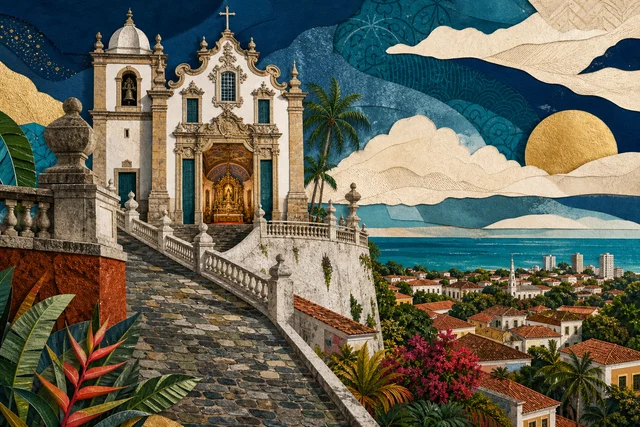
Church of 16th century origins rebuilt in Baroque style, with carvings, paintings and churchyard elevated over the city.
2 sources and traceabilityVerified 2026-07-28
01

The church of the Misericórdia hospital

Olinda's Misericórdia church is the Church of Nossa Senhora da Luz, attached to the old Hospital of the Santa Casa de Misericórdia and built in 1540 by order of the Portuguese Crown. This is not an ordinary parish but part of a medical and social institution typical of the Portuguese empire.

The Santa Casa is the oldest form of organised charity in the Portuguese world: it ran hospitals, asylums and funeral services, and the church was the centre of that house rather than a separate building.

The second reason to come is the siting. The temple stands in the upper town beside the Alto da Sé, and its raised forecourt opens one of the best views over the coast.

The third is the interior: after rebuilding, the church took on baroque features with echoes of the Portuguese Renaissance, and a band of tiles ran along the skirting of the nave and chancel.

Come for the combination of social history, view and sacred art in one place.

02

1540, 1630, 1631, 1654

The church was built in 1540 by order of the Portuguese Crown beside the Hospital of the Santa Casa de Misericórdia, one of the earliest dates in Olinda's building history.

In 1630 the establishment was plundered by the Dutch and burned the following year. For the town this was not an isolated episode: the destruction of those years shaped the whole historic centre.

After the Dutch left in 1654 the church was rebuilt with baroque features and reminiscences of the Portuguese Renaissance, a combination characteristic of rebuilt churches in Pernambuco.

From then on begins the long maintenance history typical of the upper town: humidity, salt and heat demand constant care, and any pause in funding shows in the fabric.

The four dates form a compact scheme: foundation, plunder, fire, rebuilding.

03

Baroque and tiles

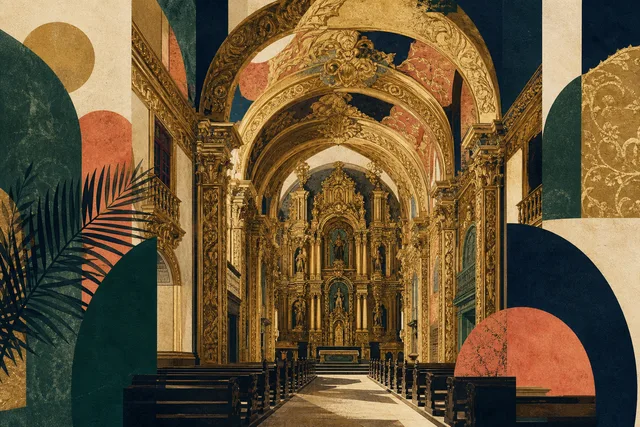
The present appearance belongs to the post-Dutch rebuilding: a baroque composition in façade and interior, but with more restrained modelling than the late eighteenth-century churches.

The distinctive detail is the band of tiles that ran along the skirting of the nave and chancel, with subjects drawn from biblical motifs. In the Portuguese tradition such friezes worked as narrative at eye level.

The raised forecourt is part of the ensemble: it served for processions and at the same time as a viewpoint over the town.

Inside, study the chancel and the relation between baroque ornament and the relatively plain walls of a rebuilt structure.

As in most Olinda churches there is no museum display: the meaning lies in the building and its function.

04

How to look closely

Start on the forecourt, because the view explains why the upper town was settled first and gives the scale of Olinda as a whole.

Inside, look for the tile band along the skirting, which runs at eye level and asks for a slow circuit rather than a glance from the door.

Compare the proportions of this church with the town's later baroque ones: rebuilt in the seventeenth century, the Misericórdia is more restrained, and in that you see the difference of eras and budgets.

Notice the relationship with the former hospital, because the plan of the complex shows the church belonged to a social institution.

And read the state of the surfaces, since climate loading is heaviest in the upper town and the marks of fighting damp are especially clear.

05

Alto da Sé around it

The church stands at the Alto da Sé beside the cathedral and Olinda's main viewpoint, that is, in the most visited part of the historic centre.

Around it are food stalls, crafts, musicians, guided groups and residents. It is a busy place, especially at weekends and late afternoon, when everyone climbs for the sunset.

The descents to other churches and to the lower town start here, so the Misericórdia usually enters a route on the way down.

Allow for the terrain: the climb is steep, and it is better to ride up and walk down.

There is little shade at the top, and at midday the forecourt becomes a hot surface.

06

Mercy in a colonial society

The Santa Casa was a charitable institution, but it operated inside the colonial order: assistance was distributed along lines of class and colour, and access was not equal.

Hospital and church were sustained by donations from an elite whose wealth came from a sugar economy based on enslaved labour. That does not cancel the real help such houses gave, but it sets the frame.

The plunder and fire of the early 1630s recall that even hospital institutions were not shielded from war between European powers.

There is also a present-day layer: maintaining a historic temple on a hilltop is expensive, and tourist flow brings attention and pressure at once.

An honest view holds all those lines together.

07

Planning the visit

The church is active, access happens outside services and the hours change, so confirm on the day. Allow twenty to thirty minutes for the church and as much again for the forecourt and the view.

It fits naturally into an upper-town route: the Sé, the Misericórdia, then the descent to the other churches and the São Bento monastery.

The best moments are early morning, without crowds or heat, and late afternoon for the light, with the caveat that the viewpoint will be busy.

Dress for entering a working church and confirm whether photography is allowed.

Bring water, because there is little shade and the descent still takes energy.

08

Getting there and access

The church sits at the Alto da Sé in the upper historic centre of Olinda, about seven kilometres from central Recife. The sensible approach is to ride up by taxi and walk down.

Terrain is the main limitation: steep streets, old uneven paving and steps at the entrance. For visitors with reduced mobility the route is hard, and conditions should be confirmed beforehand.

Parking at the top is limited, especially at weekends and around sunset.

After rain the stone is slippery, so wear firm shoes.

Consider the heat, because climbing at midday is demanding even for the fit.

09

Where to go next

Next door stands the Sé cathedral with its panorama, the natural start of a day in the upper town.

Going down you reach the other churches of the historic centre and then the São Bento monastery with its gilded carving.

To complete the picture, add the Seminary of Nossa Senhora da Graça, the former Jesuit college, which explains another line of religious presence in Olinda.

Below, the ordinary life of the town is worth seeing, with its market, streets and studios.

And if the day is long, close it in old Recife, for the contrast between colonial hill and port island.

10

Verified facts

Every fact below is linked to this profile’s source codes.

Location
Alto da Sé · Olinda
OLINDA_CHURCH · UNESCO_OLINDA
Listed address
Rua Bispo Coutinho, s/n
OLINDA_CHURCH · UNESCO_OLINDA
Documented focus
Church of 16th century origins rebuilt in Baroque style, with carvings, paintings and churchyard elevated over the city.
OLINDA_CHURCH · UNESCO_OLINDA
Evidence basis
Identity, location and cultural relevance are supported by primary evidence.
OLINDA_CHURCH · UNESCO_OLINDA

Original Meu Recife editorial copy based only on this profile's source codes. It does not reproduce third-party text in full or turn a community-guide opinion into fact.

11

Before visiting

The church is active: visits happen outside services and hours change, so confirm on the day. It stands in the upper town beside the cathedral and pairs naturally with the Alto da Sé and its viewpoint. The climb is steep with little shade, so ride up and walk down.

Reference address
Rua Bispo Coutinho, s/n, Alto da Sé, Olinda — PE
Religious heritage
30–60 min
What can change
Hours, tickets, accessibility and temporary closures can change. Confirm with the official source before visiting.
12

Getting there

Coordinates cross-checked against multiple mapping sources

Reference address
Rua Bispo Coutinho, s/n
District and city
Alto da Sé · Olinda, PE
Verified coordinates
-8.013017, -34.852246
The interactive map will load as you scroll
Location map for Church of Mercy
Coordinates cross-checked against multiple mapping sources · map © OpenStreetMap