Skip to content
MEU RECIFERECIFE · PERNAMBUCO
The city portal for Recife and PernambucoNEWS · EVENTS · SERVICES
Cultural atlas

Urban heritage · Olinda / Bonsucesso

Rosário Fountain
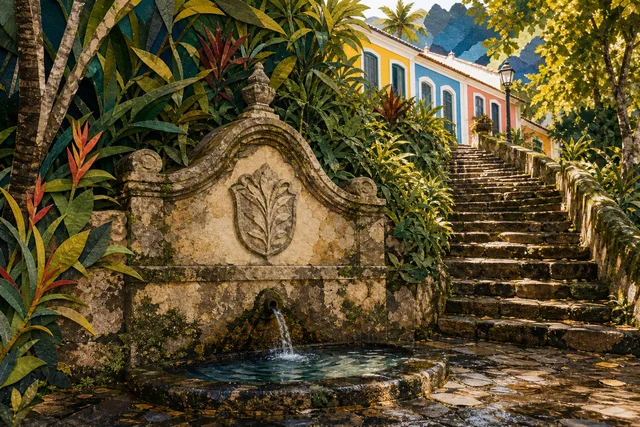
Colonial fountain mentioned in Olinda's charter, with a stone staircase and the city's historic coat of arms.
1 sources and traceabilityVerified 2026-07-28
Rosário Fountain — Original Meu Recife editorial illustration — not a documentary photograph.
Original Meu Recife editorial illustration — not a documentary photograph. · Meu Recife
01

A fountain named in the 1537 charter

The Bica do Rosário is cited in Olinda's foral of 1537, the town's founding charter, which places it among the earliest recorded pieces of urban infrastructure in Brazil.

The fountain is considered perhaps the only surviving trace of the Val de Fontes, a sixteenth-century stream that shaped the water supply of the early town.

The structure has an expressive frontispiece adorned with walls bearing stone jars, and at its base sits the town's ancient coat of arms, a detail that turns a utilitarian object into a municipal marker.

It stands on Rua dos Quatro Cantos in the Amparo district, that is, at the heart of the historic centre.

Come for the rare chance to see sixteenth-century urban infrastructure rather than only churches and convents.

A practical frame: the object is small and its meaning comes from how it sits in the town rather than from size. Olinda is a rare case where ordinary infrastructure and utilitarian buildings survived alongside the churches, and that completeness is what sustains the World Heritage title.

02

1537 and the Val de Fontes

The mention in the 1537 charter places the fountain among the earliest dates in Brazilian urban history, since that document gave Olinda its legal status.

The Val de Fontes was a sixteenth-century stream of which, by the available record, perhaps only this fountain remains. The disappearance of watercourses is the common fate of urban streams, piped or filled in.

The stone treatment with jars and the coat of arms at the base belong to a later tradition of upgrading fountains, common in Portuguese towns.

With centralised supply the fountain lost its daily function and remained as a monument.

Keep both lines in mind: the documentary one from 1537 and the material one represented by the present structure. Note that dates of construction, consecration and completion often diverge in Brazil, and official sources may give different years for the same property.

03

Frontispiece, jars and coat of arms

The structure works as a formalised water point: a frontispiece wall, decorative stone jars and the ground where residents filled their vessels.

The town's coat of arms at the base is a rare detail, because it shows the fountain was treated as public property of municipal interest rather than a private work.

The material and the cutting reflect the craft practice of the period and indicate careful work.

There is no display: what you study is the structure itself and its position in the terrain.

Remember that such objects were often recovered, and original from later elements can be told apart by joints and texture.

Remember the climate: humidity, salt and heavy rain degrade materials faster than in temperate zones, so the condition of anything here results from continuous care.

04

How to look closely

Find the coat of arms at the base, because it is not ornament but a mark of belonging to the town, rarely preserved on utilitarian structures.

Study the stone jars on the walls, a decorative motif referring directly to function, typical of the Portuguese tradition of fountains.

Notice the terrain around, since the fountain sits where water surfaced naturally, which explains the topography of the block.

Compare this fountain with the one at Quatro Cantos nearby: the same function in different treatments and periods.

And see whether water is running, because supply has been restored and interrupted at different times. Watch the limits of intervention: where restoration stopped, what was left as found and what was deliberately not rebuilt for lack of documentary evidence.

05

Amparo and Quatro Cantos

The fountain stands on Rua dos Quatro Cantos in Amparo, near the square of the same name and the brotherhood church.

This is a calm part of the historic centre, slightly off the main flow towards the Alto da Sé, with homes and studios.

From here it is easy to reach the Quatro Cantos junction, the Largo do Amparo or the climb to the cathedral.

By day it is quiet, and during Carnival the block joins the street routes.

There is almost no tourist infrastructure around, which makes the walk calmer.

Note that distances deceive because of the terrain, and a route works better organised by altitude than by metres.

06

Who carried the water

The fountain testifies to a daily life in which fetching water was heavy work, and in colonial Olinda that work fell above all to enslaved people and the poorest residents.

It is worth remembering that a handsome fountain does not cancel unequal access: in wealthy houses water arrived through someone else's labour rather than through infrastructure.

The disappearance of the Val de Fontes also shows the environmental cost of urban growth, with streams piped, filled and erased from memory.

Finally, preserving utilitarian structures always loses to preserving churches, and the survival of this fountain is an exception.

Looking at it while remembering the people who came here daily with vessels is the honest approach. Remember that World Heritage status brings attention and funding but also raises the cost of living for permanent residents.

07

Planning the visit

Allow fifteen minutes: the object is small and its value lies in context rather than size.

It fits naturally into a walk between the Largo do Amparo and the Quatro Cantos junction rather than a separate outing.

The best moment is morning, when the block is quiet and the stonework is clearly visible.

If urban infrastructure interests you, see both fountains in sequence and compare their treatment.

There is no infrastructure on site, so bring water and sun protection.

Build a day of three or four stops with pauses, because trying to see more ends in fatigue.

08

Getting there and access

The fountain stands on Rua dos Quatro Cantos in Amparo, in the historic centre of Olinda, about seven kilometres from central Recife.

The streets slope and the paving is old and uneven, which makes the route hard for wheelchairs.

The object stands on the street and can be seen at any time, with no schedule of its own.

There is little shade around, and in hot hours the walk tires you.

Parking on the block is limited, especially at weekends. Plan your return in advance, because transport is harder to find in the historic part after dark.

09

Where to go next

The nearest stop is the Quatro Cantos junction with its 1602 fountain: two neighbouring water points make a complete subject about water in a colonial town.

Beyond lie the Largo do Amparo with its brotherhood church and the Regional Museum of Olinda in the former episcopal residence.

Climbing leads to the Alto da Sé with the cathedral, the sacred art museum and the seminary.

Descending leads to the markets, the Mamulengo Museum and the lower town.

And if the water theme appeals, add the 1934 water tower, the same need solved four centuries later.

Olinda repays two short days more than one long one, because the town is small and dense.

10

Verified facts

Every fact below is linked to this profile’s source codes.

Location
Bonsucesso · Olinda
OLINDA_MON
Listed address
Largo do Rosário
OLINDA_MON
Documented focus
Colonial fountain mentioned in Olinda's charter, with a stone staircase and the city's historic coat of arms.
OLINDA_MON
Evidence basis
Identity, location and cultural relevance are supported by primary evidence.
OLINDA_MON

Original Meu Recife editorial copy based only on this profile's source codes. It does not reproduce third-party text in full or turn a community-guide opinion into fact.

11

Before visiting

The fountain stands on the street itself and can be seen at any hour, with no schedule of its own. Allow fifteen minutes and pair it with the fountain at the Quatro Cantos junction, because together they make a complete subject about water in a colonial town. The paving is sloping and uneven.

Reference address
Largo do Rosário, Bonsucesso, Olinda — PE
Urban heritage
30–90 min
What can change
Hours, tickets, accessibility and temporary closures can change. Confirm with the official source before visiting.
12

Getting there

Coordinates cross-checked against multiple mapping sources

Reference address
Largo do Rosário
District and city
Bonsucesso · Olinda, PE
Verified coordinates
-8.009982, -34.853238
The interactive map will load as you scroll
Location map for Rosário Fountain
Coordinates cross-checked against multiple mapping sources · map © OpenStreetMap