Skip to content
MEU RECIFERECIFE · PERNAMBUCO
The city portal for Recife and PernambucoNEWS · EVENTS · SERVICES
Cultural atlas

Museums & memory · Recife / São José

Museum of Popular Art
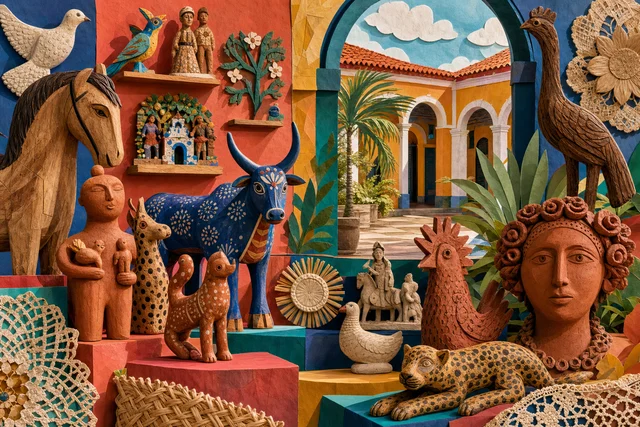
Collection dedicated to northeastern folk art, with works made of wood, clay, plaster and other artisanal traditions.
2 sources and traceabilityVerified 2026-07-28
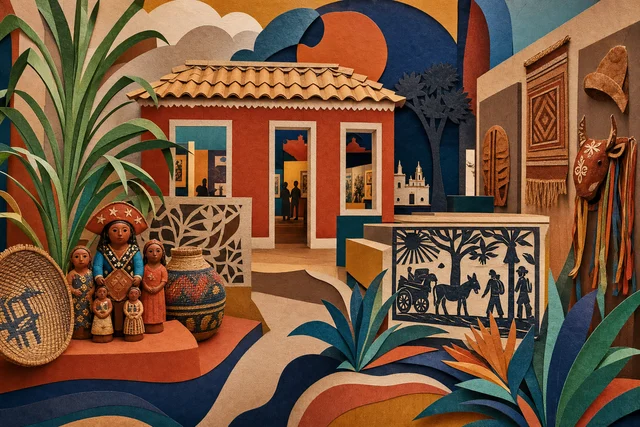
Museum of Popular Art — Original Meu Recife editorial illustration — not a documentary photograph.
Original Meu Recife editorial illustration — not a documentary photograph. · Meu Recife
01

Forty years of a popular art museum

Recife's Museum of Popular Art, known by the initials MAP, occupies house 49 on Pátio de São Pedro and marked forty years of activity in April 2026. That changes the reading: this is not a one-off project but an institution that spent four decades collecting and showing what the Brazilian hierarchy of the arts long treated as craft rather than art. The work here covers wood, plaster, clay and ceramics, and the central theme is continuity: how techniques, subjects and iconographies pass from master to apprentice and from one generation to the next. For the anniversary a long-running exhibition, Escolas do Barro, opened. Come for specific objects and names, because production appears here as an authored tradition rather than an anonymous mass.

02

From an anniversary to a long-running show

There are few dates and they are eloquent. The museum counts from 1986, and in April 2026, for its fortieth year, it opened the long-running exhibition Escolas do Barro, assembled from the permanent collection. In between came building work: in 2022 the venue entered Move Cultura, the municipal programme for restoring cultural facilities, and reopened after the works in September of that year. The sequence is typical of municipal museums: years of operation, accumulation of a collection, wear on the building, refurbishment and a rethought display. The museum is maintained by the city through its culture department and municipal culture foundation, with free entry, which matters for popular art, since it should remain accessible to the people whose culture it shows.

03

Escolas do Barro and one hundred and nine works

The anniversary exhibition brings together one hundred and nine works from the permanent collection and is organised around the idea of ceramic schools, examining what distinguishes the traditions of Caruaru, Goiana, Petrolina and Tracunhaém. The logic is simple and convincing: each centre developed its own iconography, with themes and processes shaped by economy, geography and social life, while the knowledge travelled orally from master to master. The artists include Mestre Vitalino, Ana das Carrancas, Manuel Eudócio, Elias Vitalino, Lidia Vieira, Togui, Zé do Carmo, Socorro Rodrigues, Marliete Rodrigues, Baé and other names of Pernambuco ceramics. The curator is J. Melo, a ceramist and researcher. The selection on show may change over time, but the principle of authorship and school remains. It helps to understand the logic of selection: one hundred and nine works are a slice of the collection rather than the whole of it, so a significant body of material stays outside the cases, shown in temporary projects or kept in storage.

04

How to look closely

Look in series rather than piece by piece. Popular ceramics reveal themselves in comparison: set two figures from different centres side by side and differences appear in proportion, in the treatment of the face, in firing and painting. Look for recurring subjects, such as work scenes, markets, processions, musicians and animals, and watch how different masters resolve the same motif. Pay attention to the labels with names, because insisting that these pieces have authors, not only tradition, is a deliberate curatorial position. And look for the marks of the hand: fingerprints, irregularities, joins. They are what separate a piece made by a master from the industrial copy you will meet on souvenir stalls. Compare sizes and purposes as well, because utilitarian vessels and figurative sculpture came out of the same workshops, and the passage between an object of use and an artwork is far gentler in this tradition than people assume.

05

House 49 and the square around it

The museum sits on Pátio de São Pedro, where neighbouring houses hold the Luiz Gonzaga and Chico Science memorials and Casa do Carnaval. That proximity lets you see popular culture in three dimensions: music, festival and material craft. A few minutes away is the São José market, the best possible continuation for the subject, because there the same ceramics are sold as merchandise beside herbs, leather and utensils, and the difference between display case and stall becomes obvious. The São José district has always been commercial and working class, and a museum of popular art sits well in it. Walk the square and the market in sequence to feel how an object changes status with its setting.

06

Who decides what counts as art

The history of such museums is inseparable from the question of hierarchy. For a long time the work of masters from the interior was classed as craft and folklore, while academic painting and sculpture counted as art, and the difference showed in prices, in rights and in whose names were remembered. Hence the importance of labels and authorship in the display, which is not a formality but a correction. The economics matter too: mass demand for Caruaru ceramics produced copies and middlemen, and the master does not always keep a fair share. There is also the question of selection, since every collection reflects the taste of the buyers and curators of its time, including the masters who were left out.

07

Planning the visit

The museum is compact and an hour usually suffices, but do not rush: the meaning lies in comparison, and comparing takes time at the cases. Start with one school, understand its procedures, and only then move to the next, because that is how the differences become visible. According to official information the museum opens Wednesday to Sunday during daytime hours with free entry, but hours and exhibitions change and should be checked beforehand; holidays bring exceptions. The best continuation is the São José market, where it is worth looking at prices and quality once you can tell a master's piece from a copy. With children it is easy, since the figures and scenes read without preparation.

08

Getting there and access

The address is Pátio de São Pedro, house 49, São José district. From Marco Zero it is fifteen to twenty minutes on foot and several bus routes serve the centre, while driving is inconvenient, with dense traffic, limited parking and closures on event days. The building is historic, the rooms are compact and the paving is uneven, so wheelchair access, circulation width and staff assistance should be confirmed with the museum for your date. Consider the heat, since the approach is open with little shade, and bring water. If you plan to combine the visit with the market, see the museum first and the stalls afterwards, because the trade reads far better that way.

09

Where to go next

Stay on the square: the Luiz Gonzaga Memorial at house 35 and the Chico Science Memorial at house 21 add a musical dimension to the craft, while Casa do Carnaval shows the organisational side of the festival for which masters make costumes and props. Then walk down to the São José market, an obligatory stop for this subject. If you want to see the same culture in a large contemporary display, go to Cais do Sertão. And at some point it is worth visiting the workshops outside the city, in Caruaru or Tracunhaém, because the museum explains the schools while a working studio explains them better.

10

Verified facts

Every fact below is linked to this profile’s source codes.

Location
São José · Recife
REC_TOUR_DATA · REC_CULT_DATA
Listed address
Pátio de São Pedro, Casa 49
REC_TOUR_DATA · REC_CULT_DATA
Documented focus
Collection dedicated to northeastern folk art, with works made of wood, clay, plaster and other artisanal traditions.
REC_TOUR_DATA · REC_CULT_DATA
Evidence basis
The place is listed by an official source; current visitor operation needs confirmation.
REC_TOUR_DATA · REC_CULT_DATA

Original Meu Recife editorial copy based only on this profile's source codes. It does not reproduce third-party text in full or turn a community-guide opinion into fact.

11

Before visiting

Check hours and the current exhibition before you set out, since official information indicates Wednesday to Sunday daytime opening with free entry, though holidays bring exceptions. The building is historic and compact, so arrange accessibility with the museum in advance. Leave time for the São José market next door, essential to this subject.

Reference address
Pátio de São Pedro, Casa 49, São José, Recife — PE
Museums & memory
1–2 hours
What can change
Hours, tickets, accessibility and temporary closures can change. Confirm with the official source before visiting.
12

Getting there

Coordinates published by an institutional source

Reference address
Pátio de São Pedro, Casa 49
District and city
São José · Recife, PE
Verified coordinates
-8.067310, -34.879007
The interactive map will load as you scroll
Location map for Museum of Popular Art
Coordinates published by an institutional source · map © OpenStreetMap