Museums & memory · Recife / Casa Forte
Museum of the People of Northeast Brazil

Why it matters
This federal museum of the Joaquim Nabuco Foundation explores the Northeast’s social plurality through work, faith, celebration, domestic life, and artistic creation rather than fine art alone. The most rewarding way into Museum of the Man of the Northeast is not as a checklist of celebrated objects but as a key to reading Recife. Material memory, curatorial choice, and urban landscape support and challenge one another here: an object becomes clearer when you ask who made it, who collected it, and why it was preserved. Spend the opening minutes sensing the scale and locating the principal narrative. That pause separates heritage from its present-day interpretation and prevents a rushed circuit. Rather than seeking one tidy definition of Pernambuco, notice the productive tensions between scholarly and popular culture, coast and interior, continuity and change.
A layered chronology
Founded in 1979, Muhne joined three earlier trajectories: the museums of Anthropology, Popular Art of Pernambuco, and Sugar, whose holdings developed from the 1950s through the 1970s. Read this chronology in layers. The first is the life of the building or objects before the museum; the second is their conversion into a cultural institution; the third consists of later revisions to display and interpretation. Dates provide anchors, yet changes of use reveal changes in power, taste, and the very idea of heritage. As you cross rooms and courtyards, identify traces of different phases without demanding artificial uniformity. A museum is not a frozen conclusion but ongoing work dependent on research, conservation, funding, and public debate. A recent label can therefore matter as much as an old artefact.
Architecture and collection
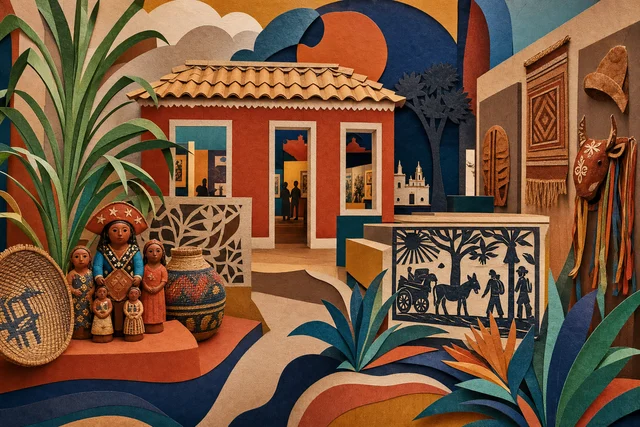
Its holdings bring together Indigenous and Afro-Brazilian objects, popular ceramics, ex-votos, toys, rural tools, tableware, and evidence of the sugar economy; Fundaj also records historic transport in the garden. Begin with the relationship between container and contents. Doors, wall thickness, light, circulation, gardens, and thresholds between inside and outside can speak as strongly as a showcase. Then choose two or three collection groups and compare material, scale, and provenance. Complete holdings are rarely displayed at once; storage and temporary exhibitions are normal parts of museum life, so this guide does not promise a particular object on view. Let the architecture act as a compass. It helps you recognise when a historical narrative becomes the experience of a studio, house, fortification, or gallery, and keeps a dense collection legible.
How to look closely
Compare social registers: elite tableware with a working tool, signed ceramics with anonymous making, and public festivity with private devotion. Select one work for slow looking, another for contextual reading, and a third to compare with the building. Search for wear, repairs, patina, surface technique, and provenance information; such evidence rescues an object from mere decoration. If mediation is available, ask what is newly under study and which absences the team considers important. Photograph only where permitted, and do not let the camera replace attention. After each group, state in one sentence how your image of Recife or the Northeast has changed. That personal synthesis is more valuable than dozens of pictures and makes relationships around a masterpiece visible.
The district inside the museum
Avenida Dezessete de Agosto crosses a part of Recife shaped by former estates, gardens, and the Capibaribe; the green campus extends the reading of Casa Forte. Museum of the Man of the Northeast belongs to Casa Forte, and the district is not a backdrop. On arrival, notice trees, street pattern, water, plot sizes, and shifts of scale between houses, institutions, and main roads. These signs show how Recife grew from port, river, estate, and residential nuclei, then changed through successive modernising projects. Look at the façade again after the visit; the internal story will probably have repositioned it in the landscape. The museum works best as a chapter in an urban walk rather than a sealed capsule, even when the sensible connection to the next stop is by car. Its city context continues beyond the gate.
A responsible reading
The historical name itself deserves scrutiny: “man” must not erase women or diverse identities, while “Northeast” cannot imply one culture without internal conflict. Ethical precision starts with language. Older classifications often compressed distinct peoples, beliefs, and experiences into convenient categories; collections formed by elites or the state also reflect unequal powers of acquisition and representation. When facing images of violence, enslavement, conquest, religion, or weaponry, avoid both comfortable aestheticisation and judgement stripped of context. Ask whose voice speaks in the label, who is absent, and whether provenance is made explicit. A mature visit can hold artistic admiration and historical criticism at the same time. This double attention does not diminish heritage: it restores the people, labour, and conflicts that gave it form.
A visit scenario
Begin with the merger of the three predecessor museums, choose one axis—sugar, religions, popular art, or everyday life—and end in the garden if it is open. For a first visit, use a three-part rhythm: brief orientation, a selective circuit, and a closing pause. Start with the institutional or architectural introduction, then choose an axis you genuinely care about instead of trying to exhaust everything. Keep the final minutes to revisit one object and check the education programme. Families can search for materials, shapes, or characters; researchers should ask in advance about documentary access. Hours, admission, exhibitions, and building works change, so verify every operational detail through the official channel on the day. Water, light clothing, and stable footwear suit Recife’s climate, especially when the route includes outdoor areas.
Arrival and accessibility
From Praça de Casa Forte, follow Avenida Dezessete de Agosto to number 2187; confirm the entrance, parking, and any required accessibility provision directly with Fundaj. Use this reference address in navigation: Av. Dezessete de Agosto, 2187, Casa Forte, Recife. A familiar name and a service entrance may point to different places. From the stated landmark, compare walking, public transport, and a ride-hailing car according to time, heat, and rain; a fixed journey time in Recife would be misleading. Treat accessibility as confirmed only when the institution verifies it for your date. Step-free entry, ramp or lift, adapted toilet, seating, wheelchair loan, tactile resources, audio description, and Brazilian Sign Language are separate provisions. A historic building may adapt only part of its circuit. If a feature is essential, contact the venue and ask for the correct drop-off point and current equipment status.
Continue the route
Continue, once opening is confirmed, through Casa Forte’s landscape or toward Apipucos; the Magdalena and Gilberto Freyre House-Museum offers a nearby counterpoint about authorship and intellectual elites. The best continuation is not an attraction sprint but a change of scale. Choose a nearby street, square, river edge, church, garden, or another museum and allow time for rest. Before leaving, check the next venue’s operation, the comfort of the walk, and the return after dark; closeness on a map does not guarantee an easy route. Compare the second place with the choices made by Museum of the Man of the Northeast: social history, art, faith, defence, and landscape each frame the same city differently. The transfer then stops being dead time and becomes part of a cultural reading of Recife. Coverage matters less than sustained attention to connections.
Verified facts
Every fact below is linked to this profile’s source codes.
- Location
- Casa Forte · Recife FUNDAJ_MUHNE · REC_TOUR_DATA
- Listed address
- Av. Dezessete de Agosto, 2187 FUNDAJ_MUHNE · REC_TOUR_DATA
- Documented focus
- Joaquim Nabuco Foundation Museum dedicated to the social formation, daily life, arts and cultures of the people of the Northeast. FUNDAJ_MUHNE · REC_TOUR_DATA
- Evidence basis
- Identity, location and cultural relevance are supported by primary evidence. FUNDAJ_MUHNE · REC_TOUR_DATA
Original Meu Recife editorial copy based only on this profile's source codes. It does not reproduce third-party text in full or turn a community-guide opinion into fact.
Before visiting
Check the official channel on the day for hours, admission, current exhibitions, temporary closure, photography rules, mediation, and accessibility provisions. If a feature is essential, request specific confirmation of the circuit and drop-off point; historical information does not guarantee present operation.
- Reference address
- Av. Dezessete de Agosto, 2187, Casa Forte, Recife — PE
- Museums & memory
- 1–2 hours
- What can change
- Hours, tickets, accessibility and temporary closures can change. Confirm with the official source before visiting.
Getting there
Coordinates published by an institutional source
- Reference address
- Av. Dezessete de Agosto, 2187
- District and city
- Casa Forte · Recife, PE
- Verified coordinates
-8.030196, -34.925281