Museums & memory · Recife / São José
Carnival House
A house where carnival is studied
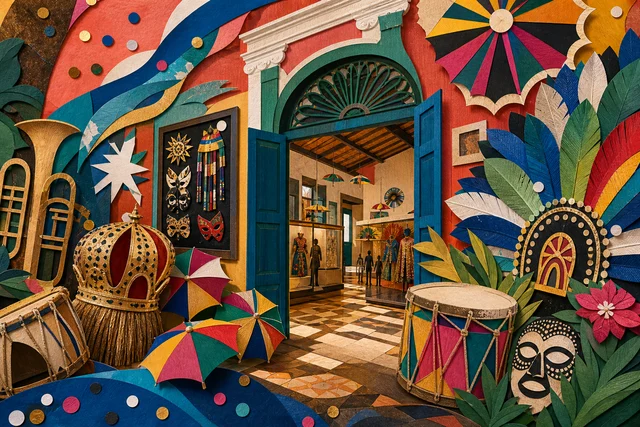
Casa do Carnaval is not a costume display or a souvenir stop: it is a research centre, and the full name says so, Centre for Training, Research and Cultural Memory. The distinction matters. Recife's carnival is the city's largest collective practice, with thousands of participants, dozens of groups and an entire economy, and a phenomenon of that size needs an archive, a method and teaching as much as a party. The work here covers all the festive cycles rather than February alone: carnival, the June festivals of São João, and Christmas. Come with a concrete question about maracatu, caboclinhos, troça or bloco and the house opens up. Anyone expecting spectacle will be disappointed, because the substance sits in folders and on shelves.
A festival that acquired a memory
The chronology of this place is really the chronology of an idea: that street culture deserves documentation. For a long time carnival knowledge circulated inside clubs and families, orally, while institutions concentrated on organising the event itself. Casa do Carnaval established a different function: to gather, keep, describe and make available for research. The centre operates under the coordination of the Recife city government in Pátio de São Pedro, a historic ensemble in the São José district where several other municipal cultural venues sit side by side. That proximity is not accidental, since the block has become a compact district of popular culture memory. Hold the distinction between the festival and its archive: one lasts weeks a year, the other works year round.
What is kept here
The core is the documentation centre on the second floor, holding more than a thousand printed items: books, periodicals, theses, dissertations and monographs, sheet music, minutes and statutes of carnival associations, letters, press clippings, photographs, cultural booklets, catalogues and leaflets. A considerable part has already been digitised for consultation. Notice the composition: statutes and minutes sit beside scores and posters, an accurate portrait of a carnival in which art is inseparable from organisation, dues, rehearsal and rules. The house also runs training and receives schools and universities through booked guided sessions. Do not expect a large permanent exhibition in the usual museum sense, because the place was built as a working tool for people who study the festival rather than a display for those who watch it.
How to look closely
Ask for documents, not only images. A club statute and the minutes of a meeting tell you what a photograph cannot: who paid dues, how a theme was chosen, how disputes were settled, how many people it takes to bring a group onto the street. Look at the sheet music, because frevos and marches were written for specific line-ups and show the difference between an urban musical tradition and improvisation. Look for press clippings from different decades, since the tone in which newspapers wrote about street groups moved from condescension to respect, and that shift is a subject in itself. And ask what has already been digitised, because availability is as much a result of work as preservation is. Ask to see material from one association across several consecutive years, because a run of posters, minutes and clippings about a single club shows the life of a group far better than a broad survey of the whole carnival.
Pátio de São Pedro around it
Pátio de São Pedro is an ensemble in the São José district, ringed by old houses and the church of São Pedro dos Clérigos. It is one of the densest cultural points in the centre: the neighbouring houses hold the Chico Science Memorial, the Luiz Gonzaga Memorial and the Museum of Popular Art, so a single stop shows how the city keeps several different musical and craft memories. By day the square lives the ordinary life of the centre, with trade and the São José market close by; on programme nights it becomes a stage. Walk the perimeter before going in, because the relationship between houses, square and church explains why processions formed here.
Whose festival, whose memory
Recife's carnival grew out of the practices of poor and largely Black neighbourhoods, and for a long time the authorities treated it as a matter of public order rather than heritage. Recognition came later and unevenly: some associations gained institutional support and a place in the official programme, others did not. Every archive therefore carries an uncomfortable question about whose documents ended up inside it, since a collection reflects who was considered worth preserving. The economic dimension matters too, because the festival rests on the work of people who often do not profit from it, while the revenue of the tourist season is distributed unequally. The archive does not resolve any of this, but it supplies material for discussing it precisely.
Planning the visit
Plan a research visit rather than a stroll: thirty minutes to an hour with a specific question yields far more than an aimless walk through. If you need access to documents or help from the staff, write or call ahead, and remember that schools and universities can book guided sessions. One awkward detail: official pages list different opening hours, so confirm by telephone before you set out. A weekday morning is a good moment, when the centre is calmer. And chain the visit to the neighbours on the square, because after the carnival archive the Chico Science and Luiz Gonzaga memorials read differently, their music visibly growing from the same urban fabric. Putting your question in writing beforehand helps the staff find the right material, whether you are after one club, a district, a year or a musical genre.
Getting there and access
The address is Pátio de São Pedro, house 38, São José district, CEP 50020-220. The centre is well served by public transport and lies fifteen to twenty minutes on foot from Marco Zero; by car it is harder, with limited parking, dense traffic and streets closed on event days. The building is historic and the documentation centre is on the second floor, reached by stairs, so accessibility should be confirmed with the institution for your date, naming the specific service you need. Wear stable shoes, since the paving of the square is uneven. In the evening the centre empties faster than the waterfront, and the way back is worth planning in advance.
Where to go next
The best move is to stay on the square. The Chico Science Memorial at house 21 shows what happened to urban music in the 1990s; the Luiz Gonzaga Memorial at house 35 explains how the sertão sounded on a national stage; the Museum of Popular Art at house 49 shifts the conversation from music to ceramics and craft. After the carnival archive all three read as parts of one system rather than separate attractions. For contrast, walk down to the São José market and watch the living trade that feeds and dresses the same festival. In the port, Paço do Frevo shows street culture at institutional scale.
Verified facts
Every fact below is linked to this profile’s source codes.
- Location
- São José · Recife REC_TOUR_DATA · REC_CULT_DATA
- Listed address
- Pátio de São Pedro, 38 REC_TOUR_DATA · REC_CULT_DATA
- Documented focus
- Municipal training, research and memory center dedicated to Carnival and popular culture manifestations. REC_TOUR_DATA · REC_CULT_DATA
- Evidence basis
- Identity, location and cultural relevance are supported by primary evidence. REC_TOUR_DATA · REC_CULT_DATA
Original Meu Recife editorial copy based only on this profile's source codes. It does not reproduce third-party text in full or turn a community-guide opinion into fact.
Before visiting
Official pages list different opening hours, so confirm by telephone before you set out. Access to documents and visits by schools and universities require booking in advance, which is worth arranging early. The documentation centre sits on the second floor of a historic house, reached by stairs.
- Reference address
- Pátio de São Pedro, 38, São José, Recife — PE
- Museums & memory
- 1–2 hours
- What can change
- Hours, tickets, accessibility and temporary closures can change. Confirm with the official source before visiting.
Getting there
Coordinates published by an institutional source
- Reference address
- Pátio de São Pedro, 38
- District and city
- São José · Recife, PE
- Verified coordinates
-8.066788, -34.879055