Skip to content
MEU RECIFERECIFE · PERNAMBUCO
The city portal for Recife and PernambucoNEWS · EVENTS · SERVICES
Cultural atlas

Religious heritage · Olinda / Monte

Our Lady of the Mount Church and Monastery

One of the oldest religious buildings in Olinda, with a sober appearance and today linked to the female Benedictine community.
1 sources and traceabilityVerified 2026-07-28
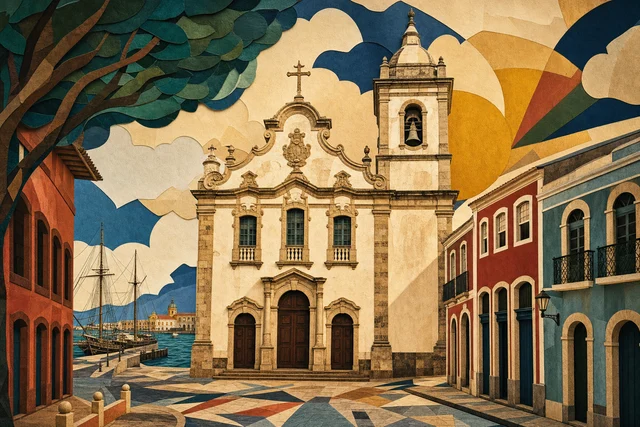
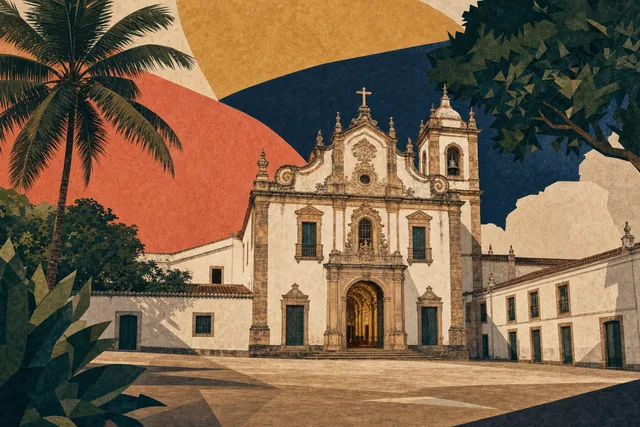
Our Lady of the Mount Church and Monastery — Original Meu Recife editorial illustration — not a documentary photograph.
Original Meu Recife editorial illustration — not a documentary photograph. · Meu Recife
01

The oldest religious building in Olinda

The Church and Monastery of Nossa Senhora do Monte is the oldest religious building in Olinda: the church was raised by order of the donatary Duarte Coelho in 1535, the year the town itself was founded.

In 1596 the temple came under the administration of Benedictine monks, and its history has been tied to that order ever since; today the complex is linked to the female Benedictine community.

The architecture is sober, without the baroque exuberance of neighbouring churches, and that is its value: this is an earlier type of building, closer to the utilitarian than the ceremonial.

The place lies away from the main circuit, up on the Monte, and therefore keeps a quiet rare in the historic centre.

Come for the oldest datum in the town and for the atmosphere of a working religious community.

A practical recommendation: do not expect a museum format, because the value lies in the building's age and in a community still living by its rule.

02

1535, 1596 and today's restoration

The church was built in 1535 by order of Duarte Coelho, which makes it contemporary with Olinda's foundation and the oldest religious building in town.

In 1596 Benedictine monks took over its administration, and the monastic function shaped its fate, separating it from the parish logic of neighbouring churches.

Like the whole town it passed through the destruction of the seventeenth century and the rebuilding that followed, and its present appearance results from many layers of work.

In recent times the complex entered restoration programmes led by Iphan together with the government of Pernambuco.

Reading the building, remember it is not a monument of one era but an almost five-century structure kept in continuous repair.

Note that 1535 places this structure at the very beginning of Brazilian colonial history, earlier than almost every surviving building in the country.

03

Sober architecture and monastic life

The defining trait is restraint: simple volumes, discreet ornament, no baroque overload. In Olinda that is rare and lets you see an earlier building tradition.

The complex gathers church and monastic quarters arranged by the logic of an enclosed community, with internal courtyards, galleries and service areas.

Study the proportions and the way the building sits on the slope, because here the terrain works as part of the architecture.

Another layer is the community's liturgical life, including chant, which draws visitors specifically.

There is no museum display, and that matters: this is an active monastery rather than an exhibition space.

It helps to grasp the difference between monastery and parish: a parish opens to the town, a monastery is enclosed and follows an internal routine, and the plan reflects that.

04

How to look closely

Notice the simplicity of the solutions: thick walls, small openings, little ornament, all signs of early colonial building adapted to climate and scarce resources.

Compare this temple with the baroque churches of the centre, because the difference shows how the colony's means and tastes changed over two centuries.

Look at the siting on the hill and the view it opens, since the site was chosen long before the town took its present shape.

If your visit coincides with sung liturgy, stay, because the acoustics of a simple volume behave quite differently.

And keep the silence: this is a monastery, not a tourist stop.

05

The Monte hill

The complex lies in the Monte district, away from the main flow towards the Alto da Sé, and is therefore calmer, with less trade around it.

Around it are residential streets of Olinda with everyday life rather than a tourist front, which gives the visit a different tone.

The way up is a climb and feels far heavier on foot than the churches of the centre, so many visitors arrive by taxi.

In exchange there are views and a quiet that lets you sense the town without the background noise of tours.

In a route this is a stop to plan on its own rather than squeeze between two temples.

06

The oldest building and the cost of keeping it

A structure of almost five centuries in the tropics survives only through constant intervention, because humidity, salt, insects and heavy rain degrade materials faster than in temperate zones.

The restoration programmes led by Iphan and the state government show that maintaining such a property exceeds the means of the community itself.

It is worth recalling the original context: the building arose by order of the donatary in the colony's first years, when a system based on seizing land and later on enslaved labour was being installed.

The monastic community lived by its own rules and did not coincide with colonial administration, but it existed inside the same economy.

Holding those lines together means seeing the building whole rather than only its age.

07

Planning the visit

This is an active monastery, so the visit follows the house's routine: access happens outside services, hours change and should be confirmed in advance.

Allow twenty to thirty minutes, because the complex is small and its value lies in age and atmosphere rather than in the number of rooms.

If you want to hear the chant, check the schedule of services beforehand, since many people come specifically for it.

Dress for entering a church and keep quiet, because this is not a tourist attraction.

Plan this stop separately rather than as a passage between other churches, because the climb takes time.

If you want to hear the chant, plan around the liturgical schedule and arrive early, because there are few places and the community does not host groups.

08

Getting there and access

The complex lies in the Monte district of Olinda, about seven kilometres from central Recife. A taxi is the most practical approach, since the way is uphill and off the usual walking routes.

The building is historic: the entrance has steps, internal passages are narrow and the paving around is uneven, so accessibility is limited and should be confirmed.

There is little shade on the way, and in hot hours the climb is heavy.

Parking nearby is limited, especially on service and festival days.

In the evening the district is quiet, so arrange your return transport in advance.

09

Where to go next

The closest neighbour in meaning is the São Bento monastery in the lower town: Olinda's two Benedictine addresses show different sides of one tradition.

From there you can climb to the Alto da Sé with its cathedral, the Misericórdia and the seminary, or descend to Carmo and the São Francisco convent.

If early colonial architecture interests you, add the Church of Nossa Senhora da Graça at the former Jesuit college.

Below, the ordinary streets of Olinda and the market are worth seeing.

And keep the panorama of the town for late afternoon, once the heat has eased.

10

Verified facts

Every fact below is linked to this profile’s source codes.

Location
Monte · Olinda
OLINDA_CHURCH
Listed address
Praça de Nossa Senhora do Monte, s/n
OLINDA_CHURCH
Documented focus
One of the oldest religious buildings in Olinda, with a sober appearance and today linked to the female Benedictine community.
OLINDA_CHURCH
Evidence basis
Identity, location and cultural relevance are supported by primary evidence.
OLINDA_CHURCH

Original Meu Recife editorial copy based only on this profile's source codes. It does not reproduce third-party text in full or turn a community-guide opinion into fact.

11

Before visiting

This is a working monastery: access happens outside services, hours change and should be confirmed, and anyone hoping to hear the chant should check the liturgical schedule. The complex sits away from tourist routes and the way is uphill, so a taxi is easiest. Silence is expected inside.

Reference address
Praça de Nossa Senhora do Monte, s/n, Monte, Olinda — PE
Religious heritage
30–60 min
What can change
Hours, tickets, accessibility and temporary closures can change. Confirm with the official source before visiting.
12

Getting there

Coordinates cross-checked against multiple mapping sources

Reference address
Praça de Nossa Senhora do Monte, s/n
District and city
Monte · Olinda, PE
Verified coordinates
-8.003622, -34.850872
The interactive map will load as you scroll
Location map for Our Lady of the Mount Church and Monastery
Coordinates cross-checked against multiple mapping sources · map © OpenStreetMap