Museums & memory · Recife / Bairro do Recife
Cais do Sertão Museum

Why Cais do Sertão sits on the water
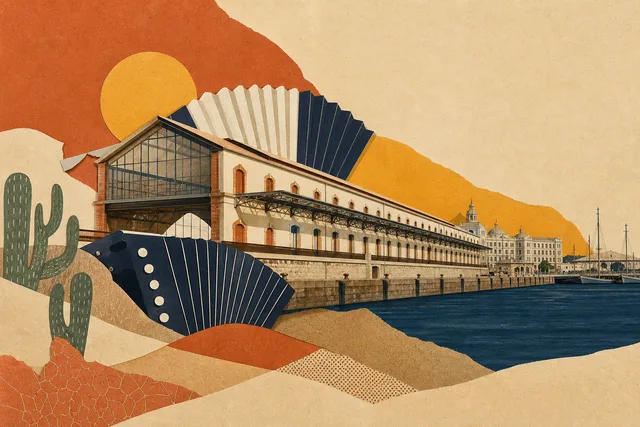
The most interesting thing about this museum is its address. Cais do Sertão speaks about the dry interior from the port quay, right by the water, inside a former cargo warehouse. The choice is deliberate: for Recife the sertão is not distant exotica but part of the city's biography, because people, goods and songs moved through here. Luiz Gonzaga is the narrative spine, the figure who carried the Northeast onto the national stage, yet the museum is not reducible to one artist's life. It explains how an enormous region sounds, what it believes and how it makes a living, and it does so with sound and image rather than a case with a label. Come if you want to know where much of the street music in this city comes from.
A warehouse that became a museum
The building is Armazém 10, one of the Recife port warehouses included in the Porto Novo renewal, in which cargo structures took on cultural and service uses while keeping their shells. The museum opened in April 2014 and occupies around seven and a half thousand square metres, which places it among the largest cultural spaces in the city. The concept and curatorial line were developed by Isa Grinspum Ferraz, with conceptual direction by the anthropologist Antonio Risério, and the project was backed by Brazil's Ministry of Culture and the government of Pernambuco. Read the house in two layers: port logistics of the early twentieth century and museum dramaturgy of the 2010s. The long warehouse turned out to be an ideal shape for a story about crossing and distance.
How the exhibition works
The space runs as a route: the elongated body of the warehouse unfolds themes in sequence, moving through music, religiosity, daily work, landscape and climate, migration. The display leans on technology, with audiovisual installations, sound, light and immersive environments replacing the classic case, so the exhibit is often the experience itself: a voice, a rhythm, an image, a sense of scale. Luiz Gonzaga runs through everything as the connecting thread, his repertoire, public image and particular way of speaking about the sertão stitching the modules together. Look at the building as well: the rhythm of the columns, the height, the clear span and the view of the water belong to the warehouse rather than the museum, and that rough port geometry supports the theme of the road with unexpected precision.
How to look closely
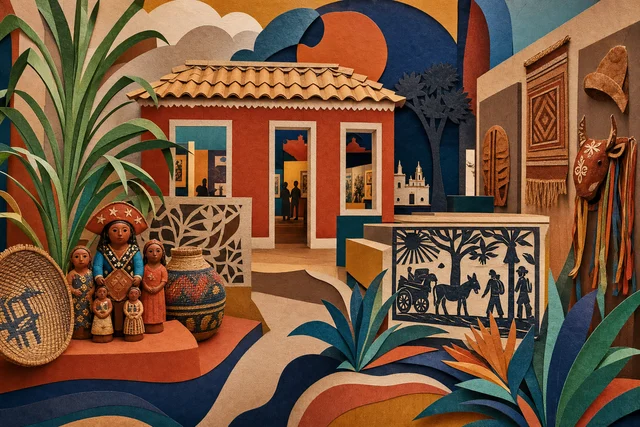
Listen. Half the meaning arrives as sound, and the difference between a studio recording, a live voice and a field recording matters here: notice where the commercial version plays and where you are hearing something captured at a market or a yard. Look at the tools and household objects, which explain climate and economy better than any text about drought. Look for differences inside the sertão, because the exhibition carefully shows it is not one uniform territory but many places, accents and practices. And test your own stereotype: if on the way out you can say something concrete about the region rather than that life there is hard, the visit did its work.
The port around it
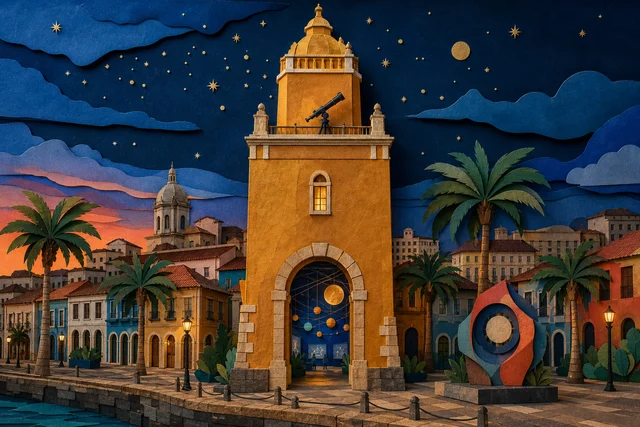
The museum stands in old Recife, inside the port, next to the Pernambuco crafts centre and minutes from Marco Zero. That makes for one continuous walk in which the city appears built on water, with quays, warehouses, bridges, vessels and the river tying it together. The district went through emptying and return, and Armazém 10 belongs to that second wave, when port structures were given new functions instead of being demolished. For this museum's subject the setting is ideal, since migration from the interior reached the city through the port and the market rather than the front door. After the visit, walk along the edge: the distance between sertão and sea that the exhibition describes is measured here in steps.
The sertão without the postcard
The sertão is one of Brazil's most stereotyped images: drought, cactus, migrants on the road, heroic endurance. The museum works against that postcard without being entirely free of it, and that is worth holding in mind. Remember who historically spoke for the region, since press, literature, cinema and radio built an image that was later sold back to the people living there. Remember too the causes of migration, among them land concentration, drought and the absence of water and work, which pushed millions towards the south and the capitals, often with no real choice. Finally, note the institution's own position: a public museum on a valuable quay narrating the poverty of the interior. That does not invalidate the account, but it asks for attention to whose voice speaks in each module.
Planning the visit
Allow an hour and a half to two hours: the route is long, there is a great deal of sound and video, and it does not read at speed. Follow the sequence rather than picking isolated rooms, because the modules chain place to music and music to migration. With children, start at the interactive points and the sound, leaving the texts for later. When this text was prepared, official information indicated opening from Tuesday to Friday in the morning and early afternoon and on weekends in the afternoon, with last admission half an hour before closing, but hours, tickets and temporary shows change and should be checked first. The best continuation on the same day is the Memorial Luiz Gonzaga in Pátio de São Pedro, at a different scale and tone.
Getting there and access
The address for navigation is Armazém 10, Avenida Alfredo Lisboa, no number, Recife Antigo, CEP 50030-150. From Marco Zero it is five to seven minutes on foot along the water, and slightly more from Rua do Bom Jesus; by car, count on the district car parks, which fill up on event days. The former warehouse is spacious, with wide spans and level floors, which usually eases movement, but specific services such as a lift between levels, an adapted toilet, audio description, staff assistance and resting points should be confirmed with the museum for your date. Consider the climate: the approach runs along an open quay, hot and almost without shade, and the stone becomes slippery after rain. Water and light clothing are not a detail here.
Where to go next
The direct continuation is the Memorial Luiz Gonzaga in Pátio de São Pedro: after an immersive exhibition it helps to see a small collection of rare records and personal objects, where the same figure appears without large staging. To stay in the port, walk on to Paço do Frevo and Torre Malakoff, since three buildings within a short radius explain the city through music, communication and engineering. The Kahal Zur Israel Synagogue adds a fourth thread about who arrived at this port and when. And if there is no appetite for another museum, stay on the waterfront at Marco Zero and let the visit settle, because this one keeps working outdoors.
Verified facts
Every fact below is linked to this profile’s source codes.
- Location
- Old Recife · Recife REC_CAIS · REC_TOUR_DATA
- Listed address
- Armazém 10, Av. Alfredo Lisboa, s/n REC_CAIS · REC_TOUR_DATA
- Documented focus
- Immersive museum about the sertão, its music, landscapes, religiosity and ways of life, with Luiz Gonzaga as the narrative axis. REC_CAIS · REC_TOUR_DATA
- Evidence basis
- Identity, location and cultural relevance are supported by primary evidence. REC_CAIS · REC_TOUR_DATA
Original Meu Recife editorial copy based only on this profile's source codes. It does not reproduce third-party text in full or turn a community-guide opinion into fact.
Before visiting
Check hours, ticket prices and temporary shows on the official channel on the day of your visit, since the programme changes and last admission is usually before closing time. Allow an hour and a half to two hours, and note that the approach runs along an open quay with no shade. Confirm any accessibility service you need in advance.
- Reference address
- Armazém 10, Av. Alfredo Lisboa, s/n, Bairro do Recife, Recife — PE
- Museums & memory
- 1–2 hours
- What can change
- Hours, tickets, accessibility and temporary closures can change. Confirm with the official source before visiting.
Getting there
Coordinates published by an institutional source
- Reference address
- Armazém 10, Av. Alfredo Lisboa, s/n
- District and city
- Bairro do Recife · Recife, PE
- Verified coordinates
-8.063163, -34.871134