Museums & memory · Recife / Bairro do Recife
Paço do Frevo — Frevo Centre

Why Paço do Frevo matters
Frevo usually reaches visitors as a carnival image: speed, a bright little umbrella, a jump. Paço do Frevo shows what holds that image up — craft, rehearsal and work. Iphan registered frevo as a form of expression in 2007, Unesco inscribed it on the list of intangible heritage of humanity in 2012, and the museum opened in 2014 to treat dance and music as things that are taught and learned: scores, orchestration, steps, pedagogy, the memory of clubs and bands. The building adds a second story. Until the 1970s an English telegraph company worked here, and messages left this address through submarine cables. The same rooms now hold an art that travels by body rather than by wire, from teacher to apprentice. Two forms of transmission a century apart share one roof, and that coincidence is the sharpest way to read the house.
From telegraph office to frevo museum
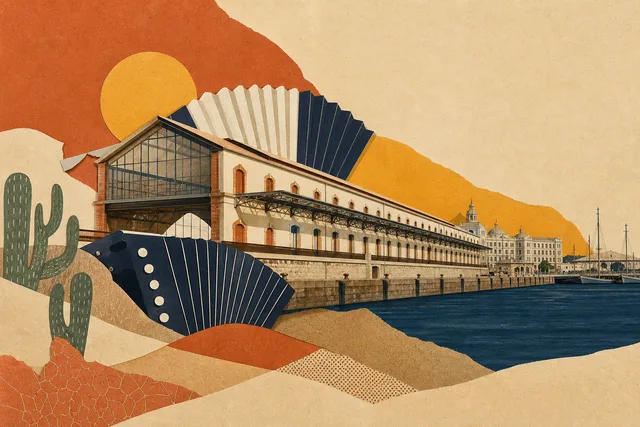
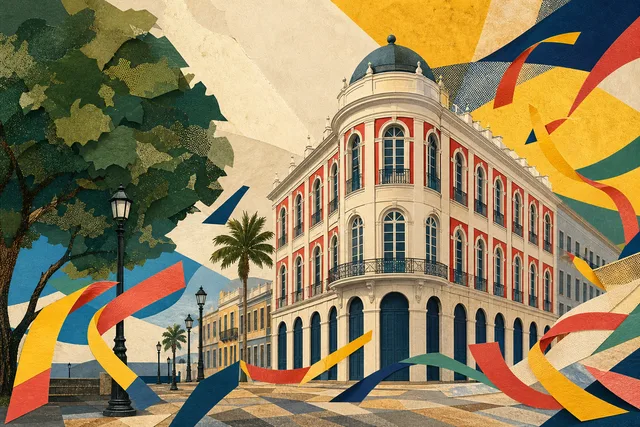
The building on Praça do Arsenal was built in 1908 for the Western Telegraph Company Limited, a British firm formed out of John Pender's concessions and the merger of the Western and Brazilian Telegraph with the Brazilian Submarine Telegraph. Recife was a node of submarine communication between Europe, Africa and South America, and the office ran like a machine: pneumatic tubes carried forms between floors, and the staff reached roughly a hundred people, more than forty of them European. In 1973 Embratel declined to renew the concession, the company withdrew, and the building stood almost empty for three decades. Iphan placed it under federal protection in 1998. The restoration was supported by BNDES through its cultural heritage line, and in 2014 Paço do Frevo opened under the management of the Instituto de Desenvolvimento e Gestão. Read the house as those successive layers.
Building, exhibition and archive
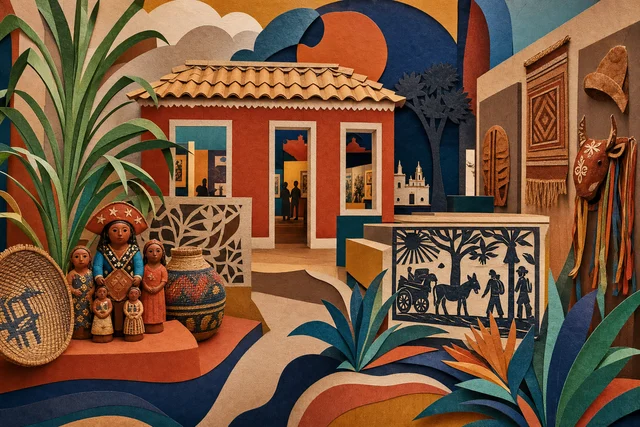
The architecture is eclectic and deliberately practical: four floors, marquetry flooring in noble Pará wood in gold and brown tones, and a structure designed to be fireproof, with cement, steel, brick walls and an asbestos ceiling. For a telegraph office that was insurance rather than taste, since a fire would have cut the link to Europe. The long-term exhibition is called Frevo Vivo and treats frevo as a living practice instead of a display case subject. A second layer is the Centro de Documentação e Memória, holding digitised books, photographs, sheet music and audio that combine the museum's institutional memory with archives from frevo communities themselves. The restoration project also provided a music and dance school, a stage and a recording studio, so the house serves the people who make frevo and not only those who come to look at it.
How to look closely
Start with the floor: the marquetry pattern and the traces of former partitions show how the office separated its operators and how the museum removed those limits. Then look at the umbrella, which in frevo is a working tool rather than a souvenir, descended from the stick carried by the capoeirista who cleared the way ahead of the band; the shape of handle and canopy explains its role in balance. Watch the feet rather than the hands, because the steps have names and internal logic, and that is where frevo reveals itself as a school rather than a mood. Listen to the brass, written to cut through street noise and therefore different indoors. And read the photograph captions: they name the composer, the orchestra and the club, which is to say the people in whose names the tradition survives.
The Bairro do Recife around it
Praça do Arsenal da Marinha belongs to the port city, the island of warehouses, offices and narrow streets that grew out of seaborne trade. The telegraph office did not land here by chance, since communication lived close to cargo and money. Walk the surrounding blocks and the building's chronology continues outdoors, among shipyards and warehouses, company houses, churches and squares, followed by the emptying out of the late twentieth century and the later return of bars, offices and cultural institutions. For frevo the district counts twice over, because the rhythm was born in street parades rather than in halls, so the museum sits precisely in the setting it describes. On the way out look at the façade again: the office now reads as port infrastructure, and the square as a stage.
Reading it responsibly
Frevo grew out of popular processions in which capoeiristas opened the way ahead of the bands, and for a long time the police treated that as a matter for repression rather than culture. The clubs were working class and largely Black, and recognition arrived far later than the music did. Keeping that in view stops the Iphan registration and the Unesco listing from looking like a natural reward, because bans, fines and contempt for what belonged to the street came first. The building carries its own uncomfortable line. A British company controlled the communications on which the export economy depended, and its office was part of a deeply unequal exchange. The house then stood closed for three decades, a visible answer to what a city does with heritage once it stops producing revenue. The museum neither dissolves those tensions nor hides them behind the festival.
Planning the visit
An order that works: Frevo Vivo first, to get the frame; then the documentary layer, where scores and photographs explain how the rhythm is written down and passed on; and only then the building itself, with its staircases, floors and windows. Ask at the desk whether a class, a rehearsal or a mediated visit is running that day, because live sound changes the whole experience and is worth planning your time around. When this text was prepared the official site listed Monday as the closing day and admission until half an hour before closing, but hours, tickets and programmes change and should be checked on the day itself. Keep fifteen minutes for the square outside: frevo was made for open air, and stepping out works as the closing chapter of the visit.
Getting there and access
The address for navigation is Praça do Arsenal da Marinha, 91, Bairro do Recife, CEP 50030-360. From Marco Zero it is an easy walk of about ten minutes, and less from the heart of Recife Antigo; by car, note that parking in the district is limited and varies with the day and the events calendar. Bus routes serve the Bairro do Recife, but the final stretch is always on foot, and heat or rain change the real travel time considerably. Confirm accessibility with the museum itself for your date: the house dates from 1908, and a lift, movement between floors, an adapted toilet, resting points, tactile material and staff support are separate services that may not all be available at once. If one of them is essential, ask in advance and agree on a drop-off point.
Where to go next
The best continuation is not simply another museum but another chapter of the same port. Ten minutes away, on Rua do Bom Jesus, stands the Kahal Zur Israel Synagogue, the first in the Americas, the story of a community that arrived by sea and left the same way. The nearby Torre Malakoff explains the same port through engineering and sky observation. Cais do Sertão, across the water, turns the conversation from the coast towards the interior of the state and Luiz Gonzaga, and works well as a second visit on the same day. If energy is short, simply walk to Marco Zero and look at the river: after Paço do Frevo the city sounds different, and that pause pays off more than another exhibition in a row.
Verified facts
Every fact below is linked to this profile’s source codes.
- Location
- Old Recife · Recife PACO · REC_TOUR_DATA
- Listed address
- Praça do Arsenal da Marinha, s/n PACO · REC_TOUR_DATA
- Documented focus
- A centre for memory, documentation, learning and live experience devoted to frevo, a cultural heritage of Brazil and humanity. PACO · REC_TOUR_DATA
- Evidence basis
- Identity, location and cultural relevance are supported by primary evidence. PACO · REC_TOUR_DATA
Original Meu Recife editorial copy based only on this profile's source codes. It does not reproduce third-party text in full or turn a community-guide opinion into fact.
Before visiting
Check hours, tickets and programme on the official site on the day of your visit, since temporary exhibitions, classes and rehearsals change through the year. Accessibility in a house built in 1908 should be confirmed with the museum for your date, naming the specific service you need. If you can choose, come when a class or rehearsal is running in the building.
- Reference address
- Praça do Arsenal da Marinha, s/n, Bairro do Recife, Recife — PE
- Museums & memory
- 1–2 hours
- What can change
- Hours, tickets, accessibility and temporary closures can change. Confirm with the official source before visiting.
Getting there
Coordinates published by an institutional source
- Reference address
- Praça do Arsenal da Marinha, s/n
- District and city
- Bairro do Recife · Recife, PE
- Verified coordinates
-8.061318, -34.871638