Stage & cinema · Recife / Bairro do Recife
Hermilo Borba Filho Theatre
Two warehouses turned into a laboratory
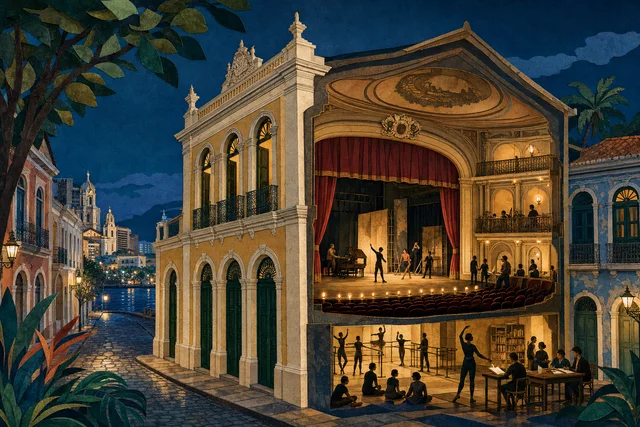
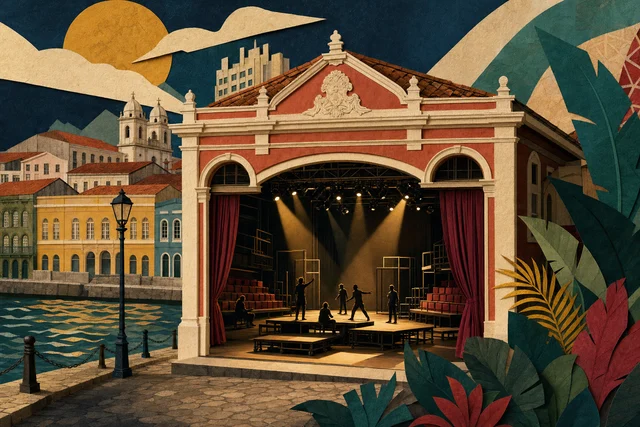
The Hermilo Borba Filho is a theatre that grew literally out of two warehouses behind the Teatro Apolo, converted into a performance space. The essential point lies in that origin: there was no grand design, only the search for somewhere to experiment. At first the space was called the Experimental Centre of the Apolo Theatre, and the name already explained the programme. The hall seats about a hundred and fifty people and its bleachers can be rearranged into different formations, so each production creates its own geometry between stage and audience. In a city whose great nineteenth-century theatre separates the public into tiers, that flexibility is a direct answer. The practical conclusion is simple: do not expect a hall of state and do not come for the architecture. The value here is seeing work in progress, with student showings, laboratories and productions by small companies that would struggle for space in a city geared to large stages.
1987, 1988 and a playwright's name
Activity began in 1987 with a staging of Jean Genet's The Balcony, directed by Antonio Cadengue and performed by students of the actor training course at the Federal University of Pernambuco. The choice of text matters, because Genet is not a comfortable author for opening a venue, and it fixed the experimental frame from the start. After extensive works the space reopened in 1988, now with a flexible configuration and capacity for around 150 people, taking the name of the Pernambuco playwright Hermilo Borba Filho. Today it belongs, together with the Apolo, to the Apolo-Hermilo centre for training and research in the performing arts. Note the link with the university: opening with a performance by students of the actor training course defined the venue's role as a passage between study and profession, a function rarely held by municipal venues.
Who Hermilo Borba Filho was
The name on the front is a programme rather than a formality. Hermilo Borba Filho was born at Engenho Verde in the municipality of Palmares, in the southern Zona da Mata of Pernambuco, and was at once a writer, literary critic, journalist, playwright, director, theatre scholar and translator. A graduate in law from the Recife law faculty, he became a central figure of Brazilian theatre. He published seven novels, three books of short stories, two novellas, twelve works of research and essays and more than a dozen translations, among them Tulio Carella, Aretino, the Marquis de Sade, Leo Tolstoy, Calderón de la Barca and Jorge Luis Borges. Of the more than twenty-three plays he wrote, only seven were published in his lifetime. Keep that list in mind during the visit, because an author of such range gives his name not to a hall of state but to a transformable space made of warehouses, a choice that says much about treating a legacy as ongoing work.
How to look closely
Start with the configuration of the hall on the day: the bleachers move, and the chosen arrangement is already a directorial statement. A frontal audience, a circle or two facing banks produce completely different relations between viewer and actor. Then look for the marks of the warehouse, in the proportions of the volume, the height and the plain walls. Unlike Santa Isabel, nothing here ornaments or ranks anyone, which leaves the work of theatre visible. And notice the composition of the audience, with many students and stage practitioners, which usually makes the conversations after a performance livelier than in larger halls. Watch the technical side: light and sound are rebuilt for every configuration, and arriving early sometimes lets you catch the end of the get-in, which shows what a performance is made of.
The same address as the Apolo
The theatre shares its address with the Apolo, on Rua do Apolo in old Recife, and that proximity shapes the visit. One entrance to the district, two halls and a shared programme let you see a more conventional production and a laboratory piece in a single evening. Around it are the port, the warehouses, Paço do Frevo and Torre Malakoff, along with the bars and restaurants of Rua do Bom Jesus, the natural place to go afterwards. In the evening the district lives on theatre and bars; by day it remains commercial. That matters, because a daytime visit here makes little sense without a session or a class. Consider the weather, since the walk from Marco Zero is exposed and the district catches wind off the water at night, so a light jacket in the rainy season is useful even in the tropics.
Experimental theatre and money
Experimental venues live in tension between freedom and resources. A hall like this does not take box office like a commercial stage and depends on municipal support, university programmes and grants, and therefore on political decisions that change with each administration. It is worth remembering the figure whose name the theatre carries: Borba Filho worked at a time when Brazilian theatre faced censorship and repression, and much of his dramaturgy was not published in his lifetime. Finally there is the question of access, because an experimental scene easily closes into a circle of insiders, and a good venue spends energy preventing that. Notice how the venue divides its time between performances and teaching, because that proportion is the most honest indicator of what the hall is today, whatever the descriptions say.
Planning the visit
It is only worth coming for a specific session or activity, so start with the Apolo-Hermilo programme. The hall is small, seats are often unnumbered and the configuration changes, so arriving fifteen or twenty minutes early helps you choose where to sit. If the Apolo has a session the same night, plan both, since the halls are a few steps apart. After the performance, do not rush away: there is often a conversation with the makers, an important part of what this venue offers. Confirm times and prices in advance, as they change from week to week. If Portuguese is a barrier, choose dance, music or physical theatre, which work particularly well in a transformable room and depend far less on language.
Getting there and access
The reference is the same as the Apolo: Rua do Apolo, old Recife, beside the port. From Marco Zero it is five to seven minutes on foot and from Paço do Frevo about three; buses serve the district and parking is limited, filling up on performance nights. The hall was adapted from warehouses, which usually means a flat floor and no tiers, but specific conditions such as an accessible entrance, wheelchair space, audibility and staff assistance should be confirmed with the venue for your date, all the more because the layout changes with each production. Late at night the district empties out. For late sessions, arrange your return in advance and prefer to call a car at the door, because old Recife empties at night and looking for transport on the street is uncomfortable.
Where to go next
The first step is the Apolo next door, the second hall of the same centre. Along the block are Paço do Frevo with urban music, Torre Malakoff with exhibitions and an observatory, and the Kahal Zur Israel Synagogue adding a historical layer. To see the opposite pole of theatre architecture, go to Santa Isabel on Praça da República, because a neoclassical hall with boxes and gallery beside a transformable space made of warehouses is the clearest way to understand how the idea of a stage changed. Teatro do Parque adds the cinema chapter to the same line. Keep the trio in mind: Santa Isabel, Apolo and Hermilo, three eras and three ideas about where an audience should sit and what it is entitled to see.
Verified facts
Every fact below is linked to this profile’s source codes.
- Location
- Old Recife · Recife REC_TOUR_DATA · REC_CULT_DATA
- Listed address
- Cais do Apolo, s/n REC_TOUR_DATA · REC_CULT_DATA
- Documented focus
- Flexible configuration room linked to the Apolo-Hermilo complex and training and experimentation in performing arts. REC_TOUR_DATA · REC_CULT_DATA
- Evidence basis
- Identity, location and cultural relevance are supported by primary evidence. REC_TOUR_DATA · REC_CULT_DATA
Original Meu Recife editorial copy based only on this profile's source codes. It does not reproduce third-party text in full or turn a community-guide opinion into fact.
Before visiting
It is only worth coming for a specific session or activity, so check the Apolo-Hermilo programme first and confirm the time. The hall is transformable and seats are often unnumbered, so arrive fifteen to twenty minutes early to choose your view. Accessibility conditions vary with each production and should be confirmed with the venue in advance.
- Reference address
- Cais do Apolo, s/n, Bairro do Recife, Recife — PE
- Stage & cinema
- 30–60 min without a show
- What can change
- Hours, tickets, accessibility and temporary closures can change. Confirm with the official source before visiting.
Getting there
Coordinates published by an institutional source
- Reference address
- Cais do Apolo, s/n
- District and city
- Bairro do Recife · Recife, PE
- Verified coordinates
-8.061830, -34.872795