Skip to content
MEU RECIFERECIFE · PERNAMBUCO
The city portal for Recife and PernambucoNEWS · EVENTS · SERVICES
Cultural atlas

Stage & cinema · Recife / Bairro do Recife

Apolo Theatre
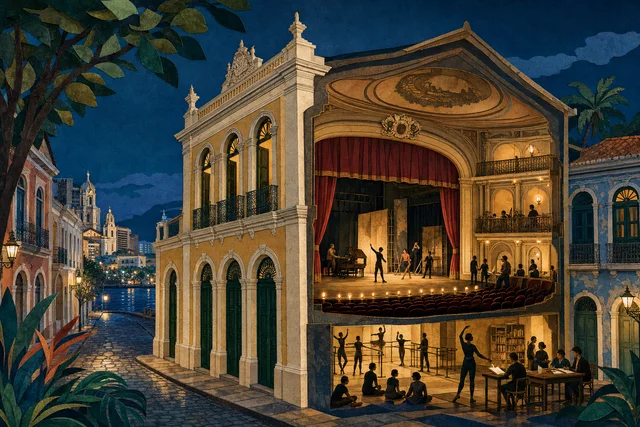
Historic theater opened in 1842 and integrated into the Apolo-Hermilo performing arts training and research center.
2 sources and traceabilityVerified 2026-07-28
Apolo Theatre — Original Meu Recife editorial illustration — not a documentary photograph.
Original Meu Recife editorial illustration — not a documentary photograph. · Meu Recife
01

The oldest theatre in Recife, once a warehouse

The Apolo is the oldest theatre building in Recife, and its biography is more interesting than the title. Construction began in 1839 under the Sociedade Harmônico Theatral, the doors opened in 1842, and the hall worked for eighteen years before being sold and turned into a sugar warehouse with only its façade preserved. That is not a curiosity but a precise illustration of how, in a port city, the economy defeats culture, because sugar was worth more than a stage. The return took over a century. Restoration began in the early 1980s, and only in 1996, with the revitalisation of old Recife, did the building gain cine-theatre status and a regular programme. There is a practical reason to come: this is the cheapest hall in the city for seeing live independent theatre, made by local companies and students, often with the creators themselves in the room.

02

Eighteen years of stage, a century of storage

The chronology is short in dates and long in consequences. 1839 marks the start of the works by the music and theatre society; 1842, the first seasons; the following eighteen years, the working life of the hall; then the sale and conversion into a sugar warehouse, with only the façade preserved. In the early 1980s restoration began and the stage function returned. In 1996 came cine-theatre status and systematic programming within the revitalisation of the district. Today the Apolo forms, together with the Teatro Hermilo Borba Filho at the same address, the Apolo-Hermilo centre for training and research in the performing arts, dedicated to education and support for the stage. Note the length of the pause: more than a century passed between the sale of the hall and the return of its stage function, a span covering an empire, a republic and several economic orders, while the building served as a utilitarian structure.

03

What survived and what was rebuilt

The building's defining feature is that less of it is original than it appears: behind the preserved façade stands an interior remade at the end of the twentieth century. For a visitor that is not a flaw but a subject of observation, since it invites you to tell historic shell from contemporary content. The hall is small, and that shapes the repertoire towards experimental work, independent companies and training productions that need no heavy machinery. The second part of the complex, the Hermilo Borba Filho, works as a transformable space. Together the halls offer a rare combination: one for more conventional presentation, one for research. There is no permanent display. It helps to understand the institutional side: the Apolo-Hermilo centre is not only two halls but a programme of training, research and support, so part of the schedule goes to rehearsals, laboratories and classes.

04

How to look closely

Start outside and try to see where the nineteenth century ends and the reconstruction begins. Inside, notice the scale of the hall, which explains why independent productions fit here and why midweek tickets cost less. Note the relationship with Rua do Apolo and the port, since the theatre sits in a block that also went through abandonment and return, rhyming with the building's own biography. If a rehearsal or a training activity of the Apolo-Hermilo centre is running, stay a while: it is the teaching function that keeps the place alive rather than merely commemorative. Notice how the hall works without heavy machinery, with light, sound and set solved by minimal means, something visible from the front rows and often what makes these productions more inventive.

05

Rua do Apolo and the old port

The theatre stands at Rua do Apolo 121 in old Recife, a block of warehouses, offices and quays neighbouring Paço do Frevo, Torre Malakoff and the synagogue. The setting explains the building's fate better than any text: when the port was everything, the hall became a store; when the city began reclaiming the district, the hall became a hall again. Walk from the door to the water and back, watching the façades, because behind elegant pediments sit plain warehouse volumes. In the evening the district livens up with bars and venues and empties late at night. Consider the weekly rhythm of the district: on weekdays it is commercial and quiet, on weekends and event nights it fills up. A Monday or Tuesday show gives a different sense of the city.

06

When sugar outweighs the stage

The Apolo's history is a history of priorities. A theatre built by a society of music and drama was sold and adapted to store sugar, the commodity that sustained the province's economy, including through the labour of enslaved people on the estates. The handsome façade stayed, the content vanished, an exact metaphor for how culture in a port city often served as ornament to a working economy. The return is not neutral either, because the restoration of the 1980s and 1990s belonged to a revitalisation project with familiar effects: rising values, displacement of residents and the conversion of a district into a showcase. Ask about the present as well: who can reach a stage here, what a hall costs an independent company, and which projects receive support. The sugar story sounds distant, but the question of priorities stays open.

07

Planning the visit

Plan to attend a performance rather than tour the building, because this is a working stage and the meaning of the place appears during a show. The Monday to Wednesday programme runs at popular prices and is the best entry point to independent theatre in Recife. Confirm the schedule and start time through the official channels of the Apolo-Hermilo centre, since programming changes week by week. If you want to combine it with a walk, reach the district an hour early, enough time to visit Paço do Frevo and return. After the show, walk down to the water. With children or teenagers, choose a session from the centre's training programme, shorter in format, where the makers often stay to talk with the audience afterwards.

08

Getting there and access

The address is Rua do Apolo 121, Recife Antigo. From Marco Zero it is five to seven minutes on foot and from the synagogue on Rua do Bom Jesus two or three; by car, count on the district car parks, which fill on event nights. The building is historic with a reconstructed interior, so an accessible entrance, wheelchair spaces and comfortable circulation should be confirmed with the venue for the date of the performance. The paving is uneven and slippery after rain, so wear stable shoes. The block empties at night, and the way back is worth arranging in advance. Arrive fifteen or twenty minutes early, since the hall is small, there is one entrance and the queue for a popular session takes time. It also gives you a chance to see the façade in evening light.

09

Where to go next

The continuation is literally behind the same door: the Teatro Hermilo Borba Filho, the second hall of the same centre, is a transformable space showing more experimental work. Further along the block are Paço do Frevo, with the history of urban music, and Torre Malakoff, with its exhibitions. For contrast in scale, go to the Teatro de Santa Isabel on Praça da República, because a nineteenth-century hall of state beside a small stage shows how the very idea of theatre changed. And to close the evening, simply walk to Marco Zero and look at the water. A simple chain for the evening: Apolo or Hermilo, dinner on Rua do Bom Jesus and a walk to Marco Zero, because in this district theatre joins ordinary night life easily.

10

Verified facts

Every fact below is linked to this profile’s source codes.

Location
Old Recife · Recife
REC_APOLO · REC_TOUR_DATA
Listed address
Rua do Apolo, 121
REC_APOLO · REC_TOUR_DATA
Documented focus
Historic theater opened in 1842 and integrated into the Apolo-Hermilo performing arts training and research center.
REC_APOLO · REC_TOUR_DATA
Evidence basis
Identity, location and cultural relevance are supported by primary evidence.
REC_APOLO · REC_TOUR_DATA

Original Meu Recife editorial copy based only on this profile's source codes. It does not reproduce third-party text in full or turn a community-guide opinion into fact.

11

Before visiting

The Apolo is a working stage rather than a museum, so plan the visit around a performance and confirm the programme on the official channels of the Apolo-Hermilo centre before you set out. Monday to Wednesday sessions run at popular prices. Confirm accessibility in this historic building in advance and arrange your journey home before the show.

Reference address
Rua do Apolo, 121, Bairro do Recife, Recife — PE
Stage & cinema
30–60 min without a show
What can change
Hours, tickets, accessibility and temporary closures can change. Confirm with the official source before visiting.
12

Getting there

Coordinates published by an institutional source

Reference address
Rua do Apolo, 121
District and city
Bairro do Recife · Recife, PE
Verified coordinates
-8.061439, -34.872534
The interactive map will load as you scroll
Location map for Apolo Theatre
Coordinates published by an institutional source · map © OpenStreetMap