Stage & cinema · Recife / Boa Vista
Parque Theatre

A garden theatre designed for the tropics
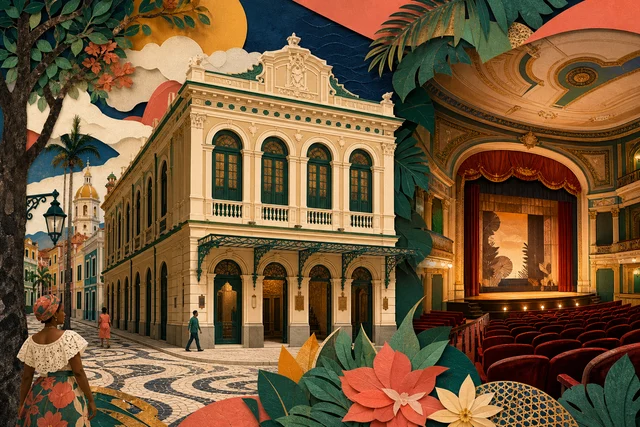
The Teatro do Parque opened in 1915 and was one of the only garden theatres in Brazil. That is not a metaphor but an engineering decision: the design included a garden to help cool the building, respecting the climate of Recife, where before air conditioning a full house became an ordeal. That alone makes the building interesting, since it solves a local problem with local means instead of copying a European model wholesale. The second thread is cinema, present here from 1921, and it was in this hall that Recife first heard sound film, in 1930. The third is a long closure and the return in December 2020. For a visitor today the conclusion is practical: see the house working rather than silent. The garden, the volume of the hall and the restoration make sense when eight hundred people are seated and the stage lights are on.
1915, 1921, 1930, 1973, 2020
The dates explain more than description. The theatre was raised through the vision and the 200 contos de réis invested by Comendador Bento Luís de Aguiar, opening in 1915 with the play O 31, packed galleries and the police band. On 24 November 1921 the cinema opened with The Tiger's Daughter, a Fox production starring Pearl White. From 1929 to 1959 it ran in the sound film circuit with Disney productions and Brazilian chanchadas, and on 24 March 1930 the film The Divine Lady brought sound cinema to Recife. In 1973, after restoration and the revocation of a decree that had suspended screenings for nearly fifteen years, it became Brazil's first Permanent Educational Cinema. It closed in 2010 because of water damage, underwent works from 2013 to November 2020 and reopened on 11 December 2020. Taken together, those dates trace a rare path: one building passing through silent film, the coming of sound, an administrative ban, educational cinema, a decade of abandonment and a full restoration, all within the same central block.
How the building is organised
The structure was modern for its time, in steel and cement, and the decoration was carried out by the painters Henrique Elliot and Mário Nunes. The major architectural innovation was including a garden in the complex to help with cooling, a rare type in the country. In the early years tickets were sold at the Hotel do Parque next door, which long had a direct connection to the theatre, a detail that reveals how the leisure industry worked at the start of the century. The restoration completed in 2020 combined civil works with delicate restoration of decorative elements and returned the characteristics of the original 1929 architectural design. The hall now holds more than 800 seats. Note what returning the characteristics of the 1929 design means: the restorers chose one historical layer as the reference, so some later changes were deliberately removed. That kind of decision is always debatable and always reveals the taste of its own time.
How to look closely
Look for traces of both functions, theatre and cinema. Screen and stage demand different geometries, and the building balanced the two throughout its life, which shows in the proscenium, the rake of the hall and the technical areas. Study the restored decorative elements knowing that you are not seeing the original 1915 surface but the recovered character of the 1929 design. Notice the garden and its relation to the interior volume, because that is the climatic idea that justified the plan. And read the hall through its capacity: more than eight hundred seats in the centre means a building meant for a broad public rather than a chamber format. Look at the technical areas and the projection box as well, because in buildings of this age the service spaces show how exhibition technology changed, from film projectors to the digital equipment installed in the latest works.
Rua do Hospício and Boa Vista
The theatre stands at Rua do Hospício 81 in Boa Vista, the part of the centre where shops, offices, old cinemas and housing gather. This is not the waterfront Recife Antigo but the working centre, driven by trade and transport. That is precisely why the building matters: a cultural venue sits where thousands of people pass every day on business rather than in a tourist pocket. The Capibaribe and its bridges are close, among them the Duarte Coelho, and a few minutes away stands the Cinema São Luiz, the other great street cinema of this part of town. Walk the block by day and by night: in the morning Boa Vista is commerce, banks and moving crowds; after dark the streets empty faster than by the waterfront, and the theatre remains one of the few lit addresses.
Ten years of closed doors
The uncomfortable part of this story is recent rather than remote. The building stood closed from 2010 because of water infiltration, and the bill for deferred maintenance arrived in full: seven years of works, with reopening only at the end of 2020, in the middle of the pandemic and with a limited audience. It is worth recalling the earlier episode as well, when a decree suspended film screenings here for nearly fifteen years, an example of how an administrative decision can remove a venue from circulation. And there is the question of access, because a large central hall can work as a space for a broad public or as a rentable event venue, and which prevails decides whose building it really is. Remember that keeping such buildings is expensive because of the climate: humidity, heavy rain and salt air degrade finishes faster than in temperate zones, and without a continuous maintenance budget any restoration success proves temporary.
Planning the visit
Organise the visit around the programme, because this is a working house of theatre and cinema rather than a museum. Check the schedule and tickets on the official site beforehand, since programming changes and some screenings happen by invitation or within festivals. Arrive twenty minutes early, because the hall is large and seating takes time, and that gives you a chance to study the restoration and the garden. If you are in the city briefly and have to choose, remember that both films and performances run here, which raises the chance of finding something suitable. After the session, walk down to the river. With children, prefer a daytime film screening to an evening play, because the hall is large, the session is shorter and afterwards you can walk the district while it is still light.
Getting there and access
The address is Rua do Hospício 81, Boa Vista. This is a well-served part of the centre; about twenty-five minutes on foot from Marco Zero and five to ten by taxi depending on traffic, while parking on the block is limited and almost absent in the evening. After the restoration the theatre is presented as prepared for every stage language and accessible to all audiences, but specific services such as wheelchair spaces, an accessible entrance, an adapted toilet, staff assistance and captioning or sign language at a given event should be confirmed with the venue in advance. The district stays busy in the evening. If you take a taxi or ride app, give the street and number rather than the theatre's name, because the centre holds similar landmarks and drivers sometimes head for another block.
Where to go next
The natural continuation is the Cinema São Luiz a few minutes away: two great street halls side by side show what the cinematic centre of the city once was. From there you can cross the river to Santo Antônio and compare the mid-nineteenth-century Teatro de Santa Isabel with this early twentieth-century house. For contrast, go to old Recife, where the Apolo and the Hermilo represent the small experimental pole. And to close the day, walk along the Capibaribe, because the bridges and banks explain why cinemas and theatres lined up along the main axis of movement. Keep the line in mind: Teatro do Parque and São Luiz explain the cinema centre, while Santa Isabel and Apolo explain the theatrical one. Both can be walked in a single day.
Verified facts
Every fact below is linked to this profile’s source codes.
- Location
- Boa Vista · Recife REC_TOUR_DATA
- Listed address
- Rua do Hospício, 81 REC_TOUR_DATA
- Documented focus
- Historic theater-cinema in the Center, restored and reinserted into Recife's cultural programming. REC_TOUR_DATA
- Evidence basis
- Identity, location and cultural relevance are supported by primary evidence. REC_TOUR_DATA
Original Meu Recife editorial copy based only on this profile's source codes. It does not reproduce third-party text in full or turn a community-guide opinion into fact.
Before visiting
This is a working theatre and cinema, so check the programme and tickets on the official site before you set out, since the schedule changes and some screenings belong to festivals. Arrive twenty minutes early to take in the restored decoration and the garden. Confirm the specific accessibility services you need with the venue for your chosen event.
- Reference address
- Rua do Hospício, 81, Boa Vista, Recife — PE
- Stage & cinema
- 30–60 min without a show
- What can change
- Hours, tickets, accessibility and temporary closures can change. Confirm with the official source before visiting.
Getting there
Coordinates published by an institutional source
- Reference address
- Rua do Hospício, 81
- District and city
- Boa Vista · Recife, PE
- Verified coordinates
-8.061976, -34.884742