Stage & cinema · Recife / Santo Antônio
Santa Isabel Theatre

A theatre where politics was decided
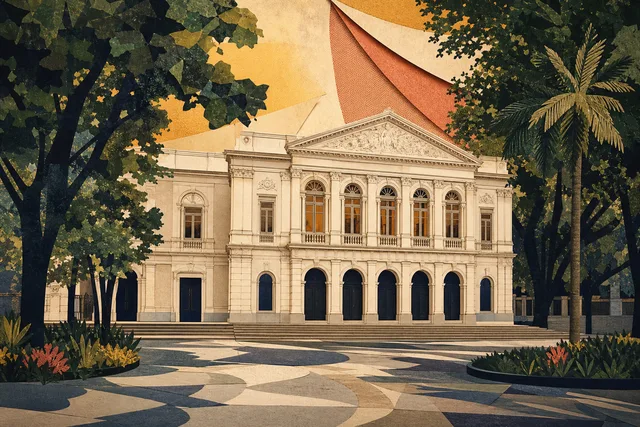
The Teatro de Santa Isabel is the oldest and most expressive example of neoclassical architecture in Pernambuco and one of the most notable in Brazil. But the columns are not the reason to come. This hall was a political stage in the nineteenth century: it witnessed the Praieira Revolution, the abolitionist campaign and the movement for the Republic, and two names are tied to its history, Joaquim Nabuco and José Mariano. It was here that Nabuco spoke the sentence still displayed on a plaque in the theatre: here we won the cause of Abolition. In a city where politics was made behind closed doors, the auditorium was one of the few places of public argument. Seeing only a handsome building is seeing half of it. In practice that means arriving with a better question: not how handsome the place is, but how this hall worked as a political instrument. Then the plasterwork, the boxes and the plaques form one coherent story instead of decorative details forgotten within the hour.
From a provincial idea to national listing
The idea of building a public theatre in the provincial capital came from Francisco do Rego Barros, later Count of Boa Vista, president of the province from 1837 to 1844. The engineer hired was the Frenchman Louis Léger Vauthier, the figure through whom mid-century European engineering and urban thinking reached Recife. The theatre opened on 18 May 1850, named in honour of Princess Isabel, and carried generations of audiences. On 31 October 1949 it was listed by the national historic and artistic heritage service, and today it belongs to the group of fourteen heritage theatres of Brazil. In 2016 it was chosen for the second time as the best theatre in the country by Cenym. It is a municipal cultural venue. It is worth remembering that almost two centuries of continuous operation are rare in a tropical climate, since timber, plaster and fabric demand constant maintenance, and every generation of restorers left traces that now have to be told apart.
The architecture and what it organises
Neoclassicism here is a programme rather than decoration: colonnade, symmetry and façade hierarchy declared that the province wished to belong to enlightened Europe. Inside, the same logic repeats, since stalls, balconies and boxes distributed the audience along a social vertical, and a seat in the hall matched a place in society. That plan survives and still lets you read the city of the mid-nineteenth century. Notice the building's relationship with Praça da República, because the theatre was conceived as part of an ensemble of power beside palaces and government buildings, its façade calculated to be seen from the square. Another layer is the set of plaques recording political episodes that happened here. Notice the acoustics as well: the hall was built before electrical amplification, and the shape of the ceiling, the rake of the balconies and the finishing materials were engineering decisions rather than ornament. That is easier to hear at a performance than on a silent tour.
How to look closely
Read the hall in terms of hearing and seeing: where the elite sat, from where the stage was hard to see, how the boxes work and how they differ from the gallery. That geometry reflects a social order directly. Find the plaque with Nabuco's sentence and read it on the spot, because words spoken at a specific point in a room land differently from a quotation in a book. Study the neoclassical detail, capitals, plasterwork and the symmetry of the openings, and compare it with the materials available in nineteenth-century Recife, since much was imported and expensive. And look at the building from the square at night, when the lighting picks out the portico. Compare the public rooms with the service corridors when the tour shows them, because the contrast between foyer and backstage explains the theatre as an enterprise employing dozens of people away from the stage.
Praça da República and power
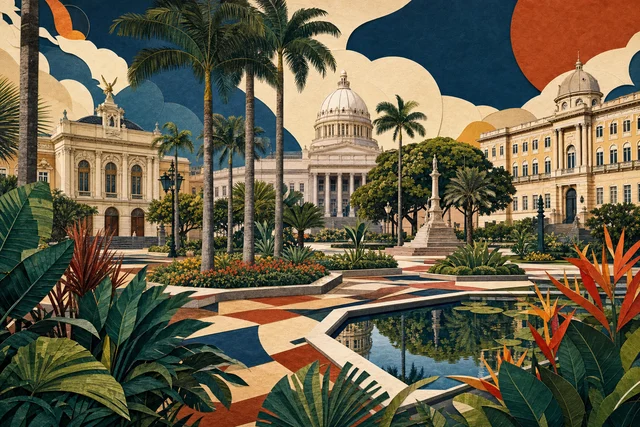
The theatre stands on Praça da República in Santo Antônio, where palaces and administrative buildings cluster. The setting is no accident: a cultural institution was raised as part of a representative ensemble of power, and going to the theatre was a public gesture. Walk the perimeter of the square and notice the scale and how trees and open ground work in favour of the façades. From here it is easy to continue towards Cais do Apolo or the bridges over the Capibaribe. For understanding the city this square is a key, showing how the provincial elite imagined European order and how that order coexisted with the slave economy of the sugar estates. In the morning the square works as a thoroughfare for officials and clerks; in the evening it becomes an urban living room. See both if you can, because the same place tells two different stories about the centre.
Who was in the audience
The handsome story of abolitionist speeches needs a qualification. The theatre was built in a society where slavery was the legal basis of the economy, and the audience applauding abolitionists largely consisted of people who benefited from it. Those whose labour sustained the sugar wealth of the province did not enter this hall. It is worth remembering that the abolition campaign was long and contested, and did not end through elite generosity but under pressure from the resistance of enslaved people themselves, from flight and from quilombos. Finally, read the distribution of seats as an explicit social scheme, because stalls, boxes and gallery were never neutral. Watch the contemporary dimension too: who steps onto this stage today, which companies reach the city's main hall, and how far the programme reflects the population of Recife. Inequality is comfortable to discuss in the past tense and necessary to check in the present.
Planning the visit
The theatre keeps two regular formats. Guided visits run on Sundays at 2, 3 and 4 pm without booking, for groups of at most twenty-five people, so arriving early helps. The second format is the heritage-education visit for students, artistic groups, community centres and NGOs, held on Tuesday afternoons and requiring a booking by email. Schedules change and are worth checking before you leave. The ideal plan combines a guided visit by day and a performance on another evening: first you understand the hall, then you see it working. Programme and tickets are published on the theatre's official site. If you are passing through and can choose only one thing, choose an evening performance, because the empty hall is beautiful but the meaning of the place appears with a full house, when the purpose of that acoustic and that geometry becomes clear.
Getting there and access
The reference is Praça da República, no number, in Santo Antônio. This is the centre: about twenty minutes on foot from Marco Zero across the bridges, with bus routes passing alongside, while by car you should expect nearby paid car parks, since spaces at the square are few. The building dates from 1850, with stairs and a tiered hall, so an accessible entrance, a lift, wheelchair spaces and staff assistance should be confirmed with the theatre for your date, especially for the Sunday visits with their limited group size. In the evening the surroundings are busy on performance days and quiet otherwise. Consider the weather, since the walk from Marco Zero crosses bridges in the open, hot by day and exposed in the rainy season. On performance days arrive with time to spare, because approaches to the square get congested.
Where to go next
The natural continuation is the city's theatrical line: Teatro Apolo and Teatro Hermilo Borba Filho in old Recife show how the stage moved from a hall of state to experimental space. Teatro do Parque on Rua do Hospício adds the history of cinema and of the garden theatre. To change register, walk down to Marco Zero and the bridges, because after a hall where politics was decided it helps to see the water and the port that paid for all of it. And to understand the square itself, look at the neighbouring administrative buildings, since the theatre was designed as part of that ensemble. For a single chain in one day, pair Santa Isabel with Teatro do Parque: two halls, half a century apart, holding quite different ideas about what a theatre is for.
Verified facts
Every fact below is linked to this profile’s source codes.
- Location
- Santo Antônio · Recife REC_SANTA · REC_TOUR_DATA
- Listed address
- Praça da República, s/n REC_SANTA · REC_TOUR_DATA
- Documented focus
- A nineteenth-century neoclassical theatre, nationally protected and central to Recife’s cultural and civic history. REC_SANTA · REC_TOUR_DATA
- Evidence basis
- Identity, location and cultural relevance are supported by primary evidence. REC_SANTA · REC_TOUR_DATA
Original Meu Recife editorial copy based only on this profile's source codes. It does not reproduce third-party text in full or turn a community-guide opinion into fact.
Before visiting
Sunday guided visits at 2, 3 and 4 pm need no booking, but each group is limited to twenty-five people, so arrive early. Heritage-education visits run on Tuesday afternoons and require a booking by email. Check the programme, tickets and current opening times on the theatre's official site before you set out.
- Reference address
- Praça da República, s/n, Santo Antônio, Recife — PE
- Stage & cinema
- 30–60 min without a show
- What can change
- Hours, tickets, accessibility and temporary closures can change. Confirm with the official source before visiting.
Getting there
Coordinates published by an institutional source
- Reference address
- Praça da República, s/n
- District and city
- Santo Antônio · Recife, PE
- Verified coordinates
-8.060693, -34.878138