Museums & memory · Olinda / Varadouro
Mamulengo Puppet Museum

Latin America's first popular puppet museum
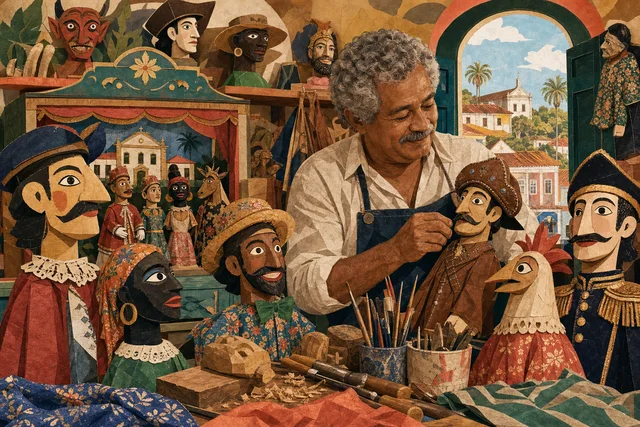
The Mamulengo Museum in Olinda is the first museum in Latin America devoted to popular puppet theatre. Founded on 14 December 1994, it holds a collection of more than twelve hundred pieces made by master puppeteers.
Mamulengo is the glove-puppet theatre of the Northeast, in which characters play out scenes of rural and urban daily life, often with rough humour and social satire. It is a living tradition rather than a reconstruction.
The collection includes eighteenth-century puppets, which makes it exceptional, because a puppet is a working object, wears out in use and rarely survives that long.
The display is organised in thematic rooms: the Enchanted, with the supernatural world; the Masters, with nineteenth-century puppets by the country's greatest makers; Customs, with the state's cultural expressions; and Folkloric, with Bumba Meu Boi and related northeastern traditions.
Come with or without children: this is a museum that works equally for both.
A practical conclusion: plan this stop deliberately, because its value emerges through the context of the town rather than through a single striking object.
1994 and the years since
The museum was founded on 14 December 1994 as the first Latin American institution entirely devoted to the popular puppet.
Its twentieth anniversary, marked in 2014, showed how firmly the house had settled into Olinda's cultural life.
The collection keeps growing through donations: collections from puppeteers and their families arrive at the museum, and each addition preserves the technique of a particular master.
The museum occupies the Mercado Eufrásio Barbosa complex, sharing space with a theatre, a bookshop and exhibition rooms.
Remember that the tradition is centuries older than the museum, so the institution must not only keep but catch up. Note that dates of construction, consecration and completion of finishes often diverge in Brazil, so official sources may give different years for the same building.
Twelve hundred puppets in four rooms
The base is more than twelve hundred pieces by master puppeteers, representing popular types in rural and urban situations.
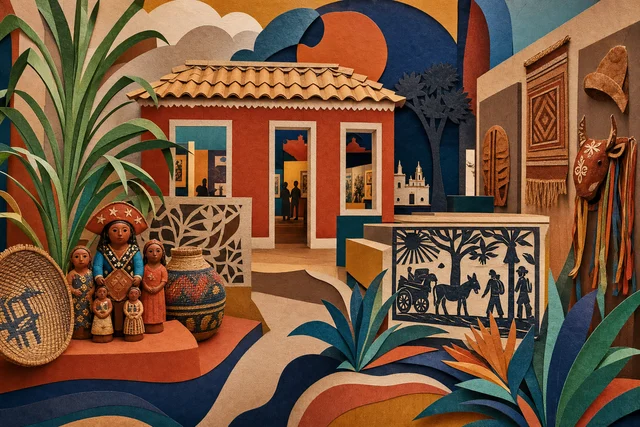
Thematic rooms give the structure: the Enchanted shows the supernatural world of the tradition, the Masters gathers nineteenth-century puppets by the country's greatest makers, Customs covers the state's cultural expressions and Folkloric addresses Bumba Meu Boi and related traditions.
A separate value lies in the eighteenth-century examples, rare in any puppet collection anywhere, because the material is perishable and the figures were used until they wore out.
Besides the figures, the technique is shown: construction, the mechanics of movement, fixings and materials.
The collection grows by donation, so the selection changes over time.
Keep in mind that the tropical climate defines everything, since humidity, salt and heavy rain dictate what survives and how often restoration is needed.
How to look closely
Look at the faces, because in mamulengo a type is made by exaggerating features, and in them you see whom the tradition mocks or celebrates, from priest to policeman, landowner to neighbour.
Study the construction: how the head is made, how the cloth attaches, how the puppeteer's hand drives the figure. The mechanics are simple and therefore expressive.
Compare puppets by different masters, because signature exists in popular tradition too, and the Masters room makes that clear.
Look for marks of use, wear, repairs and replaced parts, proof that these puppets worked rather than sat on a shelf.
And ask whether performances run at the museum or nearby, because a puppet in action explains the collection instantly.
Varadouro and the market
The museum sits in Varadouro inside the Mercado Eufrásio Barbosa complex, itself both monument and cultural centre.
The setting helps: the same building holds the Fernando Santa Cruz theatre, a bookshop, exhibition rooms and the Pernambuco crafts centre shop.
Varadouro is the lower part of the historic centre, closer to transport and gentler in terrain than the upper town.
From the museum you can climb into the historic site or stay below, where distances are shorter.
On event and fair days the complex fills and works as a civic venue. It is worth walking the block on a weekday and at the weekend, because Olinda has two rhythms and tourist flow changes how the streets feel.
Popular tradition in a display case
Mamulengo is street art and improvisation, often coarse and politically pointed, and moving it into a display case inevitably softens that edge. It is worth remembering before neatly arranged figures.
The second question is authorship and payment, because puppeteers historically worked for little money and institutional recognition came late.
The third is continuity: while masters and companies survive, the museum complements practice; if practice weakens, it risks becoming the only place where mamulengo exists.
That is why donation policy and work with living puppeteers matter more here than expanding the display.
It is worth looking at the collection with that question in mind.
Planning the visit
Allow forty minutes to an hour: the collection is compact but dense, and you will want to linger at particular figures.
Check the programme in advance and ask whether a performance or workshop runs that day, because a live showing changes everything.
With children this is one of the best stops in Olinda, since the material reads without preparation and needs little text.
Combine the visit with the Mercado Eufrásio Barbosa itself and its exhibition rooms, in the same complex.
If technique interests you, ask the staff about how the puppets are built, a subject the labels rarely cover in full.
Build a day of three or four stops with pauses, because trying to see more in Olinda usually ends in fatigue.
Getting there and access
The museum lies in Varadouro, in the Mercado Eufrásio Barbosa complex, about seven kilometres from central Recife. Taxi or bus works well.
The lower town's terrain is gentler than the upper, which makes the visit easier for families with children and visitors with reduced mobility.
The building is historic, so confirm in advance that an accessible entrance and internal route exist.
There is parking near the complex, which fills on event days.
Consider the heat: it is cooler inside, and the visit works well as a pause in a route. Plan your return in advance, because transport is harder to find in the historic part after dark.
Where to go next
Start with the Eufrásio Barbosa complex itself, with its theatre, exhibition rooms and crafts shop in the same building.
Then climb into the historic centre for the Alto da Sé museums, or go to the Mercado da Ribeira with its craft workshops.
If popular culture is your subject, add Casa do Carnaval and the Museum of Popular Art in Recife to complete the picture.
For a rest there are cafés in the lower town.
And keep the Alto da Sé panorama for the end of the day.
Remember that upper and lower town work differently, with churches and views above and markets and daily life below.
Verified facts
Every fact below is linked to this profile’s source codes.
- Location
- Varadouro · Olinda OLINDA_MON
- Listed address
- Rua de São Bento, 344 OLINDA_MON
- Documented focus
- Museum dedicated to mamulengo and master puppeteers, preserving characters and techniques from popular puppet theater. OLINDA_MON
- Evidence basis
- The place is listed by an official source; current visitor operation needs confirmation. OLINDA_MON
Original Meu Recife editorial copy based only on this profile's source codes. It does not reproduce third-party text in full or turn a community-guide opinion into fact.
Before visiting
Allow forty minutes to an hour and check in advance whether a performance or workshop runs that day, because a puppet in action explains the collection at once. The museum sits inside the Mercado Eufrásio Barbosa complex with its theatre and exhibition rooms, so the visit extends easily. The terrain here is gentler than in the upper town.
- Reference address
- Rua de São Bento, 344, Varadouro, Olinda — PE
- Museums & memory
- 1–2 hours
- What can change
- Hours, tickets, accessibility and temporary closures can change. Confirm with the official source before visiting.
Getting there
Coordinates cross-checked against multiple mapping sources
- Reference address
- Rua de São Bento, 344
- District and city
- Varadouro · Olinda, PE
- Verified coordinates
-8.016315, -34.852403