Museums & memory · Recife / Bairro do Recife
Rolando Toro Museum of Afro-Brazilian Arts
A small museum facing a vast history
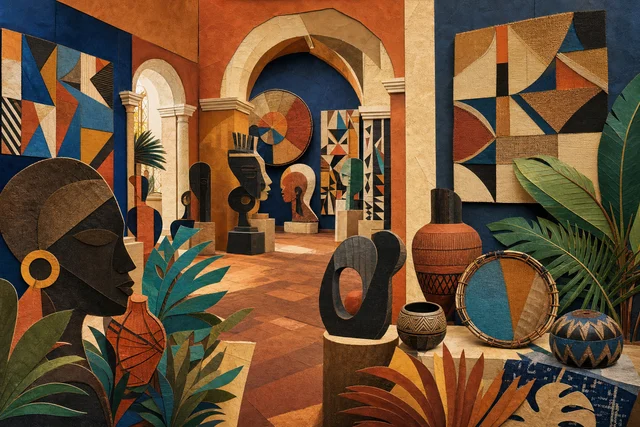
MUAFRO is intimate in scale but undertakes an enormous task: placing African and Afro-Brazilian arts at the center of a city formed by the Black Atlantic. Recife prospered as the port of a slaveholding economy; generations of Africans and their descendants produced labor, religion, music, language, and forms of association that monumental history often left at the margins. Sculptures, masks, and cultural activities offer another entrance into Bairro do Recife. The museum’s value does not lie in delivering a “summary of Africa”—an impossible and improper goal—but in bringing objects, artists, Black movements, and local audiences into contact. It is also a live venue for performance, workshops, maracatu and afoxé rehearsals, book launches, and conversation. That combination moves a visit beyond silent contemplation toward contemporary cultural presence.
From Rolando Toro’s collection to MUAFRO
The initial core came from a collection assembled by Rolando Toro Araneda, a Chilean anthropologist and psychologist known for creating Biodanza. Official Ibram records state that he transferred seventy objects during his lifetime, mainly sculptures from different parts of the African continent. The Visite Museus platform describes the institution as active since 2015, while the National Museum Register gives 2014 as its opening year. That discrepancy should remain visible rather than being settled by guesswork; institutional creation and effective public opening may have occurred at different moments. The collection came to combine African and Afro-Brazilian work, including wooden sculpture and masks by Otávio Bahia. Occupations, music, theater, dance, literature, afoxé encounters, and educational programs subsequently broadened its role. Its history therefore exceeds the biography of the collector named on the façade.
Collection, display, and cultural house
This is not an encyclopedic museum of monumental galleries. Proximity asks the visitor to notice scale, wood, gesture, and surface. Ibram classifies the holdings under anthropology, ethnography, and visual art; Visite Museus mentions pieces from several African countries alongside Otávio Bahia’s work. Such categories help but do not exhaust meaning. A mask is not shorthand for “African art,” and a sculpture may have moved between ritual practice, market, private collection, and museum. Watch whether labels record maker, people, region, material, function, and provenance—and notice when information is absent. Because the house hosts workshops and performances, its architecture emerges through use: gallery, meeting room, and stage may alternate. Layout and exhibitions can change, so confirm what is currently installed rather than expecting a fixed sequence.
Looking without reducing a continent
Choose four objects and resist quickly calling them “tribal,” “mystical,” or “primitive.” Read the place of origin when given, then compare proportion, treatment of eyes and hair, pose, surface marks, and traces of use. Ask whether an object was made to face a viewer, be carried, worn, touched, or form part of a larger ensemble. In Otávio Bahia’s work, look for an Afro-Brazilian artist’s deliberate conversation with wood, memory, and ancestral form without automatically confusing it with historic African objects. If a mediator is present, ask for distinctions among origin, function, and acquisition history. Photographs of a maracatu rehearsal, discussion, or performance also matter: they belong to what the museum symbolically collects. The experience deepens when things cease to be curiosities and become relationships among specific people, times, and territories.
The Black Atlantic in Bairro do Recife
Rua Mariz e Barros lies in the old port territory, close to Cais do Apolo, Rua do Bom Jesus, and warehouses converted to cultural use. For centuries the port connected Pernambuco to Atlantic circuits of trade, forced migration, and ideas. The restored district promoted today as Recife Antigo can conceal the Black workers who moved cargo, built streets, organized brotherhoods, and remade culture under violence. MUAFRO returns that question to the visitor’s route. Its presence also resonates with afoxés, maracatus, and other practices that continue to occupy downtown, especially during festival seasons. Do not treat the museum as a themed island detached from quays and townhouses. Ask how polished buildings related to port, sugar, slavery, and later free labor. The neighborhood then becomes an archive of contested memory and presence, rather than a colonial stage set.
Provenance, slavery, and the right to narrate
Museums of African art must face questions older collections often avoided: who made an object, how did it leave its community, through which intermediaries did it travel, and what documentation accompanied its acquisition? A private-collection origin does not itself establish wrongdoing, but it makes provenance central. European colonialism, international markets, and ethnographic classifications separated many things from names, uses, and contexts. In Brazil, speaking of Africa must also avoid reducing distinct peoples to a generic “source” of enslavement. Enslaved Africans and Afro-Brazilians were makers of kinship, faith, art, resistance, and politics, not anonymous victims alone. Visitors can expect specific labels while listening to living practices hosted by MUAFRO. The museum’s promise lies in revisiting inherited holdings through dialogue with artists, scholars, and Black communities, keeping open the questions the objects cannot answer by themselves.
An hour of looking and conversation
Plan sixty to ninety minutes, depending on the current exhibition or activity. Begin with a silent circuit to understand the room’s scale. Then select four objects of different origins or forms and give each about five minutes: label, material, marks, position, and unanswered questions. Reserve a third phase for Afro-Brazilian work and documentation of events, reading the museum as a cultural platform rather than a storehouse. If mediation is offered, ask how many pieces are displayed, how they were documented, which countries or peoples appear, and how the museum collaborates with local artists and communities. A useful question for children and adults is, “What information would I need to tell this object’s story respectfully?” Check for a temporary show, workshop, or performance before visiting; an event day may be more collective and less like a conventional gallery tour.
Arrival and conditions that require confirmation
Museum registers give the address as Rua Mariz e Barros, 328, Bairro do Recife. It is walkable from Marco Zero and Praça do Arsenal; in a ride app, use the complete MUAFRO name and verify the street number before getting out. The district changes considerably between weekdays, event nights, and weekends, so plan the return and pay attention to lighting and foot traffic. Official records conflict on hours, admission, and opening year, while the National Museum Register does not confirm mobility infrastructure or resources for blind, low-vision, Deaf, or hard-of-hearing visitors. This does not mean a visit is impossible, but accessibility should not be promised. Contact the museum about steps, door width, toilet, seating, Libras, audio description, personal assistance, and the format of any event. Confirm the agenda, ticketing, and reservation requirements too.
From collection to Atlantic landscape
After MUAFRO, walk toward Cais do Apolo and study the waterfront that once tied warehouses, ships, and labor together. The Apolo-Hermilo complex offers a complementary story of arts training and cultural reuse. In the other direction, Rua do Bom Jesus and the old port zone invite discussion of Atlantic trade, Jewish presence, and Dutch rule without erasing the slavery sustaining that economy. To deepen Recife’s Black memory, continue later to Pátio de São Pedro and Pátio do Terço, territories of maracatu, afoxé, religious brotherhoods, and Afro-Recife cultural policy. Do not force every stop into one hot walk: choose one axis and save the other. The strongest conclusion is that African art, Afro-Brazilian culture, and urban history are not separate chapters. They intersect in how Recife was built, celebrated, and contested.
Verified facts
Every fact below is linked to this profile’s source codes.
- Location
- Old Recife · Recife REC_TOUR_DATA
- Listed address
- Rua Mariz e Barros, 328 REC_TOUR_DATA
- Documented focus
- Space dedicated to artistic languages and Afro-Brazilian cultural references. REC_TOUR_DATA
- Evidence basis
- The place is listed by an official source; current visitor operation needs confirmation. REC_TOUR_DATA
Original Meu Recife editorial copy based only on this profile's source codes. It does not reproduce third-party text in full or turn a community-guide opinion into fact.
Before visiting
The two federal museum records conflict on opening year, hours and admission, so verify directly. The national record does not establish a step-free route or sensory access; ask about concrete conditions in advance. Leave time to read authorship, provenance and context: the collection gains meaning when connected to Afro-Brazilian artistic production, Recife’s Black memory and Rolando Toro’s own collecting trajectory.
- Reference address
- Rua Mariz e Barros, 328, Bairro do Recife, Recife — PE
- Museums & memory
- 1–2 hours
- What can change
- Hours, tickets, accessibility and temporary closures can change. Confirm with the official source before visiting.
Getting there
Coordinates published by an institutional source
- Reference address
- Rua Mariz e Barros, 328
- District and city
- Bairro do Recife · Recife, PE
- Verified coordinates
-8.062850, -34.873079