Museums & memory · Recife / Madalena
Museum of Abolition — Afro-Brazilian Culture Centre

A museum that shifts the centre of the story
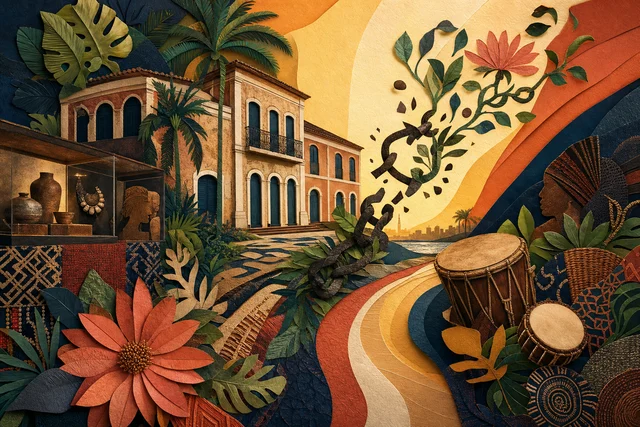
The Museum of Abolition should not be read as a mausoleum to 13 May, but as a place that asks who made freedom and who was excluded from the official account. Its institutional mission is to preserve and share Afro-descendant memory and heritage while encouraging critical reflection on abolition, identity and citizenship. That shifts attention from statesmen’s signatures to Black resistance, living cultures and consequences that outlasted 1888. The apparently conclusive name becomes a question. Slavery was abolished in law; racism, inequality, violence and disputes over the right to narrate the country did not vanish by decree.
The institutional frame explains the weight of this address: the Abolition Museum was created in 1957 by federal law 3,357, signed by President Juscelino Kubitschek, honouring the abolitionists João Alfredo and Joaquim Nabuco.
From sugar estate to reference centre
The site’s history begins long before the museum. The Sobrado Grande da Madalena belongs to the seventeenth-century world of sugar production and was remodelled in a neoclassical language in the nineteenth. A Museum of Abolition was proposed in 1954 and created by Federal Law 3,357 in 1957. The municipality expropriated the property for public use; it received national heritage protection in 1966 and was restored between 1968 and 1975. The museum opened only on 13 May 1983. It closed in 1990, reopened in 1996 and suspended visits again in 2005. A participatory exhibition launched in 2010 signalled a new approach; comprehensive building works began in 2020.
Between the 1957 law and the opening more than two decades passed: the museum was officially inaugurated only in 1983, with the exhibition The Abolitionist Process Through Official Texts.
Tiles, ironwork and a collection under review
Read the two-storey house as a social document. Its rectangular plan, symmetrical composition, decorated parapet, tiled panels and wrought-iron balconies record the nineteenth-century transformation of a house associated with a sugar estate into a prestigious residence. Timber, stone and ceramic floors meet thick brick walls and arches that have since been filled. The ensemble includes a garden, annex and open-air theatre. The holdings bring together objects related to slavery and abolition, religious pieces, coins and medals, African and Afro-Brazilian material, contemporary art, a library and an archive. A substantial part of the museum collection can also be explored through the institution’s online platform.
The building was the mansion of the Madalena estate and the residence of councillor João Alfredo, and the collection holds objects from the daily life of masters and enslaved people alike, from items of religious syncretism to instruments of the slave trade.
What deserves a lingering look
Begin outside. Notice how the parapet conceals the roof and how tiles, rhythmic openings and balconies compose an image of order. Then search for the less comfortable meaning of that order. The scale of the house, garden and separation of rooms speak of domestic and economic power even when no display explains them. Inside, compare instruments of punishment or labour, elite household objects, religious references and commemorative items about abolition. Ask who named each object, when it entered the collection and which version of history it once supported. Attention to labels, provenance and missing voices matters here as much as looking at the object itself.
Madalena: sugar, routes and urban expansion
Madalena is not an incidental address. The estate developed beside a route towards the interior and an old crossing of the Capibaribe, in territory shaped by the sugar economy. Later, country plots and large houses for affluent families accompanied Recife’s growth beyond its port core. Rua Benfica still permits glimpses of that layer, now compressed by traffic and metropolitan density. Travelling here, away from the most visited circuit in Recife Antigo, clarifies that slavery was not solely a matter of docks, markets or distant plantations. It structured landholding, housing, movement and prestige across the city’s formation.
The ethics of viewing a difficult collection
The inaugural display centred on official texts, while the early collection—largely assembled through antique dealers and donations—privileged an elite viewpoint and made little room for communities directly affected by enslavement. The institution has acknowledged that problem. After 2005 it engaged with social movements and participatory work to rethink its account. Visitors should resist treating instruments of violence as macabre curiosities or enslaved people as a voiceless category. Parliamentary abolitionism must also be distinguished from many Black struggles: escape, quilombo communities, associations, religions, labour, journalism and political action. A responsible museum does not dissolve that tension; it makes the tension readable.
How to shape the visit
Allow at least ninety minutes; two hours are better if you want to read labels critically, study the building and use the garden without haste. Start with the museum’s own introduction, follow the chronology of the exhibition currently available, and approach the most difficult objects only after understanding the curatorial argument. If an educator is present, take the opportunity: questions about provenance, community participation and changes to the collection are especially rewarding. Ibram publishes the address, contacts and programme, but hours, open rooms, exhibitions, admission and photography rules are mutable. Verify them through official channels on the day, particularly while restoration and new displays may affect circulation.
Arrival: take Rua Benfica slowly
Set your destination as Rua Benfica 1150 in Madalena. Coming from the centre, the journey reveals a city of busy avenues, bridges and older residential axes. On arrival, do not expect an instantly theatrical façade: allow the house to emerge behind the edge of its plot and compare its scale with present traffic and surrounding buildings. Pavement and crossing conditions can change, so travellers with reduced mobility should plan the closest safe drop-off. Before entering, make whatever visual circuit the street boundary allows. This pause establishes a useful order of interpretation: territory first, then house, and finally the museum narrative.
The renovation project begun in 2020 included a lift intended to reach the upper floor and broader upgrades, yet official plans and registry pages from different dates describe different conditions. A planned feature should not be presented as a guaranteed working service. Before visiting, ask whether the lift operates, which entrance provides a step-free route, whether every floor and outdoor area is accessible, whether an adapted toilet is available, and what communication resources exist for blind, low-vision, Deaf or neurodivergent visitors. Share wheelchair dimensions or other relevant requirements. Ibram has designated accessibility focal staff, but the facilities actually available still need direct confirmation.
What to combine nearby
To continue the social-history thread, pair the museum with Fundação Joaquim Nabuco and Museu do Homem do Nordeste in Casa Forte during another half-day; their anthropological perspective expands questions of labour, belief, daily life and regional formation. Closer by, a short walk in Madalena can include the Capibaribe edge and traces of old residential routes, treating the neighbourhood as more than transit. For a deeper Black-memory itinerary in the centre, reserve a separate period for Pátio do Terço, Igreja do Rosário dos Homens Pretos and Pátio de São Pedro. These are distinct contexts: the combination should build historical continuity, not reduce difficult places to a hurried checklist.
Verified facts
Every fact below is linked to this profile’s source codes.
- Location
- Madalena · Recife MAB
- Listed address
- Rua Benfica, 1150 MAB
- Documented focus
- Federal museum dedicated to the memory of slavery, abolition, resistance and Afro-Brazilian cultures. MAB
- Evidence basis
- Identity, location and cultural relevance are supported by primary evidence. MAB
Original Meu Recife editorial copy based only on this profile's source codes. It does not reproduce third-party text in full or turn a community-guide opinion into fact.
Before visiting
On the day, confirm hours, open exhibitions, admission, photography, mediation and any impact from works through official Ibram/MAB channels. For accessibility, ask specifically about a step-free entrance, operating lift, adapted toilet and communication resources. Allow unhurried time for the exhibition: its subject rewards close reading of labels, object provenance and the language the museum uses to frame abolition and its unfinished aftermath.
- Reference address
- Rua Benfica, 1150, Madalena, Recife — PE
- Museums & memory
- 1–2 hours
- What can change
- Hours, tickets, accessibility and temporary closures can change. Confirm with the official source before visiting.
Getting there
Coordinates published by an institutional source
- Reference address
- Rua Benfica, 1150
- District and city
- Madalena · Recife, PE
- Verified coordinates
-8.056521, -34.908816