Museums & memory · Recife / São José
Railway Museum — Capiba Central Station


A station that explains the scale of Pernambuco
The Railway Museum is more than a collection of old machines. It is where a visitor can grasp how rail changed distance, time, and power across Pernambuco. Suburban services, trains from the interior, and interstate connections once converged at the Central Station; workers, families, goods, and news moved through its platforms. That memory now occupies a living part of São José, beside contemporary metro and commercial flows. The overlap is the point. Rail is not presented as a sealed chapter, but as an ancestor of the corridors, terminals, and timetables that still organize Recife. The name Estação Central Capiba supplies a musical layer: it honors the Pernambuco composer Capiba, whose frevos and songs turned urban movement into art and shared memory.
From steam to a renewed museum
Recife Central Station opened in 1888, when railway expansion was already reshaping the provincial economy and the capital’s ties to plantations, ports, and inland towns. The Museu do Trem was founded here on 25 October 1972, with Gilberto Freyre as its patron and guidance from what was then the Joaquim Nabuco Institute of Social Research. The museum closed in 1983, a year also associated with the end of the building’s regular railway role; in 1985, the station returned to use as an access point for the metro. Closed again for work in 2009, it reopened at the end of 2014 as Estação Central Capiba, housing the renewed museum. This sequence of operation, interruption, and reuse matters as much as any locomotive: industrial heritage survives through repeated public choices, not a single inauguration.
Iron architecture and the tools of work
Read the building before entering the display. The station is a reference point for railway architecture and the culture of iron construction, designed to order arrivals, departures, ticketing, and waiting. The long-term exhibition Chegada e Partida — A Memória do Trem em Pernambuco occupies the ground and upper floors and contains more than five hundred objects, according to Secult-PE/Fundarpe. Seats, ticket offices, punches, signals, whistles, and clocks reveal the railway as a system of collective precision. Photographs, posters, and texts expand its geography, while audiovisual resources recover sound and motion. Rolling stock and a steam locomotive give physical scale outside. Renovation introduced a lift, climate control, exhibition lighting, bilingual signs, and technical safety systems, but visitors should still confirm what is actually operating on the day.
Details worth slowing down for
Begin with clocks and signaling instruments. They show how standardized public time displaced more local rhythms and coordinated people separated by many kilometers. Then compare the graphic delicacy of tickets, posters, and stamps with the mass of a locomotive. Historical accounts mention engineer Edgard Werneck’s office, with a desk, typewriter, calculating machine, and personal stamps; set that managerial world against the less visible physical labor of drivers, firemen, track crews, and porters. Outside, walk around the steam engine and read wheels, rods, and cylinders as mechanical choreography. Indoors, the installation known as O Túnel uses three-dimensional imagery to stage an approaching train. Treat it as more than spectacle: listen for how speed, anticipation, fear, and industrial sound entered the modern imagination.
São José: terminal, market, and popular city
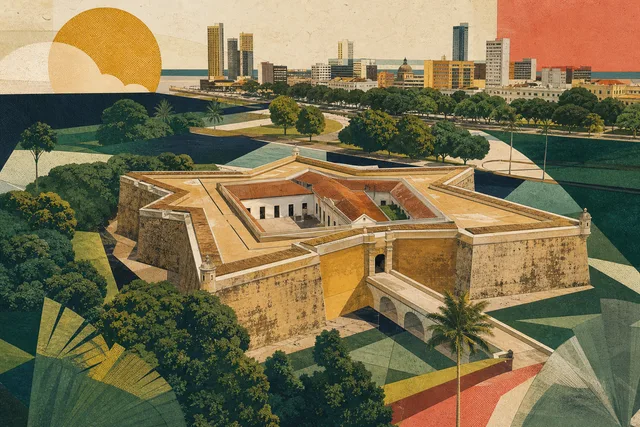
The São José location belongs to the museum’s argument. Large circulation systems coexist here with street commerce, religious heritage, markets, and housing. Nearby, Casa da Cultura occupies the former House of Detention; Mercado de São José, Pátio de São Pedro, and Forte das Cinco Pontas extend the district’s story of work, faith, control, and encounter. The station did not appear in neutral space: it drew the interior closer to the port center and intensified the movement of people and goods. Watching today’s metro passengers and shoppers prevents the surroundings from becoming a frozen period set. São José is an active downtown district, with uneven pavements, traffic, noise, peak-hour crowds, and strong social contrasts. It calls for awareness and respect, rather than a quick search for picturesque images.
Whose progress, and at whose cost?
Heroic railway narratives celebrate engineering and speed, but a mature visit asks who financed, built, and benefited from the lines. Rail enabled modernization while serving an export economy shaped by centuries of slavery, increasing land values unevenly and concentrating decisions in the capital. Railway workers created technical knowledge, labor organization, and close communities, yet official accounts long foregrounded owners and engineers. Line closures later deprived some towns of former connections, disrupted families, and dispersed collections. The museum lets visitors hold these tensions without surrendering admiration for the machines. Notice who appears in photographs, captions, and recorded voices—and who does not. Industrial heritage is most honest when innovation, discipline, accidents, inequality, labor, and longing all share the frame.
A focused ninety-minute visit
Allow about ninety minutes so the collection does not collapse into an inventory. Spend the first fifteen reading the façade, roof, openings, and relationship to the former platform. Then follow the exhibition chronologically while holding three threads: the control of time, railway labor, and urban transformation. Give twenty minutes to operational objects—ticket counter, stamps, signals, clocks—and another twenty to photographs, maps, and testimonies. Save the exterior for last, when you can connect the locomotive to the network that made it useful. If mediation is available, ask about provenance, care of the rolling stock, and memories collected from former workers. Families can invite children to find old equivalents of current apps: ticket, clock, notice, map. Confirm the day’s program, guided activities, and any closed areas before setting out.
Arrival and access without false promises
The entrance is on Rua Floriano Peixoto in São José, close to Recife metro station and Casa da Cultura. Arriving by public transport suits the subject and avoids dependence on scarce central parking. From the metro, follow surface signs and take care around busy crossings; in a taxi or ride app, enter the full name Estação Central Capiba — Museu do Trem to avoid confusion with other stations. Secult-PE records that renovation added a lift and bilingual signs, but this does not guarantee that the lift always operates, that every route is step-free, or that adapted toilets and sensory resources are available throughout. Visitors with reduced mobility or visual or hearing disabilities should ask the institution about current conditions and assistance. Hours, free admission reported on institutional pages, and courtyard access are mutable facts; check an official channel on the day.
Continue through the systems that shaped Recife
Choose a coherent nearby continuation rather than jumping across town. Casa da Cultura, a short walk away, turns a former prison into a cultural center and invites comparison between two public architectures of discipline and circulation. Continue to Forte das Cinco Pontas and Museu da Cidade for maps and images of the urban growth accelerated by rail. Alternatively, follow São José’s commercial streets toward the market and Pátio de São Pedro, linking infrastructure, provisioning, and popular culture. In strong heat, pause and keep walking segments short. End with a simple question: how did port, bridge, train, tram, and metro transform the center without distributing their gains equally? The Central Station is a powerful starting point because it reveals Recife as a network, not a series of detached postcards.
Verified facts
Every fact below is linked to this profile’s source codes.
- Location
- São José · Recife REC_TOUR_DATA
- Listed address
- Rua Floriano Peixoto, s/n REC_TOUR_DATA
- Documented focus
- Railway museum in an old station, with locomotives, equipment and memories of the Pernambuco railways. REC_TOUR_DATA
- Evidence basis
- Identity, location and cultural relevance are supported by primary evidence. REC_TOUR_DATA
Original Meu Recife editorial copy based only on this profile's source codes. It does not reproduce third-party text in full or turn a community-guide opinion into fact.
Before visiting
Do not rely on older pages for hours, prices, or lift operation. Check Secult-PE/Fundarpe on the day for courtyard access, mediation, and the specific facilities available to disabled visitors. The museum becomes clearer when its railway history is read carefully, so allow time for labels attached to machinery, models, tickets and photographs rather than limiting the visit to a quick look at the rolling stock.
- Reference address
- Rua Floriano Peixoto, s/n, São José, Recife — PE
- Museums & memory
- 1–2 hours
- What can change
- Hours, tickets, accessibility and temporary closures can change. Confirm with the official source before visiting.
Getting there
Coordinates published by an institutional source
- Reference address
- Rua Floriano Peixoto, s/n
- District and city
- São José · Recife, PE
- Verified coordinates
-8.068045, -34.883443