Museums & memory · Recife / Boa Vista
Pernambuco Archaeological, Historical and Geographic Institute
A house where Pernambuco archives itself
The Archaeological, Historical and Geographical Institute of Pernambuco is more than a museum. It combines museum, archive, library, oral history, journal and a community of researchers. Founded in 1862, it describes itself as Brazil’s oldest continuously operating state historical institute. Its importance lies as much in the intellectual infrastructure created to select, copy, publish and interpret documents as in the objects on display. Here you can see how a region constructs historical consciousness—and how every generation chooses what deserves preservation. It is a rewarding, concentrated visit for travellers who prefer study rooms, contextualised relics and historiographical questions to theatrical exhibition design.
The institute was founded on 28 January 1862 and was the first regional historical institute in Brazil, so this is where the country's regional historiography began.
From 1862 to Rua do Hospício
The Institute was founded on 28 January 1862, three years after Pedro II visited Recife and amid a desire to organise research into the provincial past. Francisco Muniz Tavares became its first elected president. It occupied rooms in the Carmo convent, the Provincial Public Library at the São Francisco monastery, a building on the former Praça da Concórdia and, from 1912 to 1919, Ginásio Pernambucano. It then settled permanently at Rua do Hospício 130. Its museum opened to visitors in 1866, while Revista do Instituto began publication in 1863, establishing an unusually durable relationship between collection, primary document and scholarly publication.
Since October 1863 it has published its journal, one of the most significant and rare historical periodicals in the country, appearing for more than a century and a half.
A townhouse for museum, archive and library
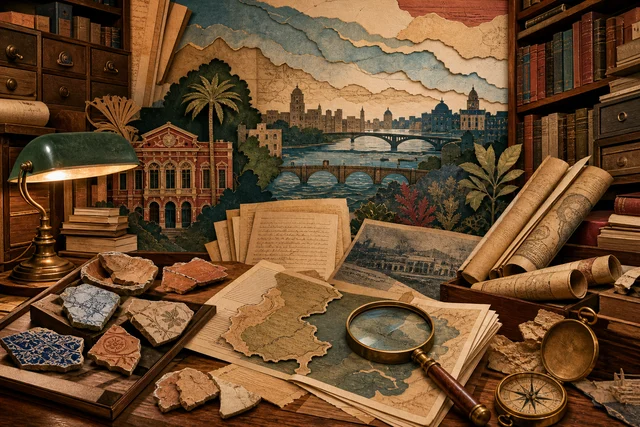
The headquarters is a patriarchal two-storey townhouse with a broad entrance, three windows and a veranda facing one of Boa Vista’s historic streets. Inside, the concentration of collections matters most. Paintings and portraits accompany four palanquins known as cadeirinhas de arruar, a Queen Victoria-model carriage and a Dutch bronze cannon made for the West India Company in 1629. The archive preserves Recife council minutes, provincial correspondence, copies of WIC documents and collections such as Mário Melo and Orlando Cavalcanti. The library and journal complete the institution. They are not secondary amenities but tools with which to test the stories suggested by museum objects.
Its core is a library with an important collection and rare works on the history of Pernambuco, and the whole collection is protected by Iphan as national heritage.
Four objects that open larger histories
Find the 2.5-tonne cannon bearing the WIC monogram. Its survival resulted from the Institute’s intervention, and it condenses warfare, Atlantic commerce and preservation history. Compare it with the street palanquins, which render mobility and social hierarchy in material form. Study the nineteenth-century carriage and ask which streets enabled its use. Before the two large paintings of the Battles of Guararapes, attend less to an illusion of eyewitness truth than to the later manufacture of heroic memory. Political portraits, the first press associated with Diario de Pernambuco and fragments of demolished city arches show how the collection also preserves pieces of a vanished Recife.
Boa Vista, print and intellectual life
Rua do Hospício crosses Boa Vista, the mainland district that became a residential, commercial, educational and cultural axis. Teatro do Parque, Ginásio Pernambucano, Rua da Imperatriz and Parque 13 de Maio place the Institute within a geography of schools, publishing, associations and public debate. Its members helped produce plaques, names and narratives for Recife’s streets. The building is therefore not merely a storehouse of Pernambuco history; the institution actively shaped what the city recognises as historical. On leaving, compare the Rua do Hospício recorded in documents with the intense, popular and heterogeneous street outside today.
Collecting is also an exercise of power
Nineteenth-century historical institutes were tied to literate elites and projects of regional identity. Portraits, military relics and genealogies can monumentalise governors and wars while leaving workers, women, Indigenous people and Black communities at the margins. This does not reduce the collection’s value; it makes critical reading necessary. Ask who donated each item, who possessed the means to write and publish, which records came from public offices and which experiences survive only indirectly. The word archaeological in the title also belongs to a disciplinary history predating current standards. An ethical visit recognises pioneering preservation without confusing institutional longevity with neutrality or completeness.
Museum and research require different rhythms
Allow about ninety minutes for the museum and select several themes rather than trying to memorise everything. The institution’s visit page publishes split weekday hours, a Saturday morning opening, admission and concessions; verify these before departure. Groups and schools must book. Archive and library research has a separate service, offered in a published Saturday period or by remote enquiry. If you seek a document, write in advance with the topic, approximate date, collection and purpose: entering the museum does not imply immediate archive access. Bring identification and be prepared for handling, photography and payment rules.
Arrive through the street, not only the address
Your destination is Rua do Hospício 130 in Boa Vista. Depending on your starting point and conditions that day, approach on foot from Rua da Imperatriz or Parque 13 de Maio. Watch commercial façades give way to cultural institutions and surviving townhouses. The headquarters can seem discreet amid the district’s movement, so check the number and look for the broad entrance. Travellers arriving by car should arrange a brief drop-off because parking and circulation can vary. The route belongs to the experience: this institution studied and named the city, while the present street displays layers that no archive can freeze.
The official sources reviewed do not describe a complete accessible route through the historic townhouse or permanent communication resources in sufficient detail. Do not assume independent access to every floor or collection. Contact the Institute to ask about entrance steps, door widths, a lift or alternative to the upper floor, toilet location, seating and the nearest practical drop-off. Researchers should confirm whether a desk, room and requested material can be prepared on an accessible level. Blind, low-vision and Deaf visitors should ask about mediation, assistance with labels and available resources. A precise answer before travel is an essential part of planning.
A circuit of Boa Vista institutions
Pair the visit with nearby Teatro do Parque, checking first whether a building visit is possible or only a performance. Parque 13 de Maio leads towards Recife’s Law Faculty; Rua da Imperatriz adds commerce, churches and the Gabinete Português de Leitura. To continue thinking about collections, Museu de Arte Moderna Aloisio Magalhães on Rua da Aurora offers a different relationship between museum and city. Do not force every stop into one morning: the Institute rewards concentration. A strong sequence is museum first, lunch in Boa Vista and an urban walk afterwards, leaving archive research for a separately arranged date.
Verified facts
Every fact below is linked to this profile’s source codes.
- Location
- Boa Vista · Recife REC_TOUR_DATA
- Listed address
- Rua do Hospício, 130 REC_TOUR_DATA
- Documented focus
- Research institution with documentation, library and collections linked to the history and formation of Pernambuco. REC_TOUR_DATA
- Evidence basis
- Identity, location and cultural relevance are supported by primary evidence. REC_TOUR_DATA
Original Meu Recife editorial copy based only on this profile's source codes. It does not reproduce third-party text in full or turn a community-guide opinion into fact.
Before visiting
The institution publishes visiting information and treats archive and library research as a separate service. Before travelling, reconfirm current hours, group booking, admission, payment, photography and accessibility. If your purpose is a particular document, book or collection, contact the institute first: a general museum visit and scholarly consultation may require different arrangements and advance preparation.
- Reference address
- Rua do Hospício, 130, Boa Vista, Recife — PE
- Museums & memory
- 1–2 hours
- What can change
- Hours, tickets, accessibility and temporary closures can change. Confirm with the official source before visiting.
Getting there
Coordinates published by an institutional source
- Reference address
- Rua do Hospício, 130
- District and city
- Boa Vista · Recife, PE
- Verified coordinates
-8.061734, -34.884386