Museums & memory · Olinda / Carmo
Olinda Public Library


Pernambuco's first public library
The Public Library of Olinda was created by imperial decree on 7 December 1830 and was the first in Pernambuco and the fifth in Brazil. In a country where public libraries appeared one at a time, that is an institution of rare precocity.
It was first installed in the São Francisco convent, so the state's first public library began inside a conventual complex, a typical link of the age between religious and civil knowledge.
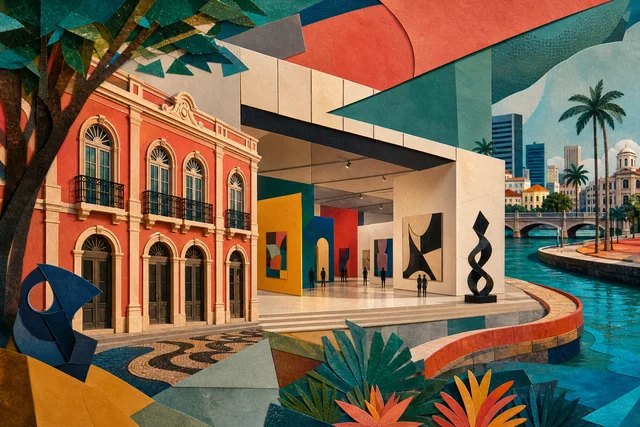
In 1984 the house at Avenida da Liberdade 100 in Carmo was expropriated for it, and restoration of the building was completed in 1996.
According to Olinda's official guide the library operates on Rua Bispo Coutinho at the Alto da Sé, receiving visitors daily in the afternoon.
Come for the fact of continuity: an institution created almost two centuries ago still works in the historic centre.
A practical frame: the object is small and its meaning comes from how it sits in the town rather than from size. Olinda is a rare case where ordinary infrastructure and utilitarian buildings survived alongside the churches, and that completeness is what sustains the World Heritage title.
1830, 1984, 1996
The decree of 7 December 1830 created the library in the first years of independent Brazil, when the state was only beginning to build secular institutions of knowledge.
Installation in the São Francisco convent shows that no dedicated infrastructure existed yet and available buildings had to be used.
Expropriation in 1984 and completion of restoration in 1996 took twelve years, a typical span for Brazilian works on historic buildings.
Today the library remains a working municipal institution rather than a museum piece.
Keep the scale in mind: almost two centuries of continuous existence is rare for a Brazilian cultural institution. Note that dates of construction, consecration and completion often diverge in Brazil, and official sources may give different years for the same property.
Library as monument and as holdings
The value is double: on one side a historic building in central Olinda, on the other a book collection accumulated over decades.
Public libraries of this age usually keep regional periodicals, reference works and books received by legal deposit, and those are what interest researchers.
The space works as a reading room rather than a gallery: come with a task rather than in search of a display.
The 1990s restoration shaped the present interiors and reveals the period's understanding of heritage work.
The house also hosts cultural events, common practice among Olinda's municipal institutions.
Remember the climate: humidity, salt and heavy rain degrade materials faster than in temperate zones, so the condition of anything here results from continuous care.
How to look closely
Read the building as an adaptation: a dwelling converted into a library always keeps traces of the earlier plan, and telling them apart is interesting.
Notice how the reading room is arranged, because the placement of tables and shelves reveals how the institution understands its public.
Ask about the older holdings, since libraries with this history usually keep separate cases of nineteenth-century editions.
Note who studies here, because the profile of users says more about the institution's role in the district than any report.
And look out of the window, because standing in the historic centre is part of the experience. Watch the limits of intervention: where restoration stopped, what was left as found and what was deliberately not rebuilt for lack of documentary evidence.
The historic centre around it
The library sits in historic Olinda, close to the main routes of the upper town.
Proximity to museums and churches makes it a convenient stop between visits, especially in hot hours.
Around it is ordinary urban life, with homes, shops, studios and schools.
During Carnival the block works differently, and institutional hours may change.
From here it is easy to continue to the Alto da Sé or descend to the lower town.
Note that distances deceive because of the terrain, and a route works better organised by altitude than by metres.
Whose knowledge it was
A public library of 1830 was born in a society with very few readers, where education remained a privilege, so the idea of public access in the nineteenth century was highly relative.
It is worth remembering that the first holdings came from conventual and private collections, reflecting the interests of church and elite.
Widening access to reading in Brazil took a century and a half, and municipal libraries played a decisive role only in the twentieth century.
Today the central question is different: stability of funding, because small municipal libraries suffer first when budgets are cut.
Looking at the institution while holding both its age and its fragility in view is the honest approach. Remember that World Heritage status brings attention and funding but also raises the cost of living for permanent residents.
Planning the visit
According to official information the library receives visitors daily in the afternoon, but the schedule should be confirmed beforehand.
Allow twenty to thirty minutes as a visitor and more if you plan to work with the collection.
It fits naturally into an upper-town route with the cathedral, the sacred art museum and the seminary.
If you need specific works, write ahead, because access to older holdings usually follows its own procedure.
Behave as in a reading room: this is a working space rather than a tourist attraction.
Build a day of three or four stops with pauses, because trying to see more ends in fatigue.
Getting there and access
The library lies in the historic centre of Olinda, about seven kilometres from central Recife; according to the official guide, on Rua Bispo Coutinho at the Alto da Sé.
The climb to the upper town is steep and the paving old and uneven, so arriving by car is more practical.
The building is historic, with stairs and thresholds, and accessibility should be confirmed in advance.
Parking at the top is limited, especially at weekends and around sunset.
There is little shade on the way, so bring water. Plan your return in advance, because transport is harder to find in the historic part after dark.
Where to go next
The nearest stops are the Sé cathedral, the Museum of Sacred Art of Pernambuco and the Seminary of Nossa Senhora da Graça.
The Antonino Guimarães Municipal Archive continues the documentary line of the town and sits in the historic part, on Rua de São Bento.
Descending brings you to the churches of the centre, the markets and the Mamulengo Museum.
If institutional history interests you, add the Regional Museum of Olinda in the former episcopal residence.
And keep the Alto da Sé panorama for the end of the day.
Olinda repays two short days more than one long one, because the town is small and dense.
Verified facts
Every fact below is linked to this profile’s source codes.
- Location
- Carmo · Olinda OLINDA_MON
- Listed address
- Av. Liberdade, s/n OLINDA_MON
- Documented focus
- Library of imperial origin installed in a historic house depicted in Dutch iconography of Olinda. OLINDA_MON
- Evidence basis
- Identity, location and cultural relevance are supported by primary evidence. OLINDA_MON
Original Meu Recife editorial copy based only on this profile's source codes. It does not reproduce third-party text in full or turn a community-guide opinion into fact.
Before visiting
This is a working municipal library rather than a museum: official information says it receives visitors daily in the afternoon, but the schedule should be confirmed in advance. If you need specific works from the older holdings, write ahead, since access usually follows its own procedure. Behave as in a reading room.
- Reference address
- Av. Liberdade, s/n, Carmo, Olinda — PE
- Museums & memory
- 1–2 hours
- What can change
- Hours, tickets, accessibility and temporary closures can change. Confirm with the official source before visiting.
Getting there
Coordinates cross-checked against multiple mapping sources
- Reference address
- Av. Liberdade, s/n
- District and city
- Carmo · Olinda, PE
- Verified coordinates
-8.016337, -34.848911