Skip to content
MEU RECIFERECIFE · PERNAMBUCO
The city portal for Recife and PernambucoNEWS · EVENTS · SERVICES
Cultural atlas

Museums & memory · Olinda / Varadouro

Antonino Guimarães Municipal Archive
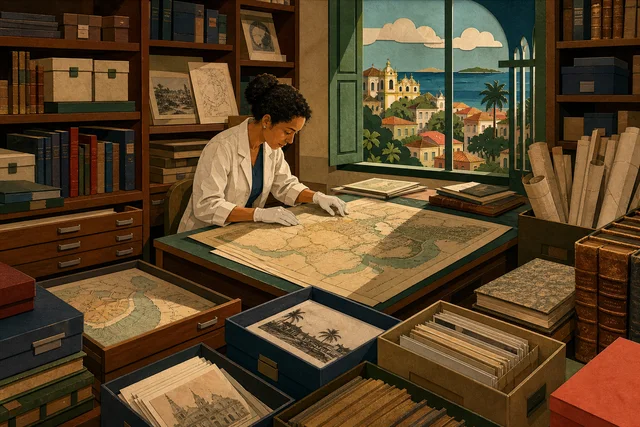
Municipal archive with textual, cartographic, iconographic documentation and rare works linked to the administration and history of Olinda.
1 sources and traceabilityVerified 2026-07-28
Antonino Guimarães Municipal Archive — Original Meu Recife editorial illustration — not a documentary photograph.
Original Meu Recife editorial illustration — not a documentary photograph. · Meu Recife
01

A municipal archive in the Coelho Leal house

The Antonino Guimarães Municipal Public Archive was created in 1983 and occupies the former residence of the Coelho Leal family at Rua de São Bento 153. For a town of this age, having its own archive is not a luxury but the condition on which its history can be written at all.

The holdings consist mainly of documentation accumulated and produced by the municipal executive, with limit dates from the late sixteenth century to the late 1970s.

The material is divided into three large groups, Textual, Cartographic and Iconographic, and the holdings include rare works from the seventeenth to the twentieth century.

Come not for a display but to understand what a town's history is made of: tax lists, plans, permits and administrative correspondence.

For a researcher this is a key point in the state; for a visitor, a rare chance to see how urban memory is kept.

A practical frame: the object is small and its meaning comes from how it sits in the town rather than from size. Olinda is a rare case where ordinary infrastructure and utilitarian buildings survived alongside the churches, and that completeness is what sustains the World Heritage title.

02

1983 and four centuries of documents

The archive was created in 1983, relatively late, which is typical: municipal archives in Brazil appeared once documents had already suffered from storage conditions.

The holdings' limit dates, the late sixteenth century and the late 1970s, cover almost four centuries of municipal administration across colonial, imperial and republican periods.

Housing it in a former dwelling means the building was adapted for storage rather than built for it, which affects conservation.

In recent years the archive marked forty years, a significant date for a municipal institution of this kind.

Keep the gap in mind: the documents are four centuries older than the archive, which explains why some material arrived in poor condition. Note that dates of construction, consecration and completion often diverge in Brazil, and official sources may give different years for the same property.

03

The three groups of holdings

The textual group is the base: administrative acts, correspondence, registers, fiscal and public-works documents of the municipality.

The cartographic group gathers plans and maps through which the development of the urban fabric can be reconstructed, with streets, plots and built areas.

The iconographic group brings images, photographs, prints and drawings, a visual layer complementing the written record.

Separately stand rare works from the seventeenth to the twentieth century, an unusual presence in municipal archives.

There is no display in the usual sense: this is a working repository with consultation access.

Remember the climate: humidity, salt and heavy rain degrade materials faster than in temperate zones, so the condition of anything here results from continuous care.

04

How to look closely

If documents are shown to you, study the medium, because paper, ink and binding speak of the technologies of their time as much as the content does.

Look at the cartographic part, since old plans of Olinda show how the coastline changed and how the slopes were built up.

Notice the state of conservation, because tropical climate, humidity and insects are the main enemies of archives and the marks of that fight are visible.

Ask about processing, because what is described and digitised is accessible while what is not remains effectively invisible.

And read the building itself, an adapted dwelling whose plan was never meant for document storage. Watch the limits of intervention: where restoration stopped, what was left as found and what was deliberately not rebuilt for lack of documentary evidence.

05

Rua de São Bento

The archive stands on Rua de São Bento in historic Olinda, near the monastery of the same name with its gilded carving.

This is an area of ordinary urban life without dense tourist infrastructure, and the walk here shows the historic centre away from the routes.

From the archive it is easy to continue to the São Bento monastery and then climb to the upper town.

The terrain here is gentler than at the Alto da Sé, which makes the walk less demanding.

During Carnival the block falls within the area of street routes.

Note that distances deceive because of the terrain, and a route works better organised by altitude than by metres.

06

What is kept and what disappears

An archive of municipal power reflects, by definition, the administration's point of view: it holds taxes, permits and orders but almost no voices of the people those papers were written about.

Remember that documents about enslaved people exist in Brazilian archives mainly as property records, and working with them requires its own method and ethics.

Creating the archive only in 1983 means that before then documentation was scattered, and part of the material was lost irreversibly.

Tropical climate and chronic underfunding make conservation a permanent problem rather than a solved task.

Looking at the archive as both a keeper of memory and evidence of its gaps is the honest approach. Remember that World Heritage status brings attention and funding but also raises the cost of living for permanent residents.

07

Planning the visit

Confirm access conditions in advance, because archives keep their own routine and consulting the holdings usually requires an appointment.

Allow an hour as a visitor and a whole morning if you plan to work with documents.

Formulate your request beforehand, because staff locate material better when they know the period, document type or subject.

Combine the visit with the São Bento monastery nearby.

Remember this is a working space: quiet and care are expected.

Build a day of three or four stops with pauses, because trying to see more ends in fatigue.

08

Getting there and access

The archive is at Rua de São Bento 153 in the historic centre of Olinda, about seven kilometres from central Recife.

You can arrive by taxi or bus with a walk, and the terrain in this part is gentler than at the Alto da Sé.

The building is historic and adapted, so accessibility should be confirmed in advance.

The paving around is old and uneven and slippery after rain.

Parking is limited, especially at weekends and on event days. Plan your return in advance, because transport is harder to find in the historic part after dark.

09

Where to go next

The nearest stop is the São Bento monastery with its gilded carving, minutes away on foot.

The Public Library of Olinda continues the documentary line, and together the two show how memory is kept.

Climbing leads to the Alto da Sé with its cathedral and museums; descending leads to the markets and the Mamulengo Museum.

If institutional history interests you, add the Regional Museum of Olinda.

And keep the panorama of the town for the end of the day.

Olinda repays two short days more than one long one, because the town is small and dense.

10

Verified facts

Every fact below is linked to this profile’s source codes.

Location
Varadouro · Olinda
OLINDA_MON
Listed address
Rua de São Bento, 153
OLINDA_MON
Documented focus
Municipal archive with textual, cartographic, iconographic documentation and rare works linked to the administration and history of Olinda.
OLINDA_MON
Evidence basis
Identity, location and cultural relevance are supported by primary evidence.
OLINDA_MON

Original Meu Recife editorial copy based only on this profile's source codes. It does not reproduce third-party text in full or turn a community-guide opinion into fact.

11

Before visiting

This is a working archive rather than a museum: confirm access conditions and hours in advance, since consulting the holdings usually requires an appointment. Formulate your request before visiting, naming the period, document type or subject, which helps staff find the material. The building is historic and adapted, so confirm accessibility separately.

Reference address
Rua de São Bento, 153, Varadouro, Olinda — PE
Museums & memory
1–2 hours
What can change
Hours, tickets, accessibility and temporary closures can change. Confirm with the official source before visiting.
12

Getting there

Coordinates cross-checked against multiple mapping sources

Reference address
Rua de São Bento, 153
District and city
Varadouro · Olinda, PE
Verified coordinates
-8.017917, -34.852371
The interactive map will load as you scroll
Location map for Antonino Guimarães Municipal Archive
Coordinates cross-checked against multiple mapping sources · map © OpenStreetMap