One Day on Foot in Recife Antigo: Port, Memory, Frevo and Sertão
A modular route through Marco Zero, Rua do Bom Jesus, Praça do Arsenal, Paço do Frevo and Cais do Sertão, with shorter options.
4–6 hours with museums
Verified points are connected in editorial order. Zoom the map and use turn-by-turn navigation outside.
- 01Marco ZeroHarbour-side start
- 02Cais do SertãoMusic and sertão culture
- 03Bom Jesus StreetUrban memory
- 04Paço do FrevoFrevo and finish
A modular route
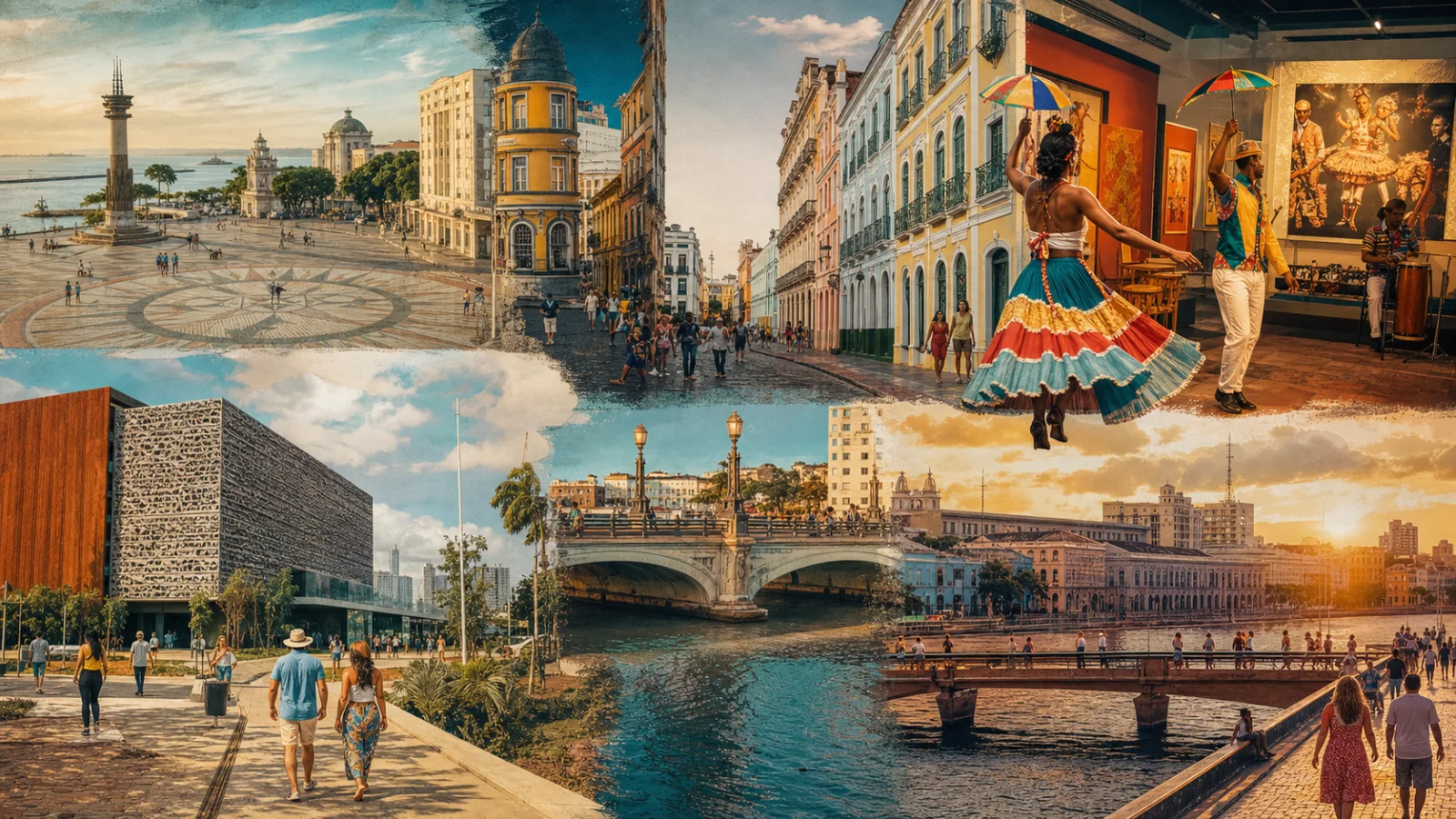
This route uses a narrative rather than a rigid timetable: port, urban memory, frevo and the sertão. It works through public space alone or with venues when open. Check weather, access and events, then choose a short or extended version.
Marco Zero and the waterfront
At Praça Rio Branco, begin with water, warehouses and the horizon. Marco Zero is a symbolic orientation point, not a summary of the district. Imagine the difference between an ordinary day and a major event. Any crossing to the sculpture park needs its own live check.
Rua do Bom Jesus
Read façades together with commerce and Jewish history. Keep entrances clear and respect worship and private activity. The Conecta Recife virtual tour helps orientation but does not replace context.
Praça do Arsenal and frevo
The square offers a pause before Paço do Frevo, a reference centre for safeguarding, training and sharing the form. Select one lens—music, dance or memory—rather than rushing.
Cais do Sertão
The museum places sertão culture inside a former port setting. Themes of work, belief, creation and migration connect coastal Recife to the interior.
Short and extended versions
The short route covers Marco Zero, Bom Jesus and Arsenal. The extended version adds one or two museums. Heat, surfaces and events change the effort, so plan an easy return.
How to use this guide without treating advice as a promise
This article provides context and a decision method, not a guaranteed outcome. the walking route and access to Recife Antigo venues may change because of maintenance, weather, administrative decisions, demand, safety measures or service updates. Readers should distinguish three layers. The first contains relatively stable facts supported by the listed sources. The second is editorial interpretation: how to organise a visit, which questions to ask and what to observe. The third contains operational data, which is reliable only when accompanied by a direct source and a recent date.
An official page can confirm status, public responsibility or procedure; it does not prove that an experience suits everyone. A Meu Recife recommendation should explain its audience, limitations and alternatives. User comments may reveal useful leads, but they must not automatically become accusations, absolute rankings or verified facts.
If reality differs from the article, readers should be able to submit a correction with a link, photograph or identifiable account. Editors preserve the revision history and display the date of the new check. An honest “not verified” label is more useful than a confident assumption.
Verification on 28 July 2026 and mutable information
The editorial foundation was checked on 28 July 2026. Prices, opening times, current events and momentary availability are intentionally excluded. Before making a decision, open the official links, inspect their update dates and, where an error would matter, confirm directly with the responsible authority or venue.
Recheck the following:
- museum access and current programmes
- works, closures and events
- crossings and boat operation
- accessibility, heat and rain
- return transport and safety guidance
These fields belong in the portal’s live layer. When recent confirmation is unavailable, the interface should say “not verified” rather than infer a value. Local signs, instructions from public agents and the competent authority take priority. Words such as “now” and “today” should never appear without a date and source.
To turn reading into a decision, note the main purpose, available time and needs of the group. Compare those conditions with what the source actually confirms. This prevents historical description from being mistaken for live operational advice and makes an alternative easier when weather, access or energy changes. A useful portal supports calm decisions through a simple map, visible source, legible date and a shorter fallback plan.
Editorial quality also depends on what the article refuses to claim. A missing fact cannot be filled with memory, advertising or a fabricated average. Information from a resident, trader or visitor may be recorded as an attributed and dated account that starts a new verification task. This respects local experience without presenting unfinished reporting as a settled conclusion.
A future review should compare the page with the original authority, identify changes in institutional responsibility and test every link on a phone. Editors should then read through the eyes of a first-time visitor, wheelchair user, family with a child and person who does not speak Portuguese. Clarity does not flatten the city; it supplies enough context for different readers to recognise limits and choose independently.
Sources and fact-checking
We link to original sources and never present machine translation as original reporting.
Sources and fact-checking
We link to original sources and never present machine translation as original reporting.
Comments
To comment, open the portal with the Meu Recife button inside Telegram.
Open the botNo links, personal data or advertising. Up to five comments per day.