Paiva Between Beach, Mangrove and Estuary: How to Read the Landscape
An environmental guide to Praia do Paiva and the Jaboatão–Pirapama estuary, focusing on mangroves, coastal wildlife and responsible visiting.
A full day with travel buffer
The map shows one verified reference point. Other stops remain unpinned until their exact locations can be confirmed.
- 01Reserva do PaivaVerified beach-side starting point
- 02Park and mangroveQuieter nature section
- 03Barra de JangadaEstuary and confirmed boat trip
Where rivers and ocean negotiate the landscape
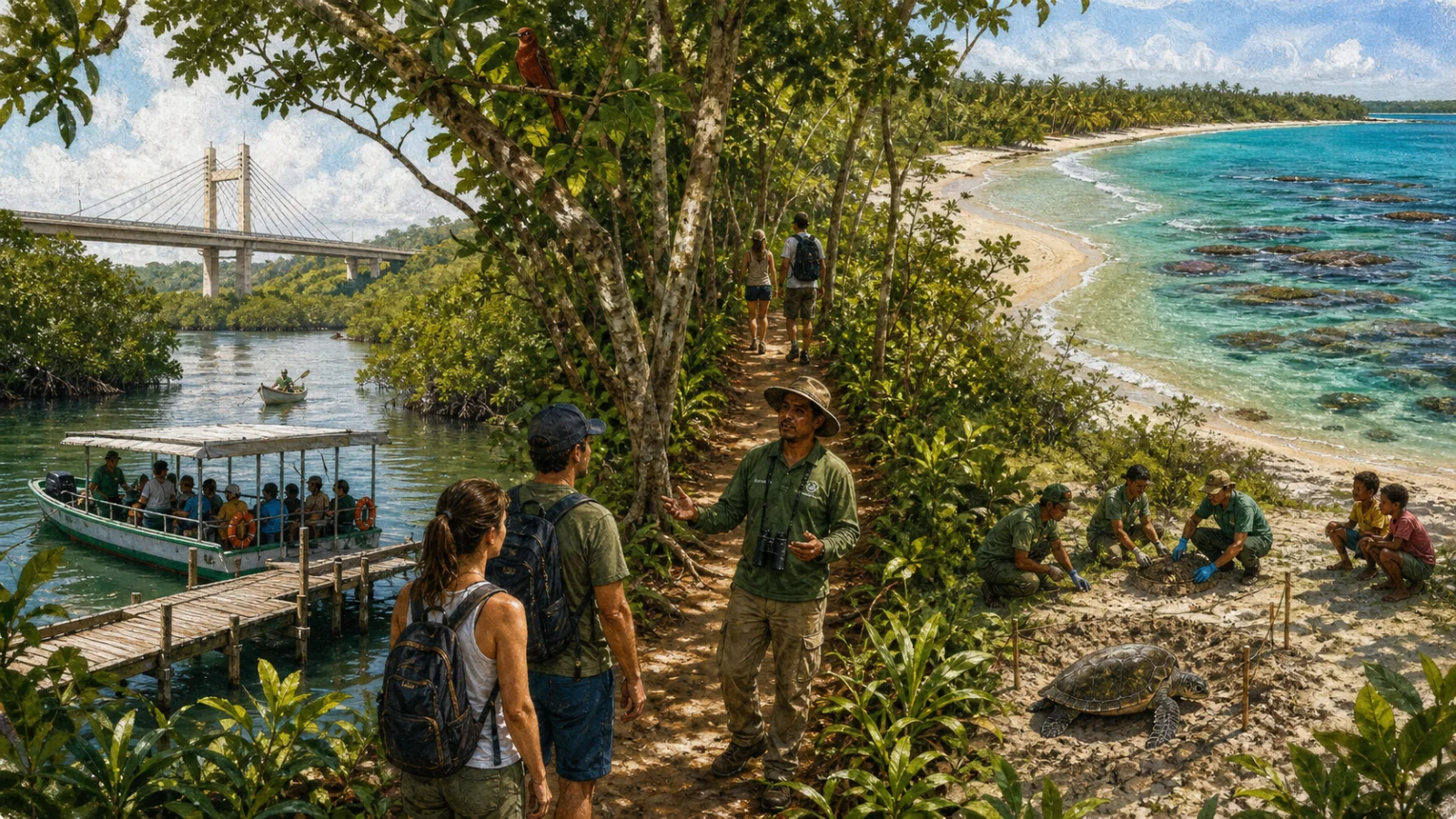
Paiva belongs to a coastal system rather than an isolated strip of sand. The Jaboatão and Pirapama Estuarine Protection Area covers environments where river and sea water meet between Cabo de Santo Agostinho and Jaboatão dos Guararapes. Tides, sediment, vegetation and water circulation create a productive and sensitive landscape.
Mangroves provide shelter and feeding areas, stabilise banks and support estuarine health. Protection does not mean every channel or shore is open to visitors.
A beach with changing conditions
The Cabo municipality describes coconut trees, Atlantic Forest remnants, natural pools and open-sea sections. None guarantees calm bathing. Tides alter depth and currents, rain affects river discharge and water quality, and waves change quickly.
Editorial copy should never call the beach safe or ideal for children without an exact point, date and official assessment.
Turtles are not a scheduled show
Municipal reporting confirms nest monitoring at Paiva. It does not justify independent searches or publication of sensitive locations. Hatchings cannot be promised as an attraction.
Keep away from marked areas, follow environmental teams and avoid light, noise, flash photography and physical contact with animals.
Boats, walks and operator checks
A company recommendation requires a verified responsible entity, contact, embarkation point, duration, lifejackets, child policy, cancellation terms and relevant authorisations. A social-media photograph is not evidence of regular operation.
Sightseeing, transport, sport and environmental education are distinct activities. If verification is absent, the portal should describe the general possibility and label the operator unverified.
A day of observation
A responsible visit can combine landscape reading, walking only through permitted access and watching the tide change. Carry water and sun protection, remove your waste and do not collect shells, plants or animals. Never enter mangroves without proper guidance.
A verified public-access and ecosystem map, supported by original photography and behaviour guidance, is more useful than presenting a sensitive environment as a theme park.
How to use this guide without treating advice as a promise
This article provides context and a decision method, not a guaranteed outcome. environmental conditions, access and activities at Paiva may change because of maintenance, weather, administrative decisions, demand, safety measures or service updates. Readers should distinguish three layers. The first contains relatively stable facts supported by the listed sources. The second is editorial interpretation: how to organise a visit, which questions to ask and what to observe. The third contains operational data, which is reliable only when accompanied by a direct source and a recent date.
An official page can confirm status, public responsibility or procedure; it does not prove that an experience suits everyone. A Meu Recife recommendation should explain its audience, limitations and alternatives. User comments may reveal useful leads, but they must not automatically become accusations, absolute rankings or verified facts.
If reality differs from the article, readers should be able to submit a correction with a link, photograph or identifiable account. Editors preserve the revision history and display the date of the new check. An honest “not verified” label is more useful than a confident assumption.
Verification on 28 July 2026 and mutable information
The editorial foundation was checked on 28 July 2026. Prices, opening times, current events and momentary availability are intentionally excluded. Before making a decision, open the official links, inspect their update dates and, where an error would matter, confirm directly with the responsible authority or venue.
Recheck the following:
- public access and environmental restrictions
- tides, waves, rain and bathing-water quality
- active nests or monitoring operations
- operators, embarkation, equipment and authorisation
- lifeguard instructions and local signs
These fields belong in the portal’s live layer. When recent confirmation is unavailable, the interface should say “not verified” rather than infer a value. Local signs, instructions from public agents and the competent authority take priority. Words such as “now” and “today” should never appear without a date and source.
To turn reading into a decision, note the main purpose, available time and needs of the group. Compare those conditions with what the source actually confirms. This prevents historical description from being mistaken for live operational advice and makes an alternative easier when weather, access or energy changes. A useful portal supports calm decisions through a simple map, visible source, legible date and a shorter fallback plan.
Editorial quality also depends on what the article refuses to claim. A missing fact cannot be filled with memory, advertising or a fabricated average. Information from a resident, trader or visitor may be recorded as an attributed and dated account that starts a new verification task. This respects local experience without presenting unfinished reporting as a settled conclusion.
Sources and fact-checking
We link to original sources and never present machine translation as original reporting.
Sources and fact-checking
We link to original sources and never present machine translation as original reporting.
Comments
To comment, open the portal with the Meu Recife button inside Telegram.
Open the botNo links, personal data or advertising. Up to five comments per day.